The FIFA World Cup is now less than a week away and although the dust has only just settled on the recent Champions League final, it is now time to put club football on the backburner for the next month or so.
Admittedly, the build up to this year’s football party in North America has collectively crept up on supporters across the globe but with no further distractions between now and Thursday’s opening game of this year’s tournament, it is full steam ahead when it comes to anticipation.
Not only is it a World Cup year but it is set to be the biggest one ever. 48 nations have earned the right to compete for global success and that means even more statistics than before – a dream for number crunchers situated anywhere between Los Angeles and London.
Which also means it is time to carry out some analysis of our own as we look at each of the 48 squads at the 2026 edition of the World Cup and answer important questions such as where is the experience and perhaps more importantly, where are the goals?
With that in mind, let’s first take a look at the average age of the squads. Starting with the top 10 oldest squads:
Nation | Average Age |
Panama | 30 years, 0 days |
Iran | 29 years, 295 days |
Colombia | 29 years, 211 days |
Cape Verde | 29 years, 84 days |
Qatar | 28 years, 337 days |
Scotland | 28 years, 267 days |
Egypt | 28 years, 253 days |
Brazil | 28 years, 239 days |
Argentina | 28 years, 225 days |
Paraguay | 28 years, 197 days |
Panama are the relative grandfathers in North America as one of England’s group stage opponents has the oldest squad of the tournament. The Central American nation will carry an average of exactly 30, will that be enough to get them into the Round of 32?
The Panamanians are closely followed by Iran, as their squad is just 70 days short on average of reaching 30 themselves. The Middle Eastern nation sits in the aged 29 bracket along with Colombia and debutants Cape Verde.
While Steve Clarke’s Scotland squad is made up of plenty of relative experience. The Tartan Army checks in at an average age of 28 years, 267 days. 28 days older than Brazil, 42 days older than that of previous winners Argentina.
The two South American giants sitting eighth and ninth in the list when it comes to oldest squads, continental compatriots Paraguay rounding out the top 10 and for additional context, England’s squad ranks 35th when it comes to oldest average age (26 years, 225 days).
13 nations with younger squads than Thomas Tuchel’s Three Lions, a baker’s dozen which includes both France and Spain. On this evidence alone, it looks as if three of the outright favourites are opting for youth over experience.
PUT YOUR CAP ON
Another layer of analysis to be added on to average age is which squads have the most total caps and when we compare the top 10 of this table to the one previous, there is an element of correlation:
Nation | Total Caps |
Panama | 1525 |
Qatar | 1397 |
Argentina | 1224 |
Mexico | 1195 |
Iran | 1149 |
Croatia | 1142 |
Portugal | 1119 |
Switzerland | 1111 |
Belgium | 1066 |
Jordan | 1048 |
Once again, it is Panama that sit at the top of the list. Their squad has a current total of 1525 caps throughout. The most experienced panel in terms of caps and appearances, they have a total of 128 more than second-ranked nation Qatar.
Two minnows when it comes to this year’s edition but Argentina’s collective experience may be another tool in their armoury. Lionel Scaloni’s class of 2026 goes to North America with a total of 1224 caps to their names.
While it is Croatia who have the highest number of total caps when looking at European nations, they arrive in North America with no fewer than 1142 to their name, 23 more than the next nation from the continent Portugal.
Roberto Martinez’ men sit on 1119 caps, seventh overall and eight caps more than Switzerland in eighth. While another nation that has been under Martinez’ international tutelage sit further back in ninth.
The Belgian Red Devils have 1066 caps throughout their squad, enough to knock another set of debutants, Jordan in tenth with a total of 1048 – 550 more than Sweden who sit second bottom of the list.
Graham Potter’s adopted nation only take a total of 498 caps to North America with them, a lot of inexperience in relative terms but still 34 caps more than that of South Africa who prop up the list of 48 nations.
The South African’s are arriving with 464 caps, England crossing the Atlantic Ocean with 799 by comparison. 36 more than France’s 763 and 91 more than that of Spain’s 708 but all three nations are well short of the 952 previous caps that Steve Clarke will have awarded as Scotland manager.
EYE FOR GOAL
At the end of the day, experience can only get you so far and it is goals that will be the currency that everyone trades in at this year’s tournament. Which nations are brining the big guns and which nations could do with an additional deployment up top?
A look at the top 10 nations in terms of total goals in the squad, highlights the following:
Portugal | 255 |
Argentina | 218 |
Belgium | 209 |
Qatar | 208 |
Netherlands | 151 |
Croatia | 151 |
Brazil | 150 |
Austria | 148 |
Iran | 148 |
England | 145 |
To the surprise of few, it is Portugal that sit top of the chars with 255 total goals in their 2026 World Cup squad. The reason for their positioning is due to Cristiano Ronaldo, the attacking phenom has scored 143 goals himself – that’s 56% of all of Portugal’s goals in the squad.
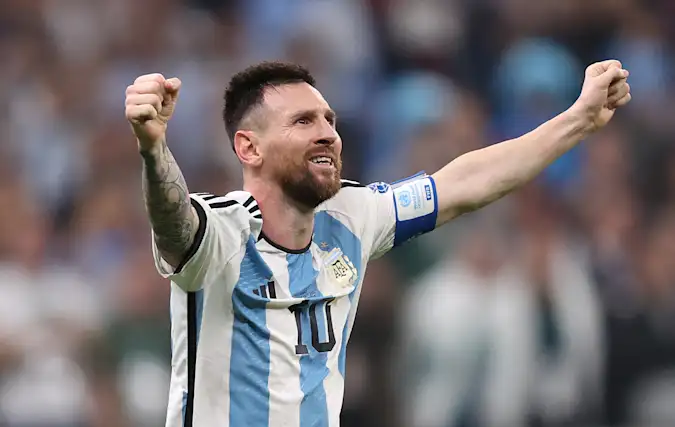
Then again, a similar explanation can be attached to Argentina sitting second in the charts. Compared to Portugal, they will bring 218 international goals with them. Of those 218, Lionel Messi has scored 116 of them – 53% in total.
Two percentages that are definitely in talismanic territory, the same can be said for Harry Kane. The nation’s record goalscorer arguably having his last crack at World Cup glory. He has 78 goals to his name; England have 145 in total. The Bayern Munich forward has scored 53.7% of them.
England sit 10th in the charts when it comes to total goals, Brazil under manager Carlo Ancelotti sit three places better off in seventh having scored five more in total. Their 150, just one short of both the Netherlands and Croatia in joint-fifth.
At the other end of the list, it is not good reading for Tunisia. The African nation has the fewest goals across the 48 nations with just 43 – less than two goals per player on average. Not a metric that screams progress into the Round of 32 and beyond.
Paraguay sit second bottom with just 49 goals while South Africa and Sweden have to make do with not only a lack of experience in their squad but also a lack of attacking prowess. The former sitting third bottom with 61, their Scandinavian cousins only one position better off with 63.
JOIN OUR CLUB
Another lens to look through is representation from a club perspective and this is where managers watching at home will be nervous at the prospect of a star name getting injured. Especially if you are in charge of any of these clubs:
Club | Players |
Manchester City | 19 |
Bayern Munich | 18 |
Paris Saint-Germain | 16 |
Arsenal | 16 |
Barcelona | 15 |
Atlético Madrid | 12 |
Manchester United | 12 |
Al-Hilal | 12 |
Crystal Palace | 12 |
Borussia Dortmund | 11 |
Liverpool | 11 |
Galatasaray | 11 |
PSV Eindhoven | 10 |
Slavia Prague | 10 |
Fenerbahçe | 10 |
Milan | 10 |
Real Madrid | 10 |
Whoever takes over from Pep Guardiola will be hoping that his Manchester City squad has a clean bill of health after the tournament comes to an end. The Etihad outfit are supplying 19 players – the largest club representation in North America.
That group of 19 sits one above Bayern Munich with 18, Vincent Kompany’s cohort is larger by two players when compared to both this season’s Champions League finalists as PSG and Arsenal will see 16 of their squads attempt to rule the world.
While it is truly a world game these days, Saudi outfit Al-Hilal will see 12 of their talents take to the field at some stage. The same number within each of the Atletico Madrid, Manchester United and Crystal Palace camps.
La Liga winners Barcelona temporarily say goodbye to 15 players, while new Liverpool boss Andoni Iraola will be waiting on the return of 11, the same number that both Borussia Dortmund and Galatasaray have loaned to international football.
Which is one more than the quintet of clubs saying goodbye on a temporary basis to 10 players. PSV Eindhoven, Slavia Prague, Fenerbahce, Milan and Real Madrid, the last to be within double figure territory. Edging out the likes of Sunderland and Aston Villa who each wave off nine of their own.
ALL ABOUT BALANCE Some squads arrive with established cores built on caps, goals and continuity, while others lean more heavily on youth and emerging talent. What stands out most is how narrow the gaps are between many of the leading contenders across these measures.
This is not a tournament defined by extremes but by marginal differences layered across multiple dimensions as experience, output and depth all pull an international squad in slightly different directions.
In that environment, the difference between success and failure may come down less to profile and more to timing, cohesion and which manager finds the right blend at the right moment. Someone such as Thomas Tuchel has opted for the balancing act but will the gamble pay off in June and July?
All data correct as 4th June 2026 (AM) - Wikipedia