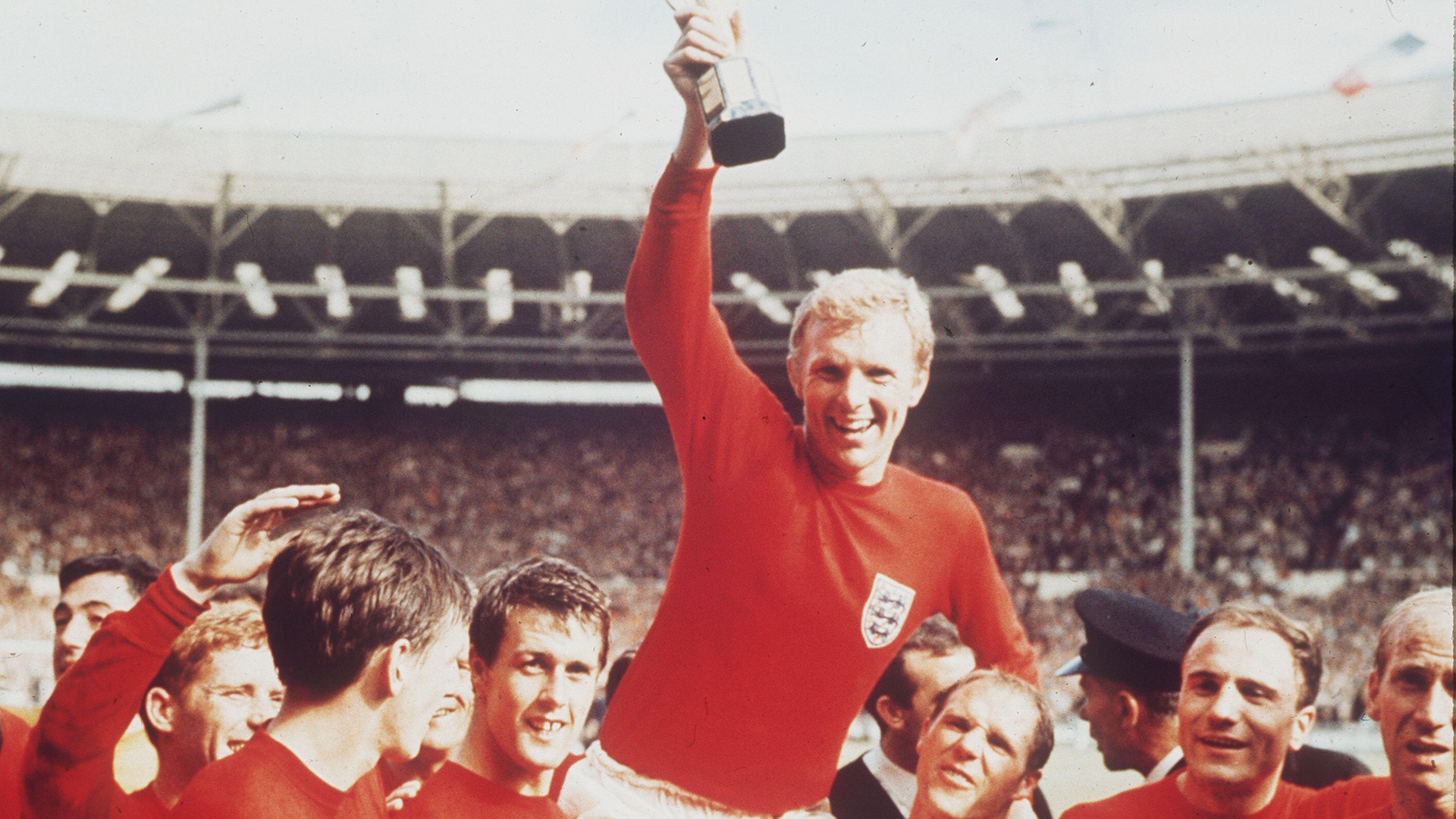
July 30, 1966 is a date etched into the hearts of any England football fan, the day when Bobby Moore held the Jules Rimet Trophy aloft at Wembley Stadium as the Three Lions celebrated winning the World Cup for the only time in their history.
We take a look back at the players and the manager behind that 4-2 win over West Germany after extra-time on that extraordinary summer afternoon 60 years ago when England were crowned the best team in the world.
England’s World Cup Winning Team
Gordon Banks, the Leicester City goalkeeper, played every minute of the 1966 World Cup and kept clean sheets in all three group-stage games against Uruguay, Mexico and France and the 1-0 win over Argentina in the quarter-finals. Gordon Banks went into the tournament as England's number one and played every single minute as the Three Lions went on to lift the trophy.
Banks won 73 caps for his country and was Leicester's starting goalkeeper when he helped England to glory. He finally conceded in the 2-1 semi-final win over Portugal and twice more in the 4-2 win over West Germany in the final.
Banks' finest hour would come four years later with a miracle save from Brazil's Pele, dubbed the greatest save of all time, in the 1970 World Cup. He is widely regarded as one of the best goalkeepers of all time and his save against Pele in 1970 is still talked about today.
Defence
England's defence at Wembley comprised of George Cohen of Fulham and Everton's Ray Wilson at right-back and left-back respectively, either side of the majestic Bobby Moore and no-nonsense Jack Charlton. The Three Lions operated a back four in the 1966 World Cup.
West Ham's Moore was the lynchpin, a classy, ball-playing central defender who Pele would later hail as the best defender he ever played against. Moore was also at the heart of defence but he provided an assist in the final, and he is still regarded as one of the best players of all time. Moore played over 500 times for West Ham, before finishing his career in America.
The statue of Moore, who was just 53 when he died in 1981, outside Wembley Stadium shows the stature and affection which England holds for the man who shook the Queen's hand that July day in 1966. He went on to win 108 caps for England—a record when he retired in 1973—and was inducted into the Football Association's Hall of Fame.
Jack Charlton was something of a contrast to Moore, which was perhaps why they gelled so well. The giant Leeds defender had only made his England debut a year before aged 29 but went on to enjoy a fine World Cup, famously marking Portugal's dangerous striker Jose Torres out of the game in the quarter-finals.
Charlton made a whopping 629 appearances for Leeds United and is adored by Whites fans. After retiring, he had spells as a manager at Middlesbrough, Sheffield Wednesday, and Newcastle, and perhaps most famously, he also coached the Republic of Ireland for a decade.
At right-back, George Cohen offered plenty of energy and made a huge contribution in the semi-finals as he set up Bobby Charlton's winner against Portugal. Cohen spent his entire career at Fulham before injury forced him to retire at 29, becoming the first member of England's starting XI to do so. He called time on his career after earning his 37th cap in 1967.
Left-back Ray Wilson may not be one of the most recognisable names in the England team, but he was the oldest member of the team that started the 1966 final against West Germany. Wilson won 63 caps for England and had spells at Huddersfield Town, Everton, Oldham and Bradford before retiring in 1971.
Midfield
The central pairing in Ramsey's World Cup-winning midfield were the Manchester United team-mates, Nobby Stiles and Bobby Charlton, Jack's younger brother. England's midfield was perhaps ahead of its time, with Nobby Stiles operating as a holding midfielder.
Stiles, who made over 300 appearances for Manchester United, was used as a disruptor in England's midfield. He was able to thwart Eusebio in the semi-finals, but despite the impact he made in 1966, he only made 28 appearances in total for his country. He is probably best known for his jig of delight with the Jules Rimet Trophy after the final.
At the heart of England's midfield was the legendary Sir Bobby Charlton, who made over 600 appearances for Manchester United and more than 100 for his country. Before Wayne Rooney eventually usurped him, Charlton was the record goalscorer for both the Red Devils and the Three Lions.
Charlton adapted his game as he got older, and United manager Matt Busby once said, "he was as near perfection as man and player as it is possible to be." What makes Charlton's story so remarkable was that he had survived the Munich Air Crash of 1958, one of English sport's most harrowing tragedies.
Alan Ball was part of the three-man midfield ahead of Stiles and he enjoyed a remarkable career, making over 800 appearances in total. Best known for his spells with Blackpool, Everton, Arsenal and Southampton, he was the youngest member of England's World Cup-winning team. Ball grabbed an assist for England's third goal and his energetic displays played a huge role in England's success.
Martin Peters completed England's midfield and made a big impression in 1966. He was left out of the opening game against Uruguay but stayed in the team after that, scoring England's second goal in the final. Like Moore, he was a household name at West Ham, before further spells with Tottenham and Norwich.
Strikers
Great moments of fortune can define careers—just ask Geoff Hurst. Sir Geoff Hurst became a hero in 1966 and was the first of only two players to score a hat-trick in a World Cup final. Kylian Mbappe of course emulated Hurst in 2022, but the England legend will never be overlooked.
The 84-year-old was another West Ham icon and, remarkably, he only scored 24 goals for England in 49 appearances. His international career lasted just six years, but not many players will have made the same impact on a tournament.
When England went into the 1966 World Cup, Jimmy Greaves was the more prolific striker and the preference at the time. However, Greaves suffered an injury before the quarter-final against Argentina and despite recovering in time to start the final, Hurst was given the nod. The rest, as they say, is history.
It was Hurst who wrote his name into football folklore. The West Ham United 24-year-old scored the only goal in the 1-0 win against Argentina and then scored two goals in extra-time in the final to complete his hat-trick, win England the World Cup, and ensure he will be forever remembered.
Fellow striker Roger Hunt also had a quiet England career on the whole, earning 34 caps and scoring 18 goals. At club level, however, he was prolific, scoring 244 times in 404 appearances in an 11-year career at Anfield. Hunt scored three times in the 1966 World Cup, playing in all six matches.
The most famous of Hurst's three goals was the one the Germans disputed ever crossed the line. Ball had crossed and Hurst's shot on the turn cannoned down off the crossbar and landed on or close to the line. Swiss referee Gottfried Dienst took one look at Russian linesman Tofiq Barhramov, whose nod of approval was all that was needed.
Manager
When Alf Ramsey was appointed England manager in 1963 he boldly prophesied that "we will win the World Cup". Few believed him. Sir Alf Ramsey was the mastermind behind England's glory in just his second job as a coach.
After playing for Southampton and Tottenham, Ramsey turned to coaching. He earned 32 caps for England until 1953, then becoming Ipswich boss two years later. He changed everything about the England team, stacking midfield and not using classic wide men—hence the nickname the 'Wingless Wonders'.
The methodical Ramsey, a former England defender who had cut his teeth in management guiding Ipswich to the 1961-62 League title, got his system to work perfectly. As Bobby Charlton put it: "Without Alf Ramsey England would not have won the World Cup".
Ramsey enjoyed 11 years as national boss before he was sacked after England failed to qualify for the 1974 World Cup. His sacking is still discussed today and many of his players were surprised at the decision. After England, he joined Birmingham City for a season, before enjoying one year as Panathinaikos's technical director.
Full England World Cup Winning Team
Gordon Banks | Goalkeeper |
George Cohen | Right-back |
Ray Wilson | Left-back |
Bobby Moore | Centre-back |
Jack Charlton | Centre-back |
Nobby Stiles | Defensive midfielder |
Alan Ball | Right midfielder |
Martin Peters | Left midfielder |
Bobby Charlton | Attacking midfielder |
Roger Hunt | Striker |
Geoff Hurst | Striker |
Alf Ramsey | Manager |
Sixty years on and England will try again this summer in North America to repeat what Sir Alf and his boys did in '66. And you can follow England's World Cup path on LiveScore.