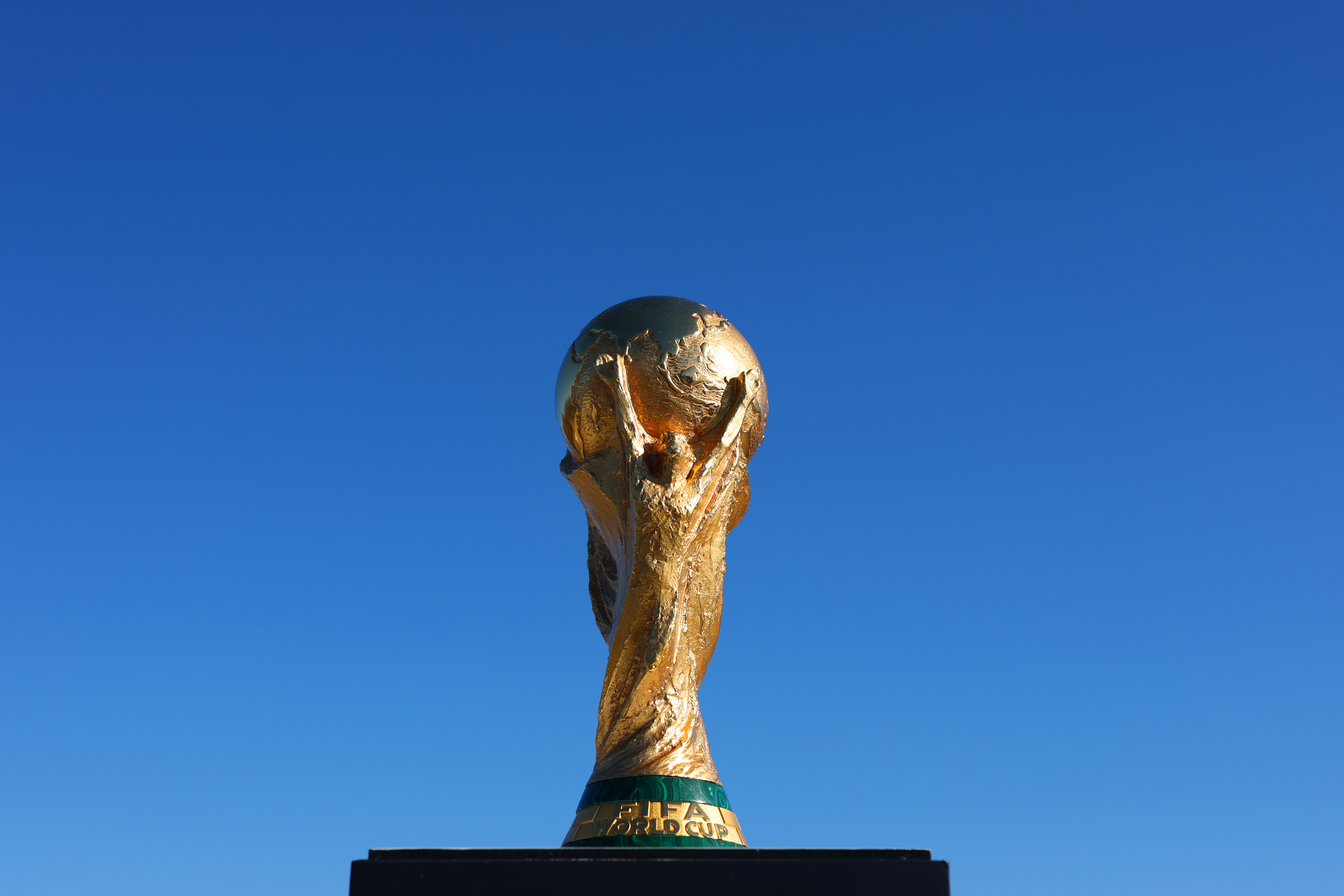
With just 43 days to go, the countdown to the World Cup 2026 in Canada, Mexico and the USA is well and truly on.
Every day between now and the big kick-off on June 11, LiveScore guides you through a history of the World Cup in numbers…
43 Days to Go
45,000 seater stadium BMO Field will play host to six World Cup matches in total, including co-hosts’ Canada’s tournament opener against Bosnia and Herzegovina on June 12th.
Ghana’s game against Panama, Germany v Cote d’Ivoire, Panama’s meeting with Croatia, Senegal’s clash with Iraq and a round-of-32 clash will take place in Toronto over the summer.
And at 43 degrees north, Toronto is one of the most northerly cities to host the summer showpiece. It’s not quite as northerly as Vancouver, which is located close to the 49th parallel north.
44 Days to Go
Italy fluffed their lines in their bid to make the 2026 World Cup, losing on penalties to Bosnia and Herzegovina as they - at the time of writing - missed out on a third successive tournament.
The Azzurri, World Cup winners in 2006, are one of the most successful teams in the competition’s history. To miss out again is a travesty as they seek to add to their four titles.
Champions in 1934, they became the first team to defend the World Cup as they lifted the 1938 title. They didn’t do so again until 1982. A 44-year gap between their second and third trophies is the longest between titles in tournament history.
45 Days to Go
They say age is just a number, and it rang true for Egyptian goalkeeper Essam El Hadary.
Egypt endured a disappointing first tournament in 28 years at Russia in 2018, losing their opening two group games to Uruguay and the World Cup hosts. A much-changed Pharaohs side took to the field for the eventual 2-1 loss to Saudi Arabia, with El Hadary called upon.
And at 45 years and 161 days, the legendary shotstopper became not only the oldest player in World Cup history, but the competition’s oldest ever debutant. Another goalkeeper - Faryd Mondragon - previously held the record having started Colombia’s 4-1 win over Japan, three days after his 43rd birthday at Brazil 2014.
46 Days to Go
The World Cup has seen its fair share of veteran players take to the pitch over the years, but none have been as old as MacDonald Taylor Sr.
Aged 46 years and 217 days when he played for the US Virgin Islands against St. Kitts and Nevis in a 2006 World Cup qualifier, the defender still holds the Guinness World Record for the oldest men’s international footballer.
Seven players have appeared at the World Cup finals beyond their 40th birthday, with legendary Italian goalkeeper Dino Zoff the first to do so in 1982 – when he captained the Azzurri to glory in Spain.
47 Days to Go
In 1947, one of the World Cup greats was born in Amsterdam: three-time Ballon d’Or-winning Dutch icon Johan Cruyff.
Arguably the finest player never to lift the trophy, Cruyff only appeared at one World Cup – the 1974 edition in West Germany – but he well and truly left his mark on the history of football’s grandest competition.
Inspirational captain as the Netherlands reached their first World Cup final, Cruyff stunned the world with his eponymous turn against Sweden in the first round and scored three goals at the tournament – throughout which he famously wore two stripes instead of the usual three on his number 14 Adidas shirt, out of respect for his sponsorship deal with rival brand Puma.
48 Days to Go
This year’s World Cup will be the first to feature 48 teams, an expansion of 16 from the previous edition.
The World Cup grew to 32 teams at the 1998 tournament in France, having been a 24-team competition from 1982 until 1994 – the last time the USA were hosts.
Between 1954 and 1978, 16 teams competed in the World Cup, while the first four editions (1930, 1934, 1938 and 1950) involved 13, 16, 15 and 13 teams respectively.
With the World Cup 2026 being the biggest-ever, it will be the first to have a Round of 32. The top two in each of the 12 groups will advance to that stage, along with the eight best second-placed sides.
49 Days to Go
The San Francisco 49ers are among 13 NFL teams whose stadiums will play host to the other kind of football this summer.
In fact, only four of the venues in use for the World Cup 2026 cater primarily to football, Toronto’s BMO Field, and all three stadiums in Mexico: the Estadio Banorte (aka the iconic Estadio Azteca) in Mexico City, the Estadio BBVA in Monterrey and the Estadio Akron in Guadalajara.
Opened in 2014, the 49ers’ Levi’s Stadium (which will temporarily become the San Francisco Bay Area Stadium in line with FIFA’s policy on sponsored stadium names) will stage six games at the tournament, beginning with the Group B clash between Qatar and Switzerland on June 13.
50 Days to Go
After a 12-year hiatus due to the Second World War, the World Cup returned in 1950 for its fourth edition – the first to be hosted by Brazil.
Uniquely, this World Cup didn’t have a one-match final, instead employing a final group phase – and it produced one of the most iconic games in the history of the competition: the Maracanaco (the Maracana Smash).
Needing just a draw at the iconic Maracana in Rio de Janeiro, Brazil blew a one-goal lead to lose 2-1 to Uruguay.
Officially, 173,850 people were inside the stadium to see Alcides Ghiggi’s 79th-minute winner put the newly renamed Jules Rimet Cup in Uruguay’s hands for the second time.
The 1950 World Cup also marked England’s first appearance at the tournament, with Walter Winterbottom’s side famously beaten 1-0 by the USA in Belo Horizonte.