The World Cup is a tournament built on small sample sizes. Three group games can completely shape the narrative around a team, whether that's talk of a champion being crowned two weeks later or suggestions they are heading for an early flight home.
Every four years, opinions are formed quickly, and often with very little evidence and even though there is little evidence to work with, supporters will aim to convince themselves that the tournament is already a closed case.
History is full of examples. A team starts with three wins from three and suddenly looks unstoppable. Another drops points in the group stage and questions begin to emerge about whether they have what it takes to go all the way.
By the time the knockout rounds begin, perceptions are often firmly established. At this stage, the minnows have been sent packing as expected. The heavyweights have done their sparring and are now looking to land knockout blows.
But do those perceptions stand up to scrutiny? To find out, I looked at every World Cup winner since 1982 and started with the simplest possible question: what did their group stage record actually look like before they went on to become world champions:
Tournament | Winner | Group Stage | Results | GF | GA | GD | Teams |
1982 | Italy | Second | W0 D3 L0 | 2 | 2 | 0 | 24 |
1986 | Argentina | Group Win | W2 D1 L0 | 6 | 2 | 4 | 24 |
1990 | Germany | Group Win | W2 D1 L0 | 10 | 3 | 7 | 24 |
1994 | Brazil | Group Win | W2 D1 L0 | 6 | 1 | 5 | 24 |
1998 | France | Group Win | W3 D0 L0 | 9 | 1 | 8 | 32 |
2002 | Brazil | Group Win | W3 D0 L0 | 11 | 3 | 8 | 32 |
2006 | Italy | Group Win | W2 D1 L0 | 5 | 1 | 4 | 32 |
2010 | Spain | Group Win | W2 D0 L1 | 4 | 2 | 2 | 32 |
2014 | Germany | Group Win | W2 D1 L0 | 7 | 2 | 5 | 32 |
2018 | France | Group Win | W2 D1 L0 | 3 | 1 | 2 | 32 |
2022 | Argentina | Group Win | W2 D0 L1 | 5 | 2 | 3 | 32 |
When looking at the last 11 winners of the World Cup between 1982 and 2022, 10 of those completed the first task of finishing top of the group. The only nation not to do so were Italy 44 years ago.
In each of the past 10 World Cups that have taken place between 1986 and 2022, a group winner has then gone on to win outright. This tournament may only allow small sample sizes to work with but it does also form revealing patterns.
However, just because a World Cup winner tops the group, it does not mean that they have had it their own way early on. Of these 11 tournaments in our sample, only two nations had a perfect record in the group stage.
Not since Brazil’s last tournament success in 2002 has a nation won all three group games and then gone on to rule the world. The likes of Ronaldinho, Rivaldo and Ronaldo matching what the duo of Thierry Henry and Zinedine Zidane did four years prior.
This highlights that a World Cup-winning nation does not have to be at its absolute best at the beginning of the tournament, they just have to be good enough not to fall at the first hurdle. Argentina’s success in Qatar serving as a perfect example of this.
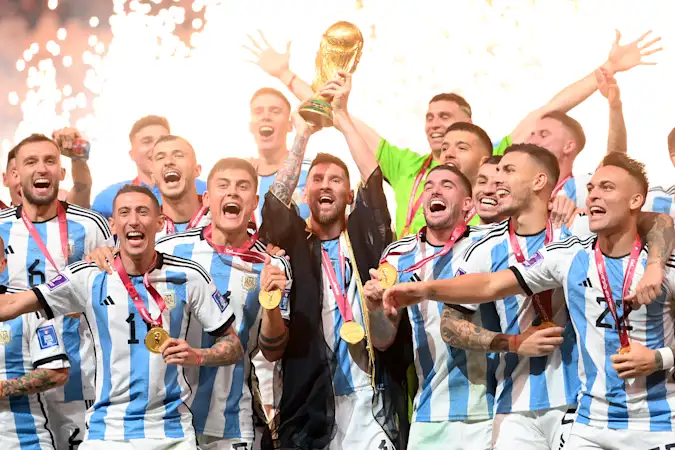
Lionel Messi may have dazzled past defences but he and his teammates came unstuck against Saudi Arabia in their opening tournament encounter in 2022. You could argue their 2-1 reverse served as a wakeup call for manager Lionel Scaloni and his players.
The margin of error is incredibly slim at this stage of proceedings, but at least there is more margin than when you reach the knockout phase of the competition. If you are to lose a game, best to get it out of the way as early as possible.
A principle that Spain also used to their advantage in 2010, they may have lost to Switzerland in their opening clash but from there, they never looked back. Entering the South African-based tournament as defending European Championship winners in 2008, exiting as World Cup winners two years later.
TIGHT AT THE BACK
Another pattern that appears when looking at these 11 World Cup winners is that each of them are defensively sound (even if they have dropped points along the way). No nation conceded more than three goals across their opening three games.
Interestingly, the two nations that did concede three goals, Germany in 1990 and Brazil in 2002 were also the two highest scoring sides in our sample. The former scored 10 goals, their South American counterparts going one better.
This suggests a greater deal of confidence in their respective attacks. No matter, if goals were given up at one end, there would be plenty being logged at the opposite end to mask any slight defensive deficiencies.
Ultimately, that is all they are, slight defensive deficiencies. An average of one goal conceded per game in the group stage. By comparison, four of these 11 nations only conceded a single effort on the way to topping their four-team mini-league.
A solid defence will not win you the World Cup in the opening fortnight, but it will keep you in the tournament and boost your chances of going all the way. A lesson that the class of 2026 should certainly take on board before their own respective bids for success.
A PERFECT RATIO
Another way to analyse the group stage performance of World Cup winners since 1982 is to create a ratio between the number of goals scored and their goal difference.
To create this ratio, we can divide a nation’s group stage goal difference by the number of group stage goals scored:
Tournament | Winner | GF | GD | GD/GF |
1998 | France | 9 | 8 | 0.89 |
1994 | Brazil | 6 | 5 | 0.83 |
2006 | Italy | 5 | 4 | 0.80 |
2002 | Brazil | 11 | 8 | 0.73 |
2014 | Germany | 7 | 5 | 0.71 |
1990 | Germany | 10 | 7 | 0.70 |
1986 | Argentina | 6 | 4 | 0.67 |
2018 | France | 3 | 2 | 0.67 |
2022 | Argentina | 5 | 3 | 0.60 |
2010 | Spain | 4 | 2 | 0.50 |
1982 | Italy | 2 | 0 | 0.00 |
At the bottom of the list, you will find the outlier of Italy’s 1982 winning squad. They took the defensive mantra to the nth degree 44 years ago; three successive draws was only good enough for second but it would set them in good standing for outright victory when it truly mattered.
Spain in 2010 also sits outside the main cluster. Their ratio of 0.50 places them below the broader band of efficiency shown by most other champions, reflecting a group stage that was functional rather than forceful but also showing there is more than one way to win a World Cup
Once past the outliers, the pattern becomes more interesting. The majority of World Cup winners since 1982 sit within a relatively narrow range, with GD/GF ratios clustering between roughly 0.60 and 0.89 – France’s 0.89 showing almost total domination in the group stage.
This suggests a level of consistency in how efficiently champions convert their group stage performances into control of games, regardless of era or tournament format. You can map generation against generation or 24 versus 32 teams and it all comes back to the same point.
The point which confirms the group stage does not reward dominance. It filters for stability and in a tournament defined by small margins, that stability is often what separates champions from everyone else.