
The Nations League returns for its fifth edition this month, with four rounds of group fixtures taking place during the extended September-October international break.
Here’s all you need to know about the 2026/27 edition of the UEFA competition…
When did the Nations League begin?
The Nations League was approved by all of UEFA’s member associations in 2014, with the tournament first being held in the 2018/19 season.
Its conception came about from a longstanding desire among countries to have more competitive fixtures instead of friendlies.
Since then, it’s been played every two seasons, with four different nations lifting the trophy so far.
Who are the current Nations League holders?
Portugal won the most recent Nations League in 2024/25, beating holders and reigning European champions Spain on penalties in the final.
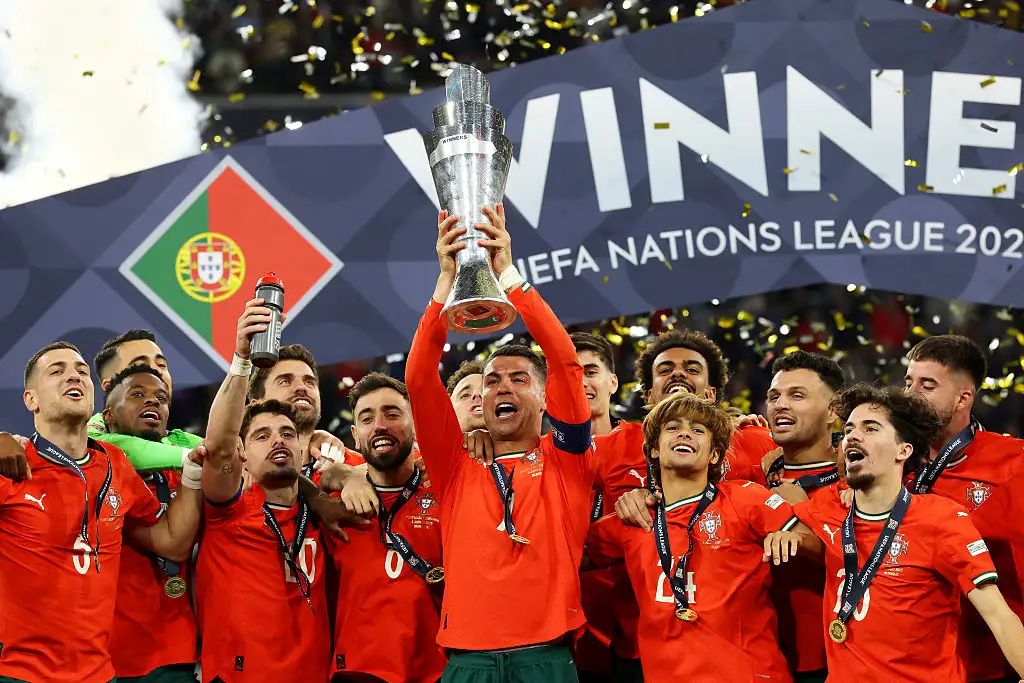
It was Portugal’s second crown having won the inaugural Nations League – when they also hosted the final.
France are the other country to have won the Nations League, doing so in 2020/21.
How does the Nations League work?
The Nations League is divided into four Leagues, with teams placed according to their final ranking in the 2024/25 tournament.
Leagues A, B and C consist of four groups of four teams, while League D consists of two groups of three teams.
The eight sides finishing first and second in the four League A groups advance to the quarter-finals, with the competition continuing in a knockout format culminating in the Nations League Finals (two semi-finals, the final and the third place play-off) in a yet to be determined host nation.
The four sides finishing third in the four League A groups are ranked, with the top two staying in League A for the next Nations League and the bottom two entering the relegation play-offs.
The same goes for the four sides finishing fourth in the four League A groups, with the top two going into the relegation play-offs and the bottom two relegated to League B.
In League B, the four group winners are promoted to League A, with the four group runners-up going into the promotion/relegation play-offs against third or fourth-placed sides from Group A.
The four bottom-placed sides go into the promotion/relegation play-offs against the four League C group runners-up.
And in League D, the two group winners will be promoted to League C, with the two group runners-up playing off against the two best-ranked fourth-placed sides from League C.
Historically, a strong Nations League finish has also allowed teams a ‘second chance’ at qualifying for the next World Cup or Euros, though it has yet to be confirmed if this will be the case for Euro 2028.
What are the 2026/27 Nations League groups?
League A
Group A1 France Italy Belgium Turkey
Group A2 Germany Netherlands Serbia Greece
Group A3 Spain Croatia England Czechia
Group A4 Portugal Denmark Norway Wales
League B
Group B1 Scotland Switzerland Slovenia North Macedonia
Group B2 Hungary Ukraine Georgia Northern Ireland
Group B3 Israel Austria Republic of Ireland Kosovo
Group B4 Poland Bosnia and Herzegovina Romania Sweden
League C
Group C1 Albania Finland Belarus San Marino
Group C2 Montenegro Armenia Cyprus Latvia
Group C3 Kazakhstan Slovakia Faroe Islands Moldova
Group C4 Iceland Bulgaria Estonia Luxembourg
League D
Group D1 Gibraltar Malta Andorra
Group D2 Lithuania Azerbaijan Liechtenstein