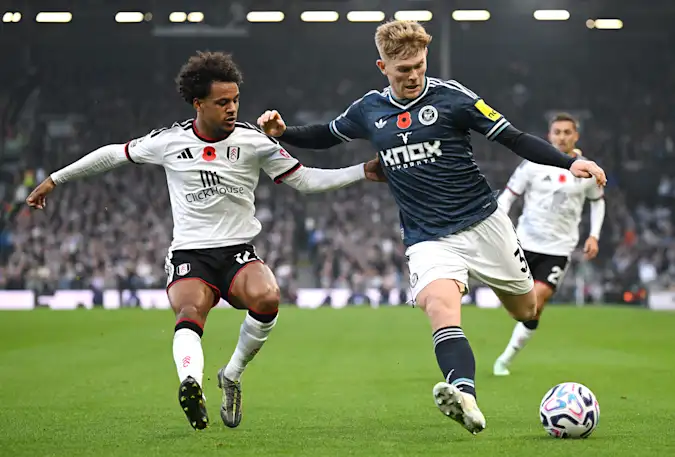
With the November international break behind us, it is time for a well-earned rest after 10 breathless weeks of the current Premier League season. 100 games in the history books for 2025/26, another 280 still to be contested.
However, that rest will largely not apply to many of the stars in the Premier League, as they will be required to represent their respective national teams, and with talk of player load already coming to the fore so early in the season, managers of top-tier clubs will be hoping that injuries to their biggest names are avoided.
The physical demands of modern football are hardly a secret, but how much work are Premier League teams actually doing? Are the sides covering the most ground translating that into results, or are they putting in plenty of effort for little reward? Our three statistics should tell the story.
DISTANCE
Rank | Team | Total Distance (km) |
1 | Fulham | 1194.46 |
2 | Arsenal | 1193.79 |
3 | Ipswich | 1173.7 |
4 | Leeds | 1172.83 |
5 | Bournemouth | 1169.74 |
6 | Brentford | 1164.25 |
7 | Brighton | 1159.51 |
8 | Newcastle | 1158.03 |
9 | Hull | 1148.41 |
10 | Nottingham Forest | 1143.36 |
11 | Sunderland | 1142.69 |
12 | Tottenham | 1141.11 |
13 | Everton | 1139.33 |
14 | Aston Villa | 1137.55 |
15 | Chelsea | 1136.19 |
16 | Coventry | 1133.64 |
17 | Crystal Palace | 1132.41 |
18 | Manchester City | 1126.49 |
19 | Manchester United | 1125.24 |
20 | Liverpool | 1112.16 |
The best place to start is the distance covered by each of the 20 Premier League teams, and at the latest pause in the season, Fulham top this metric, having covered 1194.46 km across their first 10 matches.
Alvaro Arbeloa’s men top the charts when it comes to covering ground, but their current league position suggests that running the most is not necessarily a precursor to earning positive results in the division.
The Cottagers sit 15th in the table during the enforced autumnal hiatus, but they have gone unbeaten in their last four league outings. Perhaps their change of fortune can be attributed to the extra distance their players are running of late.
Especially when you look at who sits second in the charts. With the Arsenal squad generating a total distance covered of 1,193.79km, they are just squeezed out by their fellow London rivals – proof here that effort can be converted into results.
The defending champions have been worked hard by manager Mikel Arteta in the early weeks, and this is highlighted by the fact that both they and Fulham have run 20km more than Ipswich in third – an average of an additional 2km per game.
At the other end of the distance chart, maybe Michael Carrick and Pierre Sage would have wished for a bit more from their respective former groups of players. The two men were both sacked on the same day and are now saying goodbye to teams positioned 17th and 19th in the distance-covered table.
United have run nearly 50km less than Fulham at present, but they are still not the side that has covered the least distance in the Premier League this season. That accolade goes to Andoni Iraola’s Liverpool, who have racked up just 1,112.16km between them.
What Liverpool lack in distance, they seem to be making up for in league form. With the Reds currently sitting in fourth, can they call on another work-rate attribute as the reason for their advanced position at present?
SPRINTS
Rank | Team | Total Sprints |
1 | Liverpool | 1301 |
2 | Brentford | 1204 |
3 | Newcastle | 1198 |
4 | Ipswich | 1192 |
5 | Bournemouth | 1164 |
6 | Leeds | 1162 |
7 | Chelsea | 1161 |
8 | Sunderland | 1116 |
9 | Hull | 1107 |
10 | Nottingham Forest | 1088 |
11 | Tottenham | 1086 |
12 | Arsenal | 1082 |
13 | Fulham | 1067 |
14 | Manchester United | 1065 |
15 | Aston Villa | 1060 |
16 | Brighton | 1056 |
17 | Manchester City | 1031 |
18 | Everton | 1030 |
19 | Crystal Palace | 994 |
20 | Coventry | 987 |
The answer is yes, and although Liverpool do not cover as much distance as their 19 Premier League counterparts, they do have a habit of being explosive. The Merseyside men have generated 1,301 sprints this season, equating to an average of 130.1 per game.
There is an element of logic to this, as what they save in distance, they make up for in short bursts. Considering the Anfield outfit have generated 97 more sprints than Brentford in second, their current tactic of hitting teams with lightning-fast pace seems to be standing them in good stead.
The Bees have recorded 1,204 sprints this season, and Keith Andrews' men have lost twice in the Premier League this season. They too appear to be benefiting from an approach built around plenty of high-intensity work as they look to improve on last season’s efforts, which saw them just miss out on Europe.
Rounding out the top three in terms of sprints is Newcastle, and with Matthias Jaissle’s brand of football not quite hitting the right notes on Tyneside, the man who took the managerial baton from Eddie Howe may have to revise his tactical plans after the international break.
Should he fail to generate further wins, the German could be the next man to be shown the exit door. The Magpies sit just above Ipswich in fourth, and considering they are also third when it comes to distance covered, it suggests that manager Gary O’Neil is putting the Tractor Boys through their paces.
The former Bournemouth and Wolves boss is approaching Ipswich’s return to the Premier League with a strategy that demands plenty of effort, and even though the Portman Road outfit has picked up three wins this season, they are now four games without a win.
As for Fulham, who top the distance-covered charts, they do not share the same desire to sprint. With the Cottagers sitting 13th in this metric, they are below Arsenal in 12th, with the Gunners having 15 more sprints to their name. The fact that these two teams are so intertwined in the metrics should not be overlooked.
Both teams seem prepared to cover an incredible amount of distance, but neither seems prepared to convert that effort into sprints. The strategy is paying off for Arsenal right now; the same cannot be said for Fulham.
DUELS
Rank | Team | Duels Won |
1 | Leeds | 557 |
2 | Tottenham | 542 |
3 | Manchester City | 532 |
4 | Everton | 526 |
5 | Brentford | 521 |
6 | Sunderland | 517 |
7 | Nottingham Forest | 516 |
8 | Chelsea | 514 |
9 | Bournemouth | 512 |
10 | Arsenal | 502 |
11 | Liverpool | 501 |
12 | Aston Villa | 491 |
13 | Manchester United | 490 |
14 | Ipswich | 488 |
14 | Crystal Palace | 488 |
16 | Newcastle | 477 |
17 | Hull | 470 |
18 | Brighton | 463 |
19 | Coventry | 460 |
20 | Fulham | 432 |
According to this metric, it is Leeds who love a battle on the field. Considering they have one of the best defences in the Premier League this season, it is fair to say that Daniel Farke’s men are up for the fight. Just eight goals conceded and a league-high total of 557 duels to date.
That battling instinct has been good enough to see Leeds sit ninth in the table, and although they failed to win six Premier League games in a row before the visit of Tottenham, their recent win at Elland Road has given them just reward for their battling instincts.
Instincts that Tottenham have also displayed this season. Although they were edged out by the West Yorkshire outfit only a few days ago, Roberto De Zerbi’s men sit second in the duels table, with 542 to their name.
That is 10 more than Manchester City in third, and with Enzo Maresca’s group of superstars having lost each of their last three league outings, it may suggest that although they are prepared to battle for possession, they are struggling to win those contests.
At the bottom of the table, Coventry sit second from the bottom when it comes to duels. Not only do Frank Lampard’s men seem to ignore sprints, but they also seem to avoid challenges at the same time.
However, the most interesting finding is that Fulham sit at the bottom. Even though they are prepared to run around under Alvaro Arbeloa, they are not getting themselves into duelling positions. Just 432 this season, 125 fewer than Leeds.
The Cottagers have averaged 55.5% possession this season, the fifth-highest in the division after 10 weeks. Therefore, one could argue that their possession-based football is removing the need for them to sprint or duel to win the ball back.
Fulham are covering the most ground, Liverpool are producing the most explosive bursts, and Leeds are winning the most individual battles. But perhaps the most impressive all-round performance belongs to Leeds, who rank inside the top six across all three measures.
Brentford also deserve recognition, sitting sixth for distance covered, second for sprints and fifth for duels won. They may not top any individual chart, but their consistency across all three suggests a team prepared to work hard in every aspect of the game.
Ultimately, there is no single answer. Running further does not automatically mean running better, sprinting more does not guarantee success, and winning more duels does not necessarily mean dominating the physical contest.
What these figures do show is that there is more than one way to meet the physical demands of the modern Premier League. Some teams cover the ground, others attack it at speed, while others are simply better at winning the battles along the way.