
The many mysteries of Celtic’s first trophy
At their best, Celtic have sat atop Europe’s peak. And for much of their history, the Bhoys have dominated Scotland’s national game…
Yet every great story has a beginning. For the Celts, that came not in a famous national competition but in a modest local tournament: the Glasgow North Eastern Cup. It was this event that delivered Celtic’s first piece of success and marked the start of a remarkable footballing journey.
However, more than a century later, the story of the North Eastern Cup remains wrapped in uncertainty. Questions persist about whether Celtic actually received a trophy for their 1889 triumph, while the fate of a later replacement cup is unknown.
This is the story of the many mysteries involving Celtic and the North Eastern Cup.
The Bhoys’ first season was a great success. They reached their first cup final – in the 1888 Exhibition Cup – and even more impressively, got to the Scottish Cup Final at their first attempt. Unfortunately, both these matches resulted in defeat.
So in their maiden season, Celtic were still without silverware. That changed with the Glasgow North Eastern Cup. The competition reflected the character of Scottish football during the late-1800s. Before league football became dominant, local cup competitions flourished throughout the country.
The North Eastern Cup, organised by the Glasgow North Eastern Football Association, was officially known as the North Eastern Challenge Cup, based on its trophy engraving.
It was a local tournament designed for clubs from Glasgow’s eastern and northern districts, with teams from nearby areas such as Rutherglen also participating.
First played during the 1881-82 season, the tournament occupied a distinctive place within the Glasgow football calendar. Although never among the nation’s most prestigious competitions, it provided valuable opportunities for local clubs to compete for honours.
Over its lifespan, twenty different teams participated, with clubs such as Northern and Clyde featuring regularly. Celtic, by contrast, entered only twice but won on both occasions.
In season 1888-89, Celtic marched through the rounds by beating Clydesdale and then Northern. In the final, the Bhoys hammered Cowlairs 6-1 to win the tournament.
This should really be the end of the story. As winners, Celtic were naturally entitled to the trophy. Yet almost immediately, uncertainty emerged.
Before Celtic’s victory celebrations, newspaper reports indicated that the champions would receive the North Eastern Cup during the awards ceremony. Contemporary reports spoke confidently of the presentation taking place, with both the cup and commemorative gold badges expected to be handed over.
However, different newspapers subsequently offered conflicting accounts of what actually happened at the awards night.
The source of the confusion lay in the North Eastern Football Association’s decision to commission a new and grander trophy. The replacement cup was described as a more valuable prize and intended to enhance the status of the competition.
The original trophy was to become the prize for the North Eastern Association’s Second XI tournament. But unfortunately for Celtic, the new trophy was not yet finished when the celebration event took place.
Reports agreed on these basic facts but differed dramatically on what took place next. Some suggested that Celtic were given the competition’s original trophy, at least until the new prize became available. However other reports said that it had already been donated to the association’s Second XI competition and was therefore unavailable.
There is considerable evidence suggesting that Celtic may not have actually received any cup on the night of their celebrations.
Just two weeks after Celtic’s awards ceremony, another event was held to recognise the winners of the Glasgow North Eastern Association’s Second XI competition. Clyde emerged victorious in that final and received what observers described as a “grand silver cup” – a particularly handsome trophy.
The detailed attention paid to the prize in contemporary accounts suggests that this was viewed as a significant new award. If the original First XI trophy had already been reassigned to the reserve competition, then it would explain why Clyde received such an impressive cup and why Celtic may not have taken possession of the original trophy.
The alternative possibility is that Celtic briefly received the trophy at their awards event before immediately returning it to become the Second XI prize. While not impossible, this scenario appears less likely.
As a result, there is a strong argument that Celtic’s players celebrated their victory in 1889, received their gold badges and enjoyed the festivities, but left without ever having a trophy physically placed in their hands.
A further piece of evidence sits today in the Scottish Football Museum at Hampden Park.
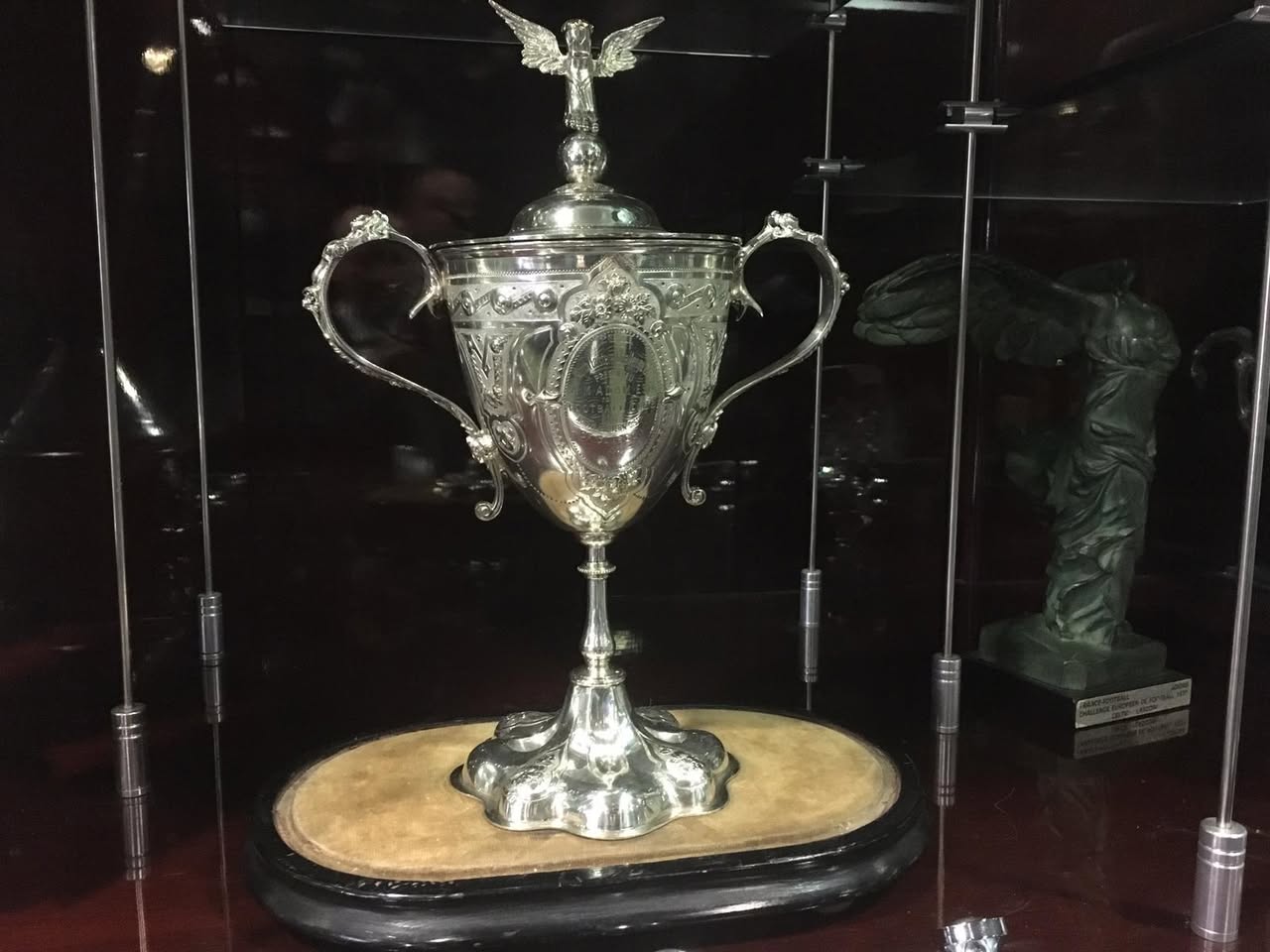
On display is a Glasgow North Eastern Cup believed to be the original prize from 1882. Standing fifteen inches high and weighing 1,412 grams, the silver trophy provides valuable clues about the mystery.
Its inscriptions reveal that it was originally created for the North Eastern Challenge Cup. At some later stage, additional lettering indicating “2nd XI” was added, showing that the trophy was indeed repurposed for the reserve team competition.
Even more revealing are the names engraved upon it. The rear of the cup records only two winners: ‘Clyde FC, 1888-89’ and ‘Celtic FC, 1889-90’.
These were not First XI winners in those years but the champions of the reserve competition after the trophy had been reassigned. While not conclusive proof, the physical evidence appears to support the theory that the original trophy never officially became Celtic’s property.
But whatever happened in 1889, one fact is beyond dispute – a new trophy was created.
By 1890, Celtic had again won the competition and this time there was no uncertainty surrounding the presentation. The awards ceremony took place on 28 March 1890 and attracted around 150 attendees.
As in the previous year, music, celebration and speeches formed part of the evening’s entertainment.
Songs filled the venue and guests reportedly enjoyed more than two hours of festivities. The presentation itself was the highlight.
Each Celtic player received a gold badge that contemporary observers described as substantial and artistically crafted. More importantly, the club finally received the new North Eastern Cup.
The trophy clearly made an impression.
Journalists praised it lavishly, with one commentator declaring that it surpassed even the Scottish Cup and the Charity Cup in appearance. Such praise suggests an exceptionally striking piece of silverware and demonstrates the effort made by the North Eastern Association to elevate the status of its competition.
For Celtic, this was the first occasion in which the club can definitively be said to have been handed a trophy for a first team competition victory.
Yet this only created another mystery – what happened to this cup? Unlike the original award, which survives and is displayed publicly at Hampden Park, the second North Eastern Cup appears to have vanished.
The competition continued until 1895, with Clyde winning the final edition. After that, the trail effectively disappears.
Several explanations are possible. The most optimistic scenario is that the trophy survives somewhere, unrecognised and forgotten. It is conceivable that the North Eastern Cup remains in private ownership, stored in an attic, collection or archive where its significance has not yet been realised.
Another possibility is that the trophy was repurposed. Reusing silverware was not uncommon in football and other sports during the period. Cups frequently changed purpose, particularly when competitions ended. If the trophy became the prize for another tournament, its origins may simply have been forgotten over time.
Unfortunately, there is also a more pessimistic explanation. After winning the final North Eastern Cup in 1895, Clyde may have retained possession of the trophy. If so, the cup could have been destroyed during one of the disastrous fires that later struck Shawfield Stadium.
The first major blaze occurred in 1914 when the stadium’s grandstand was destroyed in an inferno so intense that metal structures themselves were ruined. A second devastating fire followed in 1975, causing extensive damage that included Clyde’s trophy room.
Countless items connected to the club’s history were lost in those disasters. If the North Eastern Cup was among them, then one of the earliest trophies associated with Celtic’s history may have been lost forever.
By the early 1890s, Scottish football was changing rapidly. The establishment of league football transformed priorities across the country. Clubs increasingly focused their energy on national competitions, while many local tournaments began to lose prestige.
Celtic’s relationship with the North Eastern Cup reflected this broader trend. Although the club entered the competition in 1890-91, it later withdrew in order to fulfil league commitments. Thereafter, Celtic largely abandoned participation altogether.
The tournament itself gradually declined. Other clubs also began to prioritise league fixtures and national competitions. By its final season in 1894-95, only three teams took part, despite efforts to widen eligibility by including clubs such as Partick Thistle.
In the grand sweep of football history, the North Eastern Cup was a relatively modest local competition. Yet its significance to Celtic cannot be overstated.
It provided the club’s first tangible success. At a time when Celtic were still establishing themselves, victory in the tournament demonstrated that the new club could compete and win. It offered players, officials and supporters an early taste of achievement that laid the foundations for future triumphs.
At the same time, the North Eastern Cup has also left a series of mysteries. Did Celtic actually receive a trophy in 1889? What became of the magnificent replacement trophy presented in 1890? Does it still exist somewhere, waiting to be rediscovered, or was it lost forever in one of Shawfield’s devastating fires?
More than 130 years later, definitive answers remain elusive. But one thing can be said for certain.
The Glasgow North Eastern Cup long ago faded from the football calendar, but its place in Celtic history is secure. It was the competition that started everything, the first taste of success that inspired one of the world’s top football clubs.
If you want to learn more about many of Celtic’s less well-known prizes – including the full story of the North Eastern Cup – you can get the new book series, ‘Green, white and silverware’ by Matthew Marr. It is available now in all Celtic stores and also on Amazon.