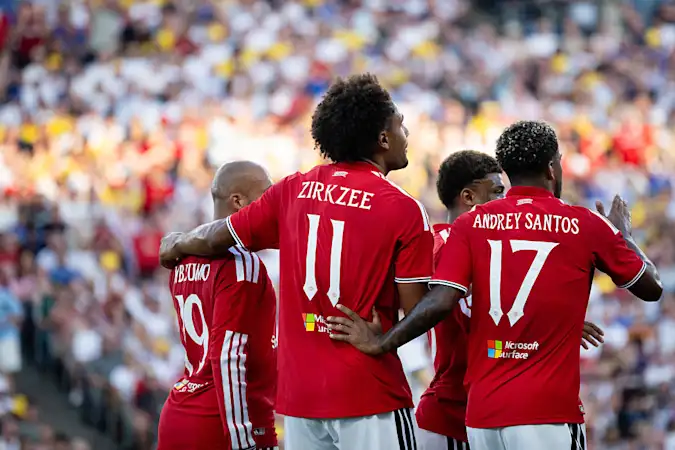
Manchester United go into the new Premier League season with two things they have not had for a while: genuine momentum and a fresh midfield.
Across Premier League matches played in 2026, United collected 41 points from 17 games, one more than Arsenal. They won 12 of those matches and scored 36 goals, compared with Arsenal's 34.
It is a useful snapshot of the progress made under Michael Carrick, but the challenge now is stretching that form across an entire season.
Carrick took over following Ruben Amorim's departure and immediately simplified things. United moved back to a four-man defence and became more compact without the ball, winning five and drawing one of the six games in which Lisandro Martinez, Harry Maguire, Luke Shaw and Diogo Dalot started together.
There are still obvious weaknesses. United kept only two clean sheets across those six matches, while three of the victories finished 3-2. Carrick has also experimented with a higher defensive line and more aggressive press during pre-season, which was exposed during the 4-2 defeat to AC Milan.
Have United improved enough in the transfer market?
Importantly, the midfield has been the main focus. United signed Andrey Santos from Chelsea for £50million and Youri Tielemans from Aston Villa for £35m, with goalkeeper Karl Darlow arriving on a free transfer. Youngsters Tynan Thompson and Cristian Orozco have also joined.
Casemiro has left for Inter Miami, while Rasmus Hojlund has joined Napoli for £38m. Andre Onana has moved to Trabzonspor on loan and Jadon Sancho has also departed.
Carrick has already admitted that United still "want" and "need" more additions before the transfer window closes, with the defence an area that could still be strengthened. Carlos Baleba is reportedly on his way to Old Trafford, and that would be seen as a complete midfield refresh from Michael Carrick.
What should Manchester United realistically aim for?
A title challenge would be a major leap. The more realistic target is Champions League qualification.
United have shown since the turn of the year that they can take points at the rate required to compete near the top of the table. Now they need to prove they can do it over 38 games, while handling European football and keeping key players fit.
Their opening schedule gives them an opportunity to start well. United begin away to promoted Hull City before facing Ipswich and Everton, although a Manchester derby follows in their fourth league match.
A top-four finish would represent a successful season. Anything beyond that would mean United's strong 2026 was not just a good run, but the beginning of something much more substantial. Early momentum is the key, but will they manage to balance a tighter schedule with their Champions League commitments too?