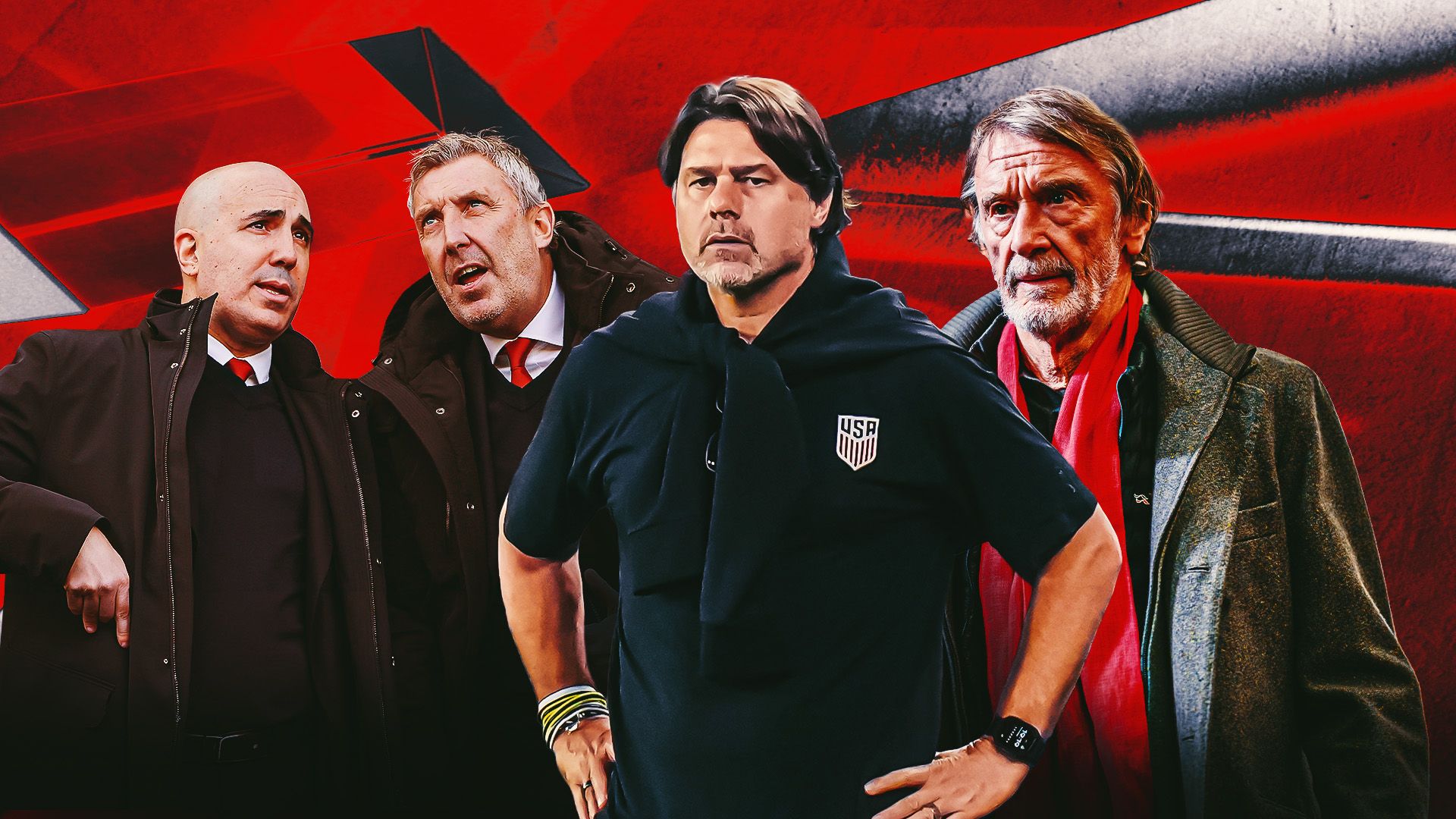

From three failed attempts to the big dream: Pochettino faces Manchester United's minefield
The sacking of Michael Carrick from the Manchester United dugout did not come as a complete surprise within the club's corridors, even if it appeared to the fans a swift and harsh decision, especially as the man who had returned the team to the Champions League just a few months earlier had begun his new season amid a storm of negative results. But what was not visible to everyone was that the management was already moving to arrange the post-Carrick phase, and that Mauricio Pochettino had become the closest name to taking on the task, in negotiations that were not merely passing contacts but had reached the point of discussing the release clause in his contract with the United States national team.
While Carrick led training and tried to salvage what he could, senior Manchester United officials were holding decisive meetings in Monaco, with Sir Jim Ratcliffe in attendance, to settle his future. The story did not stop at the sacking of a manager who failed to repeat his early successes. It extended to the way the matter was handled, the messages Carrick received before his departure, and the questions now raised over the timing of Pochettino's arrival and just how ready the team is to face Liverpool in one of its toughest tests this season.
Michael Carrick did not need to read the press reports to realise his future at Old Trafford was under threat. Before the announcement of his sacking, the English manager received clear signals from the club's hierarchy that his position was up for discussion, even if he was never explicitly told the final call was heading towards ending his mission.
According to the British Broadcasting Corporation "BBC", Omar Berrada, the chief executive of Manchester United, contacted Carrick's agent on Monday and told him he would travel to Monaco with Jason Wilcox, the sporting director, to meet Sir Jim Ratcliffe, one of the club's co-owners, and discuss the manager's future.
The following day, Wilcox held a similar conversation with Carrick himself. Both calls confirmed the management would present a recommendation on his future, without revealing its nature or whether the manager and his agents had grasped that departure had become the likeliest scenario.
Regret lingered within the club over the public manner in which the arrangements leading to Carrick's exit played out. United officials felt that concealing such moves entirely was extremely difficult at an institution the size of the English club, especially with the growing media speculation over the identity of the next manager.
Even so, the club believes it dealt with Carrick as transparently as possible, and told him internal discussions about his future were under way before the final decision was taken.
Three matches that decided the fate
Recent results were not the sole reason behind Carrick's sacking, but they formed the decisive test the management set before him. After the heavy defeats to Como and Bournemouth, Manchester United officials attached exceptional importance to the next three matches, treating them as a final chance for the English manager to prove he could correct the course and return the team to the right path.
During that stretch, United faced Chelsea, Roma and Aston Villa, but the outcome fell short. One win, a draw and a defeat was not enough to change the management's conviction about the future of the coaching staff.
For the officials, the problem was not simply the number of points collected. It extended to the overall performance and the absence of clear progress in the style of play, especially in defensive organisation and the team's structure on the pitch.
Conceding eight goals across those matches was a further sign of continued suffering, at a time when the management awaited the emergence of a clearer technical identity capable of addressing the recurring errors.
The thrilling 4-4 draw against Aston Villa was the final chapter in Carrick's tenure. The match brought another defensive collapse, as the team fell two goals behind inside the first four minutes, then found itself 4-2 down at the start of the second half, before snatching a draw in the dying minutes.
Fighting spirit from the players was not enough to save the manager. The management judged the problem to be deeper than one result, and that the team had not made the required progress under his leadership.
Why did the management initially believe in Carrick?
The irony is that Manchester United once viewed Carrick as one of their most promising sources of stability, a man to build around after he made a quick positive impact during his first spell.
In January 2026, the former midfielder took charge on a temporary basis following the sacking of Ruben Amorim, amid turbulent circumstances. He restored calm to the dressing room, improved the relationship between players and coaching staff, and gave the team a greater degree of confidence.
His influence was not limited to the psychological side. It showed in the style of play too, as the management felt his approach gave the attackers greater freedom of movement, helped the team regain its attacking edge, and was reflected in the results.
Under his leadership, United won 12 of 17 matches that season, a win rate of around 70.1%, and finished the Premier League in third place to secure a return to the Champions League.
Carrick's positive messages to the players and the media strengthened his standing with officials. He showed great calm in dealing with crises and a clear determination to shield his players from criticism, an approach the management saw as a world away from the atmosphere that prevailed in the final stages of Amorim's reign.
United studied several coaching options during the summer, but the conviction settled in the end on giving Carrick a full opportunity, with the management considering him worthy of the responsibility on a permanent basis.
The 45-year-old duly signed a two-year contract, with clauses protecting the club should the relationship end early. The long-term deal was designed to provide stability after years of successive changes in the dugout.
But what looked like a promising start quickly turned into a disappointing experience. Carrick could not carry his early successes into the new season, and the team began to suffer a clear decline in results and performance.
Pochettino: a secret move and a £7 million release clause
As Carrick's future was being debated inside Manchester United's offices, the management was already moving towards Mauricio Pochettino, whose name has long been linked with the manager's post at Old Trafford.
According to the "BBC", United officials knew of a release clause in the Argentine's contract with the United States Soccer Federation, worth 10 million dollars, around 7 million pounds sterling.
One source indicated that Pochettino's representatives were the ones who conveyed the details of this clause to the English club, a sign the contacts were no mere initial inquiries, but were heading towards completing the deal.
Negotiations ran between the two parties from Monday, before Omar Berrada contacted the United States Soccer Federation on Wednesday to confirm the details of the release clause and inform them of Manchester United's intention to trigger it.
None of this surprised the American side. Pochettino had been open with the federation's officials about his contacts with the English club, and he did not hide his desire to return to the Premier League.
Manchester United duly reached a verbal agreement with the Argentine, under which he will take charge on a contract running two and a half years, through to the summer of 2029, succeeding Carrick as manager.
Pochettino had been linked with the United job on three previous occasions without taking it on, before circumstances finally lined up this time for his arrival at Old Trafford, after spells with Tottenham, Chelsea and Paris Saint-Germain.
He is expected to become the eighth manager to take charge on a permanent basis at Manchester United since Sir Alex Ferguson's retirement in 2013, a figure that lays bare the scale of the turmoil at the club over the past years.
For years the Argentine remained a permanent candidate for the Old Trafford hot seat without the speculation turning into reality, until a fourth opportunity finally opened the doors of the English club to him, with an agreement that brings him closer to his dream of leading one of the biggest clubs in the world.
Why did Pochettino not arrive immediately at Carrington?
Despite Manchester United's desire to begin the new phase as quickly as possible, Pochettino's commitment to the American national team imposed a different reality on the English club's plans.
The Argentine was preparing to lead the United States in two matches against Haiti in the CONCACAF Nations League, and his commitments with the national team could not be ignored, especially as he told United States Soccer Federation officials he wanted to complete his mission before moving to England.
Pochettino had indeed begun overseeing the players' training at the national training centre near Atlanta, preparing for the first leg in Miami, then the return in Cincinnati.
He was expected to take charge of the second match on 18 November, before heading to England and beginning his new task at Manchester United's training base in Carrington.
As a result, Pochettino will not get an ideal preparation period before the anticipated clash with Liverpool at Anfield on 22 November. He will have only a few days to get to know his players, lay out his ideas, and prepare for a match that carries exceptional importance for the club's supporters.
The task becomes harder still given the possibility of several players being absent through their international commitments, which thins out the options available to the Argentine at the start of his experience.
Will United sacrifice the Anfield match for the sake of Pochettino?
The timing of Pochettino's arrival raised questions over the way the INEOS group is handling the transition between coaching staffs, especially as the clash with Liverpool is no ordinary match in the eyes of Manchester United's supporters.
As the club announced Carrick's departure and prepared to present its new manager, a logical question imposed itself: why did officials not demand Pochettino's arrival at Carrington as soon as possible, even if he was not available to lead the American national team in the second match?
This is not only about the importance of the clash with Liverpool. It is about giving the new manager enough time to get to know the players, clarify his tactical ideas, and work on the problems that caused the team's decline over recent weeks.
Pochettino will likely get no more than one or two training sessions with his new group before the visit to Anfield. That is very little time for a manager inheriting a team suffering technical and psychological crises, one that needs to rebuild confidence and organisation.
At the very least, the Argentine could have laid out the first features of his philosophy, defined the roles required of the players, and explained the basic principles he wants to apply, even without the chance to make sweeping tactical changes.
But United chose to respect Pochettino's commitments with the American national team, a decision understandable on contractual grounds but one that opens the door to criticism over the club's ordering of priorities.
Meanwhile, Carrick kept overseeing training for two further days, despite realising his future was all but decided and that the club was already moving to agree terms with his successor.
It is hard to ignore the psychological toll of such a situation on a manager who knows he is working through his final days, while the news of his successor tops the newspaper headlines and the media circulate the details of the negotiations around his exit.
That cloud of ambiguity hanging over the team may also have shown in the training atmosphere and the players' focus, especially knowing the coaching staff was about to change.
Some see delaying Pochettino's arrival as unavoidable given his international commitments. Others may read it as evidence that Manchester United failed to move with the required speed through an extremely sensitive transition.
Neville attacks the management: the problem is bigger than the managers
Carrick's sacking was no technical decision that passed unnoticed. It reopened the debate over the structural crisis Manchester United has endured since Ferguson's departure.
Gary Neville, the club legend and analyst for the "Sky Sports" network, was among the most prominent critics of the idea that recurring crises can be fixed by changing the manager alone.
Neville said the past 12 years have proven that sacking managers is not the solution, citing the long line of names in the dugout without any of them able to return United to its former standing.
He pointed out that the club had hired managers from different schools, including Jose Mourinho, Louis van Gaal, Erik ten Hag, Ole Gunnar Solskjaer and Ruben Amorim, as well as Michael Carrick, yet the result remained the same.
The real problem, Neville stressed, lies in the absence of an integrated management system. The club needs a strong performance department, effective contract management, and clear leadership at the heart of its organisational structure.
Such criticisms capture a hard truth: since Ferguson's retirement, Manchester United have been unable to build a stable project capable of protecting the team from swings in results and changes of manager.
Since 2013, a long line of managers have succeeded one another at the club, whether on a permanent or temporary basis. Jose Mourinho remains the holder of the best win rate among the permanent managers after Ferguson, at 58.3%, and the most decorated during that period.
Mourinho won three trophies in his first season, including the Europa League, the League Cup and the FA Community Shield. Erik ten Hag landed the two domestic cups, Louis van Gaal lifted the FA Cup, and David Moyes won the FA Community Shield.
Figures reveal the scale of the collapse
The figures lay bare the gulf between the start of Carrick's experience and its end. The manager who posted an exceptional win rate in his first season turned into one of the most prominent victims of the decline in the new campaign.
Last season, Manchester United won 12 of 17 matches under Carrick, a rate of 70.1%, surpassing everything every permanent manager at Old Trafford had managed in the years after Ferguson.
The picture changed across the full span of his matches. He won 15 of 32, a rate of 46.9%, bettering only Ruben Amorim's record among the permanent managers of that period.
As for this season, Carrick won just three of 15 matches, a rate of no more than 20%, against the 38.1% the team recorded in the last 21 matches before Amorim's sacking.
That decline echoes the experience of Ole Gunnar Solskjaer, who delivered impressive results on a temporary basis, a win rate of 73.7% in 19 matches, before it dropped to 51.7% during his permanent tenure.
The comparison shows that reviving a team in crisis does not necessarily mean possessing the ability to build a long-term project, a dilemma that has recurred at Manchester United for years.
Pochettino facing a test that cannot tolerate failure
Mauricio Pochettino arrives at Manchester United laden with great expectations. He will not inherit a stable team needing only a few tweaks, but a group suffering a slump in results, defensive problems, and mounting pressure from fans and the boardroom.
His first challenge will be to restore confidence to the players, and to find the balance between attacking ambition and defensive discipline, especially as the team conceded heavily in recent matches and could not protect a lead or handle moments of pressure.
He will also be asked to prove his arrival marks the start of a real project, and not just another episode in the serial sacking that has become a hallmark of the club since Ferguson's departure.
The clash with Liverpool at Anfield hardly looks an ideal start for a new manager, especially with so little time and so few training sessions, but it may hand him an early chance to show the character of the team he wants to build.
In the end, Manchester United's dilemma is not just finding a new manager. It is providing the environment that lets him succeed and stay. Major managers have gone, names have come and gone, plans have changed, yet the crisis has remained.
Now Pochettino faces the task he has waited years for. But reaching Old Trafford is not the real victory. The hardest victory will come in breaking the cycle that swallowed all who went before him, and proving Manchester United can finally build a project that goes beyond simply reacting to bad results.