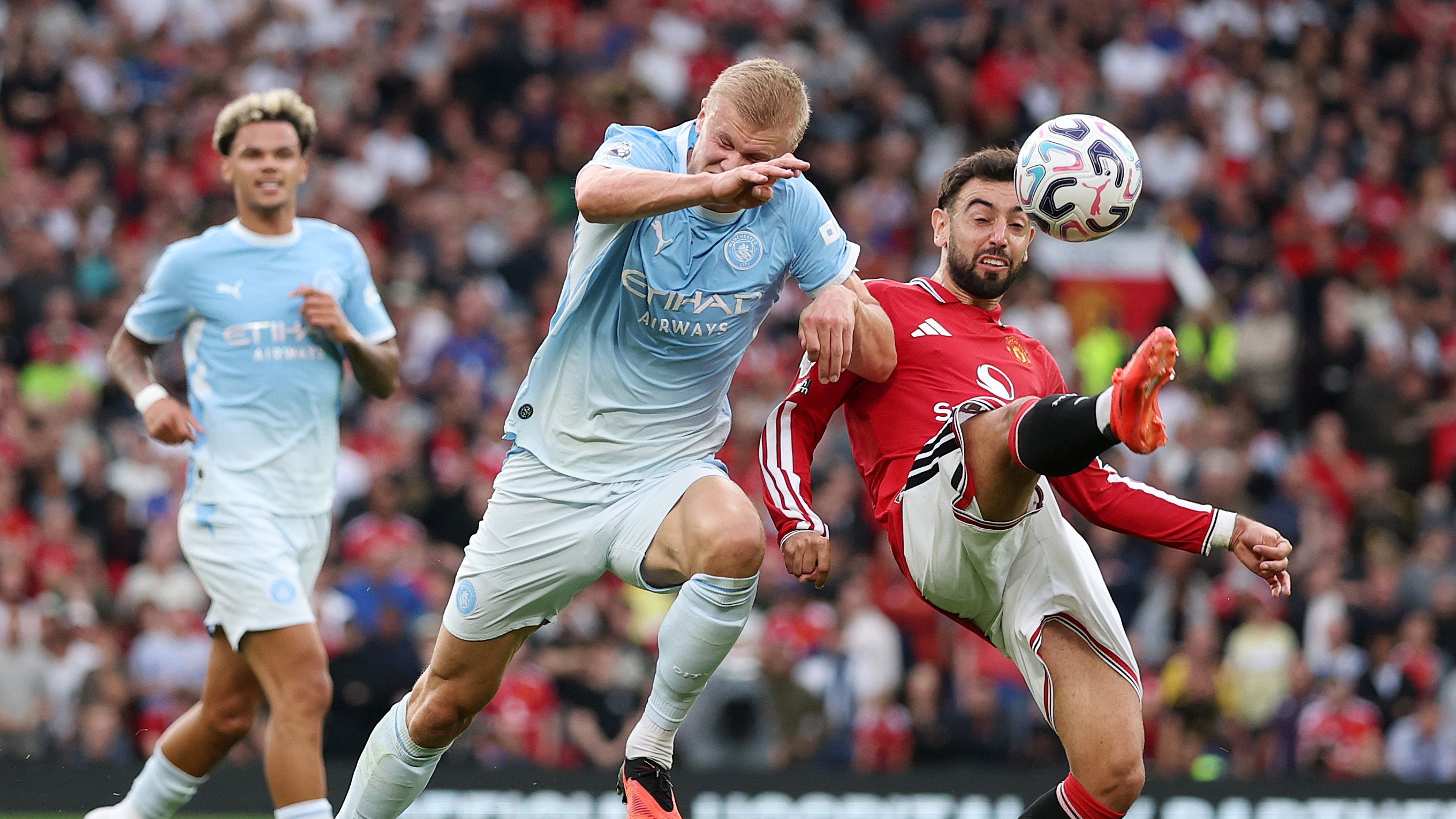

Derby analysis: Foden's sending-off exposes Manchester United's fragility, and Haaland shows no mercy
Manchester City hold firm and refuse to collapse: and where is United's bench?
The Manchester derby did more than hand City the win. It laid bare the gap between a side that knows how to protect a lead under pressure and one that had every reason to turn the game around but couldn't. City, remember, played more than an hour with ten men.
Phil Foden's sending off in the 23rd minute left Manchester City in serious trouble. Yet they held firm against United at Old Trafford and waited for their moment, until Erling Haaland's controversial goal handed them a decisive advantage despite the numerical disadvantage.
Victory took Manchester City to 12 points, level with leaders Arsenal on a perfect record. The real value, though, runs deeper than three points. City showed they can handle one of the game's toughest scenarios and still come out on top.
For Manchester United, the derby stung. It exposed their flaws in plain sight. Michael Carrick's side not only failed to exploit the extra man, but revealed a clear crisis on the bench, one that offered no solutions when they were needed most.
Foden sent off: turning point
The opening exchanges were largely balanced. Play stayed confined to midfield for most of it, and neither side threatened the other's goal. Then came the moment that changed everything: Phil Foden saw red after Bruno Fernandes kicked him off the ball, and the derby tilted completely.
The dismissal seemed to hand Manchester United the perfect chance to settle it, especially with City down to ten men from the 23rd minute onwards. What unfolded on the pitch told a different story. City never once looked like a team playing a man short.
United dominated possession for long spells, true, but they had no idea how to turn it into a real threat on Gianluigi Donnarumma's goal. They couldn't break through City's defence or reach dangerous areas. It was as if the numerical advantage simply didn't exist.
Set-pieces produced United's best moments, not open play. Marcus Rashford struck the post from a free-kick, then Kobbie Mainoo repeated the feat with another effort off the woodwork. Beyond that, nothing. Foden's red card had turned from a golden opportunity into fresh proof of United's inability to exploit a clear advantage.
Manchester City's resilience and United's sluggishness
Manchester City were superbly organised after Foden's dismissal. Most importantly, Enzo Maresca saw no need to change his line-up for the rest of the first half. His players closed down the spaces, dealt with United's attempts and showed no signs of panic despite being a man down.
Maresca made his first move at the start of the second half, taking off Rayan Cherki and sending on Iliman Ndiaye on the left wing. He wanted the Senegalese's pace and his willingness to track back and support his team-mates when the ball was lost. In midfield, he stuck with Elliot Anderson and Enzo Fernandez, the pairing that had shut down the spaces in front of United's runners.
City's job grew easier thanks to the sheer slowness of United's build-up. Playing against ten men at Old Trafford, the hosts failed to exploit the gaps that a numerical advantage should have opened up. Their attacks stayed slow and predictable, handing City's defence all the time it needed to reset.
This was where the real gulf between the two sides showed. City handled the numerical disadvantage with an organised mentality and kept their solidity. United lacked the pace and variety to make the extra man count, and the slower they built, the easier the Sky Blues found it to protect their goal. Then came the decisive blow, delivered by Haaland.
Haaland shows no mercy
Manchester City created few chances all afternoon, but when a real one arrived they took it. Erling Haaland was there on time to score the game's only goal, proving once again that the Norwegian needs barely a sniff to punish his opponents.
The goal sparked major controversy. Enzo Fernández, in an offside position, had tried to get involved by playing the ball with his head before it reached Haaland, so the linesman raised his flag and the goal was ruled out at first. Then VAR stepped in, re-examined the incident, and the referee awarded the goal.
Once ahead, City knew how to protect their lead to the end. United were supposed to turn into a more ferocious side, especially in front of their own fans at Old Trafford and with a numerical advantage. It never happened. The team stayed at the same slow pace that had marked their attacks throughout.
Stranger still, United had a full half-hour after Haaland's goal and could not create any real danger on Donnarumma's goal. The only chance came in the final minute of stoppage time, when Bryan Mbeumo broke through one-on-one. The Italian keeper was outstanding and denied him, securing City's victory and completing one of their most cohesive performances despite being a man down.
Where is the substitutes' bench?
Trailing at home, Manchester United needed fresh legs to change the shape of the match. The bench offered nothing. The proof? Carrick made just two changes, sending on Benjamin Sesko in the 67th minute and Joshua Zirkzee in the 83rd.
Three further substitutions sat unused. Carrick simply couldn't find anyone on that bench capable of making the difference in a match of this magnitude, and the problem looked all the more glaring against an opponent who had been down to ten men since the 23rd minute.
United needed to refresh their ranks and throw everything forward. The tools weren't there. They stayed just as slow and toothless against the Manchester City defence, the minutes ticking by without any sign they could exploit the numerical advantage.
The Manchester derby didn't just reveal a problem in United's style of play. It laid bare the fragility of the team and the weakness of the bench. Facing ten men for more than a full hour on your own ground, then failing to punish them despite five available substitutions, points to something far deeper than bad luck or squandered chances. It goes to the quality of the squad and its ability to find answers when matches turn awkward.