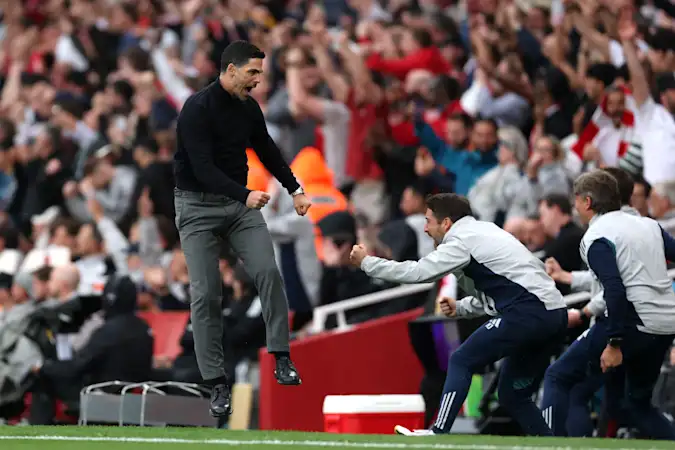
As Matthias Jaissle takes over Newcastle, his installation at St James’ Park is the ninth new managerial appointment in the Premier League since the start of June. Nine changes, 45% of the league’s clubs having a different face at the helm when compared to the end of the previous season.
From Enzo Maresca to Gary O’Neil and the seven names in between, the summer has been one of upheaval and with all this change taking place before a ball has been kicked in anger, the number of new managerial appointments in the Premier League is likely to eventually expand into double figures before the season's end.
Who eventually finds themselves on the chopping block depends on the fortunes of the Premier League’s current class, but if you are someone looking for job security, the top tier of English football may not be the best environment to find it.
Jaissle’s arrival on Tyneside comes a week after the departure of Eddie Howe as Newcastle manager and with the 48-year-old spending nearly five years in charge of the Magpies, the Premier League has lost what was its second-longest reign of current bosses.
Which means in an era where patience is viewed as incredibly scarce, a tenure the length of Howe’s is now seen as an exception rather than the expectation and this point is reinforced when you look at the division as a whole:
Manager | Club | From | Days as manager |
Mikel Arteta | Arsenal | 22-Dec-19 | 2420 |
Unai Emery | Aston Villa | 01-Nov-22 | 1375 |
Daniel Farke | Leeds United | 04-Jul-23 | 1130 |
Régis Le Bris | Sunderland | 01-Jul-24 | 767 |
Fabian Hürzeler | Brighton & Hove Albion | 02-Jul-24 | 766 |
Frank Lampard | Coventry City | 28-Nov-24 | 617 |
David Moyes | Everton | 11-Jan-25 | 573 |
Sergej Jakirović | Hull City | 11-Jun-25 | 422 |
Keith Andrews | Brentford | 27-Jun-25 | 406 |
Michael Carrick | Manchester United | 13-Jan-26 | 206 |
Roberto De Zerbi | Tottenham Hotspur | 31-Mar-26 | 129 |
Marco Rose | Bournemouth | 01-Jun-26 | 67 |
Andoni Iraola | Liverpool | 04-Jun-26 | 64 |
Pierre Sage | Crystal Palace | 15-Jun-26 | 53 |
Gary O'Neil | Ipswich Town | 23-Jun-26 | 45 |
Enzo Maresca | Manchester City | 29-Jun-26 | 39 |
Xabi Alonso | Chelsea | 01-Jul-26 | 37 |
Oliver Glasner | Nottingham Forest | 06-Jul-26 | 32 |
Álvaro Arbeloa | Fulham | 07-Jul-26 | 31 |
Matthias Jaissle | Newcastle United | 05-Aug-26 | 2 |
A snapshot of the current 20 Premier League managers highlights just how little job security there seems to be at present, as not only have nine clubs decided to make personnel changes in the off-season but the average length of tenure is just 459 days.
459 days or just over 15 months in charge and this is including the outliers of both Mikel Arteta’s near seven-year stint at Arsenal and the appointment of Jaissle, which stands at just two days at the time of writing.
Therefore, if we remove the outliers of the data and focus on the remaining 18 managers, the average length in charge is shrunk to 376 days. 11 days more than a single year in charge, a figure that points towards rented accommodation rather than opting for a mortgage.
Instead of putting down permanent fixtures, those men who are tasked with Premier League employment are simply renting short-term and to give you an idea of the rate of turnover, Michael Carrick is already the 10th longest-serving current Premier League manager.
The now permanent Manchester United boss has only been in charge at Old Trafford for 206 days but that is still enough to be placed in the top half when it comes to current managerial tenure; while Roberto De Zerbi finds himself one place further back in 11th.
De Zerbi arrived at Tottenham at the end of March and even though he has been in charge for 129 days, he still finds himself with a longer tenure than nine Premier League bosses – the nine that have taken new jobs over the summer.
THE SENIOR FIGURES
While only five managers or 20% of the division have been in charge for longer than two years. Arteta leading the pack with 2,420 days in charge, followed by the quartet of Unai Emery, Daniel Farke, Regis Le Bris and Fabian Hurzeler.
To drill down further, if you take the tenures of the top three names on the list (Arteta, Emery and Farke), they currently account for 53.6% of all the days in charge of a Premier League club. Three managers holding on to more than half the overall experience in the division.
Emery’s 1,375 days in charge at Aston Villa may be viewed as longevity, but at the same time, it also comes with an element of caution. The reason for that caution is due to having a longer tenure than average. Some will view that as consistency; others may view it as approaching the end of the road.
A word of caution for the man who oversaw Aston Villa’s Europa League success and with the club having sold some of its key names over the course of the summer, this upcoming campaign may prove to be a difficult one at Villa Park.
The scale of the challenge facing Premier League managers becomes clearer when looking beyond the individual appointments and at the division as a whole. When you band the appointment lengths into years:
Tenure | Managers | % |
Less than 1 year | 11 | 55% |
1–2 years | 4 | 20% |
2–3 years | 2 | 10% |
3+ years | 3 | 15% |
Total | 20 | 100% |
You can see that 11 of the 20 managers have been in their post for less than a year, and although several tenures could develop into something more substantial, substantial may end up being no more than two years in charge.
ON SHAKY FOUNDATIONS
Which is where you will find the next belt of managers, those who have been in charge for a maximum of 24 months and this is where you will find the quartet of Frank Lampard, David Moyes, Sergej Jakirovic and Keith Andrews.
Two of those four managers are overseeing outfits that earned promotion from the Championship at the back end of last season and for both Lampard of Coventry and Jakirovic of Hull that will obviously bring its own concerns.
Because neither manager can simply rely on the achievements of a few months ago, instead it is now a case of making sure they can swim with the tide of the Premier League. Failure to do so may see the pair swept from their current posts.
Which would then lead to another two names adding to the pile of managers who have been in charge for less than a year. Depending on whether there are hiring and firings and when they take place, the number could be as high as 13.
At the same time, neither David Moyes nor Keith Andrews can relax either. For the former, there is a feeling that Everton will need to kick on now that they have settled into their new home. Any hint of even standing still may place pressure on the veteran Scottish manager.
While for Andrews at Brentford, it is the expectation that comes with a second season in charge and after getting so close to Europe just a few months ago, supporters of the Bees will hoping for more of the same. The bar has subsequently been lifted at the G-Tech Community Stadium.
Whether Andrews can deliver on that remains to be seen; the departure of Jordan Henderson to crosstown rivals Chelsea will be sorely felt when you consider the England international’s experience, experience that is hard to replace for a team of Brentford’s size.
With the Premier League being a results-driven environment, the current landscape suggests that patience has become one of the rarest commodities in English football. Managers are no longer judged over eras or even multiple seasons, but assessed over short windows of opportunity.
For some, those windows may be enough to build momentum and establish themselves. The likes of Enzo Maresca, Xabi Alonso and Andoni Iraola are looking to build legacies with their new employers. For others, a poor run of form can quickly turn into another change in the dugout.
Nine managerial changes before a ball has been kicked is a striking figure, but it may not be the final number. The bigger question is not who will be the next to leave, but whether anyone outside the small group of long-serving figures will be afforded the time to build anything longer-term. Manager data correct at time of writing - 7th August 2026