The views and opinions expressed in this article are those of the author and do not necessarily reflect the official editorial policy or position of LiveScore.
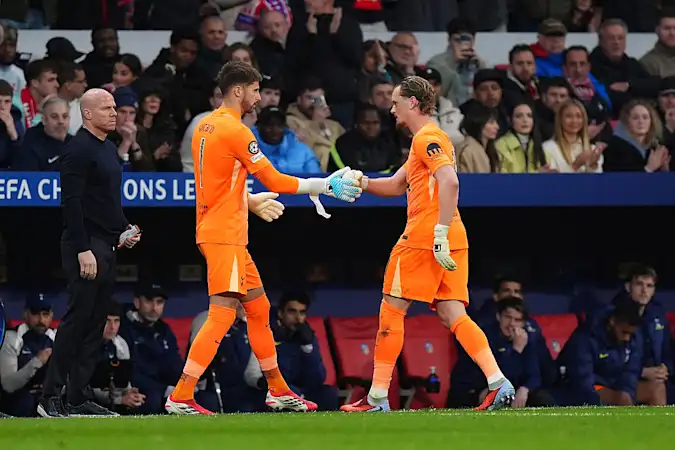
The moment lasted 17 minutes. That is how long Antonín Kinský lasted in goal for Tottenham Hotspur against Atlético Madrid before Igor Tudor decided the experiment had already gone too far. Those 17 minutes might have ruined a young man’s football career.
By the time the goalkeeper was substituted, Spurs were 3–0 down inside the opening 15 minutes, two of those goals arriving after errors directly attributed to Kinský. The decision to remove him so early was brutal, but also revealing. Tottenham’s current tactical approach leaves almost no room for mistakes. And when they arrive, the consequences are immediate.
For a young goalkeeper still trying to establish himself at elite level, it was the worst possible stage for such an introduction. For Spurs, it was something else entirely: the latest symptom of a system that increasingly feels like a controlled tactical freefall.
His errors reminded us all of Loris Karius, and his career since his high-profile errors in the Champions League final of 2018. It all looks a little too familiar.
The Vicario Safety Net Spurs Abandoned
The contrast with Guglielmo Vicario is stark.
Vicario has been one of the busiest goalkeepers in the Premier League this season, recording 76 saves and seven clean sheets according to official league statistics. In Europe, he has played nine Champions League matches, producing 28 saves and six clean sheets, while maintaining a 74.78% pass completion rate in build-up play.
Those numbers describe a goalkeeper performing two roles simultaneously. Vicario is both Tottenham’s last line of defence and a key component in their possession structure.
Remove that stability, even briefly, and the entire system starts to wobble. Kinský’s 17-minute nightmare showed exactly how fragile the structure has become. But, it has to be said, it’s hardly his fault. The wrong moment, the wrong decision by his manager, who refused to engage with him after bringing him off.
A System That Leaves No Margin for Error
Under Tudor, Tottenham are playing on what feels like the tactical equivalent of a tightrope.
Opta tracking shows Spurs pushing their average defensive line close to 45 metres from their own goal, one of the most aggressive defensive positions recorded in the Premier League this season. The intention is obvious. Compress the pitch. Win the ball high. Attack quickly.
When it works, the football can be thrilling. When it fails, which it has been, the consequences are catastrophic.
With the defensive line pushed so high, even small errors instantly turn into clear chances. Opponents only need to break the press once to find open space behind Tottenham’s defence. And this season they have been doing exactly that.
Why the Goalkeeper Becomes Crucial
A system this aggressive places enormous responsibility on the goalkeeper.
He must sweep behind the defensive line, distribute accurately under pressure and react instantly when transitions occur. That is why Guglielmo Vicario’s numbers are so important to Tottenham’s season.
Vicario has recorded 76 saves and seven clean sheets in the Premier League, highlighting how frequently Spurs rely on him to repair defensive breakdowns.
In the Champions League he has made 28 saves in nine matches while keeping six clean sheets, while maintaining a 74.78% passing accuracy during build-up play. Those statistics illustrate how much Tottenham’s system depends on a reliable goalkeeper.
Remove that stability, even briefly, and the structure starts to collapse.
The Kinský Decision
That is exactly what happened in Madrid. Instead of the experienced Vicario, Tudor handed the gloves to Kinský in one of the most hostile environments in European football.
Against Atlético Madrid, a side that thrives on punishing defensive mistakes and attacking transitions, it proved disastrous. Three goals inside 15 minutes. Two direct errors. A substitution in the 17th minute. For Tottenham, the damage was immediate.
For Kinský, the consequences could be far longer-lasting. Young goalkeepers develop through gradual exposure and confidence. Being publicly withdrawn before the first half has even properly begun can have the opposite effect. It risks defining a player before he has even begun.
The Gamble Spurs Are Taking
Tudor’s philosophy is not without precedent. High pressing and aggressive defensive positioning have powered some of Europe’s best teams. But those teams combine aggression with control. Right now Tottenham look like a side leaning almost entirely on risk.
The Opta numbers show an attack that produces 15 shots per match, but a defence conceding 13 shots and more than 1.7 expected goals per game.
That is not balance. That is volatility.
And the image of Kinský walking off after 17 minutes in Madrid may end up symbolising Tudor’s entire Spurs project: bold, uncompromising and dangerously exposed. Ignored by his own manager, it's a long way back for him… when the true victim should have been Igor Tudor himself. It looks to many that he never had the dressing room to lose it, and this is another nail in the coffin for Spurs' interim manager.