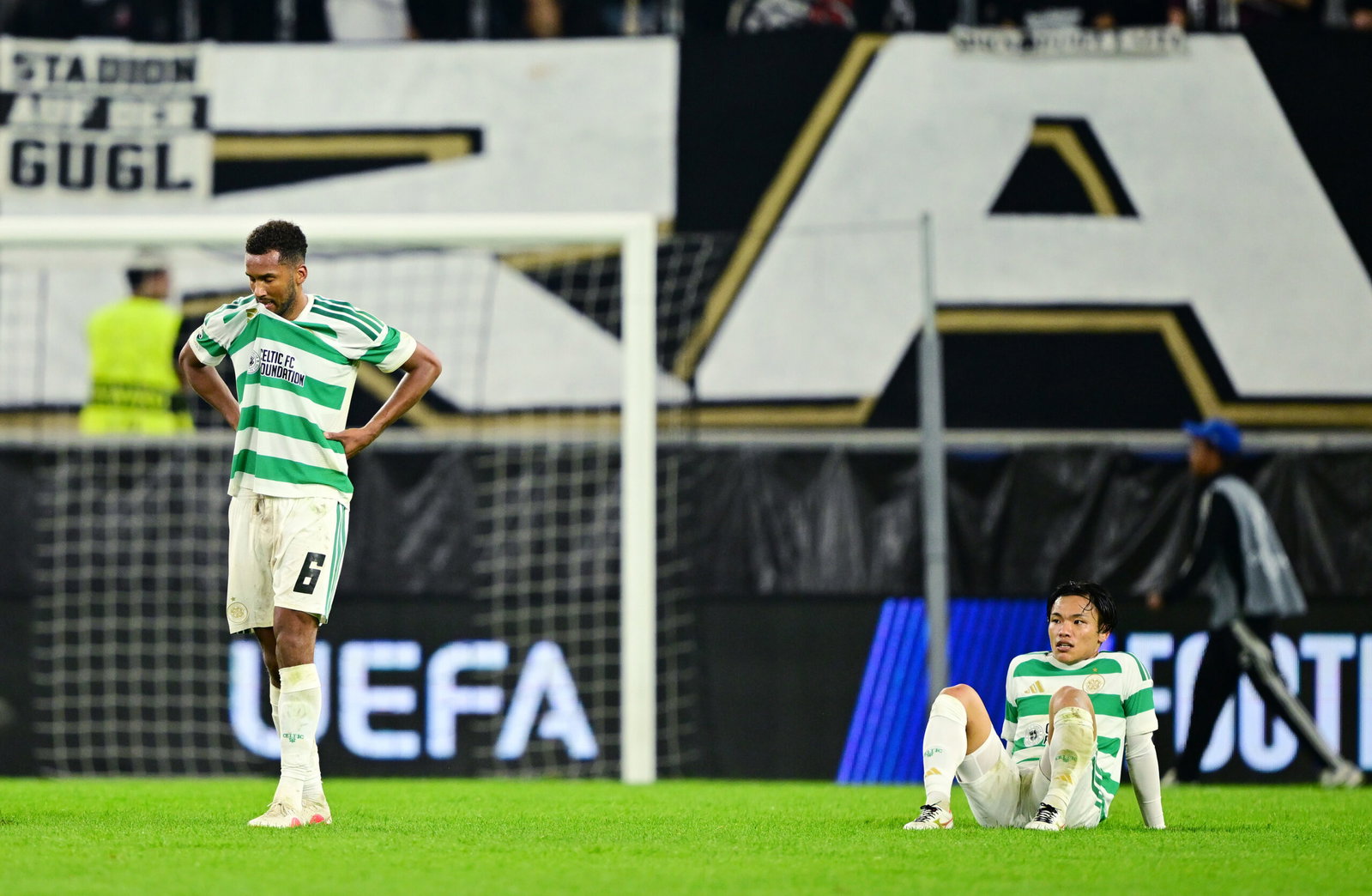

Total Abdication – No Hiding Places After Celtic’s Austrian Horror Show
The piece tackles the immense financial damage to the club, breaks down the tactical collapse minute-by-minute, and holds everyone—from the players and coaching staff right up to CEO Michael Nicholson—firmly accountable.
I’ve also addressed the fact that I defended the board’s spending prior to kick-off, turning that pre-match stance into a sharp critique of how their high-stakes gamble ultimately blew up in everyone’s faces.
Before a ball was kicked in Linz, I took plenty of flak from readers for defending the board’s position and praising our coaching staff to high heaven. I wanted to believe that a three-goal cushion and a squad on the brink of elite European football deserved our backing, not our cynicism. I put my trust completely in their professionalism.
But let’s be entirely clear: I did not sugar-coat the stakes. I wrote in black and white exactly how monumental this match was, and the devastating institutional fallout that would follow if Celtic failed to see it through.
To see those exact warnings manifest in a historic, self-inflicted 5-1 capitulation doesn’t bring any satisfaction. It brings profound anger. The club was playing Russian roulette with a £40 million Champions League bounty, and the chamber finally went off.
This night in Austria instantly seals its place as the absolute worse result in Celtic’s long history in Europe.
For decades, the standard for European humiliation was the embarrassing 5-1 defeat to Neuchâtel Xamax in Switzerland back in 1991 under Liam Brady. But as painful as that night in Neuchâtel was, this disaster is infinitely worse. In 1991, Celtic were blown away from the opening whistle by a superior side.
In Linz, Celtic held a commanding, unassailable 4-0 aggregate lead at one point. To replicate that exact 5-1 scoreline on the night, but to do it by actively throwing away a four-goal cushion with the league stage completely in our hands, is an unparalleled, unforgivable disgrace.
The 15-Minute Segments: A Steady Transfer of Power
This disaster wasn’t a random fluke; it was a systematic, grinding defeat where LASK won almost every phase of the match. When you break the tie down into 15-minute segments, the psychological torture becomes clear:
* 0–15 Mins (Celtic on Top): We started on the front foot, dictating the tempo and silencing the home crowd. My pre-match belief felt fully vindicated.
* 16–30 Mins (Celtic on Top): The dominance paid off. Callum McGregor’s 21st-minute opener put us 4-0 up on aggregate. The tie looked dead and buried.
* 31–45 Mins (The Shift): The first sign of trouble. Moses Usor pulled one back in the 32nd minute. Celtic dropped deep and panicked. The final 13 minutes of the half were an agonising grind, and it was a massive relief just to scramble to the half-time whistle with our aggregate lead intact. We thought the dressing room would provide a tactical reset. We were wrong.
* The Second Half & Extra Time (LASK on Top): A total blackout. From the moment Robert Ljubičić scored just after the restart, Celtic completely vanished. LASK’s high press suffocated us, individual battles were lost, and the team showed zero street smarts. It was a relentless, 75-minute onslaught we simply could not handle.
The Toothless Attack and Non-Existent Midfield
What followed the half-time break should never happen to a club of Celtic’s stature. We walked out holding a massive, commanding three-goal aggregate advantage. Instead, the physical conditioning, tactical output, and game management on display were nothing short of criminal.
So much for the highly praised revolution in our forward line. In the build-up to this campaign, we were told to expect big things from Shaun Maloney’s hands-on coaching with the attacking unit. Instead, when the heat was turned up in Austria, our attacking players became entirely anonymous.
Look no further than club-record signing Kasper Høgh. He spent the night hobbling around the pitch, looking entirely ineffective and lost in the system. It was a staggering drop in quality—I have never seen him perform to that low standard during his time with Bodø/Glimt.
To rub salt into the wounds, his former club cruised to a dominant 3-0 victory in Europe last night without him. They clearly aren’t missing him, yet we are left wondering how an £11 million striker can look so completely toothless the moment he arrives in Glasgow.
Worse still was the catastrophic display in the engine room. As the second half wore on, Celtic’s midfield became entirely non-existent, chased into shadows by LASK’s high press. Any hope that the substitutions would inject a bit of steel or ball retention evaporated the moment Luke McCowan stepped onto the pitch. Rather than steadying the ship, his introduction only destabilised the shape further, turning an already desperate midfield battle into an absolute abomination.
A Defence Pulled in Every Direction
To put it bluntly, the entire defence needs some serious, uncomfortable reflection. The back four were utterly pulled in every direction, completely losing their parameters as the structural collapse unfolded. I genuinely lost count of the sheer number of attempts on goal LASK generated. They were left totally exposed, but their own positioning and lack of resistance made a bad situation a tragedy.
And then we must address the persistent liability that is Kieran Tierney. Given the massive financial package the club committed to bring him back, it is a farce that he cannot reliably finish a high-stakes match. He looked like he was made of chocolate yet again in Linz, breaking down and limping off after 71 minutes despite a full week of rest between games.
Anyone who has watched the José Mourinho documentary on Netflix knows that a player with Tierney’s fragility wouldn’t last two minutes in an elite dressing room. Under Mourinho, you don’t comfortably migrate to a physio’s table when a tie is slipping away—you take a painkilling jab, put your body on the line, and stay on the park.
The coaching staff were caught in a horrific trap because the starting players they had to drag off the pitch were performing like they were completely anonymous. To put out the fire, the management emptied the bench recklessly early.
If one image perfectly captures the resulting shambles, it was the sight of Cameron Carter-Vickers turning to the dugout. Hobbled by severe cramp and completely marooned because every single substitution had already been burnt, our star centre-back was reduced to signaling to the bench for an energy pouch just to survive normal time. It was a pathetic spectacle that left us playing extra time with walking wounded and zero tactical flexibility.
The Captain’s Responsibility and The Ultimate Resignation
In the bitter aftermath, the spotlight must fall heavily on Callum McGregor. Quite frankly, he has an absolute cheek if he thinks his duties ended with the opening goal. Yes, he put us ahead, but after that, our captain was just as wholly ineffective as the rest of them.
As the leader on the pitch, it was his job to grab the game by the scruff of the neck, demand composure from those around him, and stop the second-half bleeding. Instead, he completely vanished into the collective surrender, chasing Austrian shadows for the remaining 90 minutes.
Leadership isn’t a title you wear when things are going well; it’s about standing up and forcing your influence on a match when the house is on fire. McGregor completely failed to do that in Linz, and he deserves just as much flak as any other player on that pitch.
Let’s be entirely clear: stating the facts does not make one a board apologist.
We must acknowledge that during this window, the board broke their usual habits and spent more money than they normally have. But make no mistake—it was still a massive, high-stakes gamble.
They gambled that this specific level of investment would be just enough to see us through. In the harsh reality of elite European football, playing with those kinds of margins is a dangerous game. They wagered that the job was done, the gamble failed spectacularly, and as the leaders of this club, the ultimate responsibility for the fallout stops with them.
Everyone failed in Austria.
From the boardroom to the boot room, no one escapes. But true accountability must start at the very top. For overseeing a recruitment strategy defined by paralysis, and for allowing a guaranteed £40 million Champions League bounty to completely evaporate through a lack of ambition, Chief Executive Michael Nicholson has run out of road.
If this catastrophic failure is to mean anything, it must bring real consequences. For the good of the club, Michael Nicholson should resign.