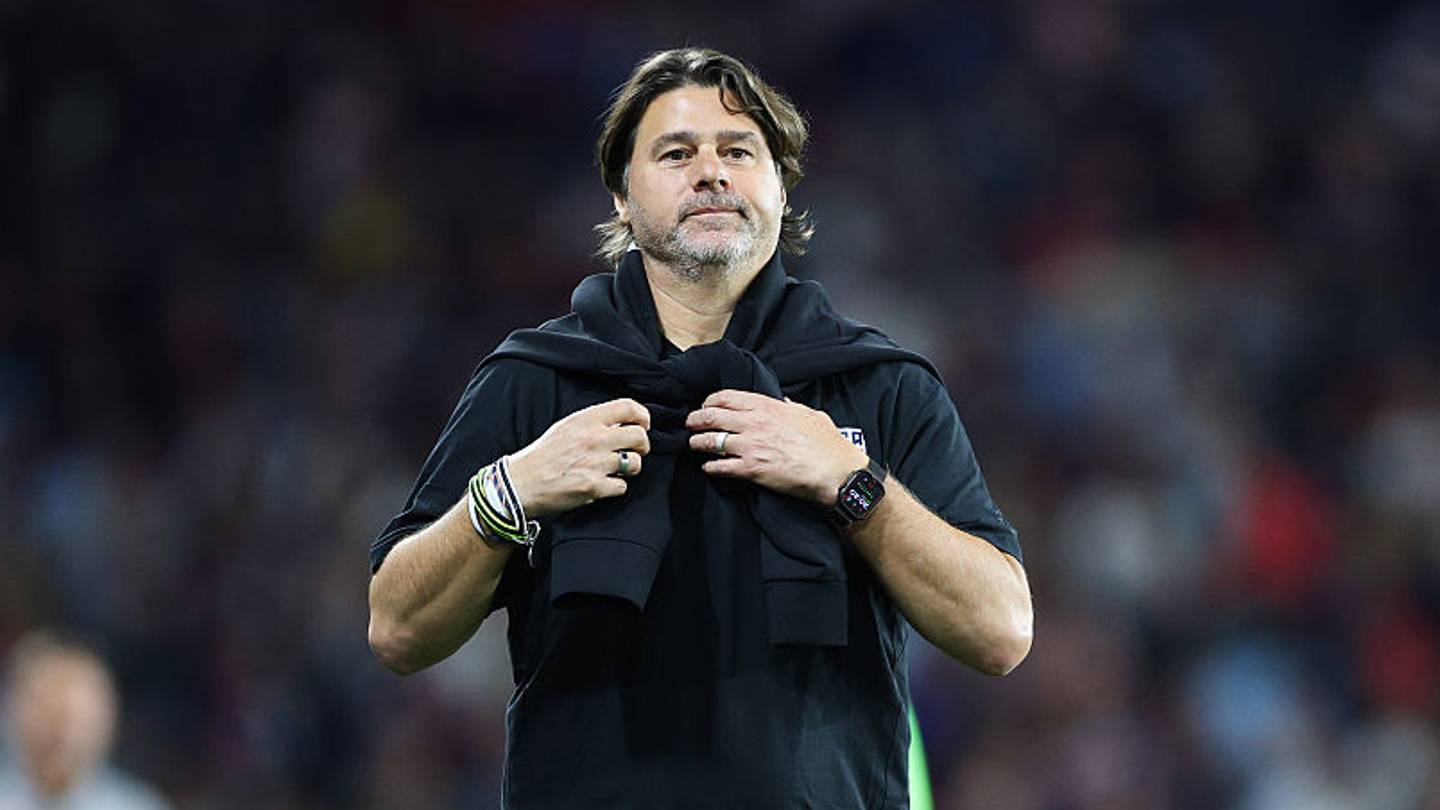

The Most Defining Moments of Mauricio Pochettino’s USMNT Tenure—Good and Bad
Despite having just signed a contract renewal through the 2030 World Cup in August, Mauricio Pochettino is set to leave the U.S. men’s national team at the end of the November international break.
After honing his managerial skills at the international level for the first time, Pochettino is now headed for his sixth club job and fourth in the Premier League with Manchester United. Starting as soon as Wednesday, he replaces Michael Carrick, who, after a promising spell as the Red Devils’ interim manager, failed to convince as the permanent leader this fall.
While United fans will be counting on Pochettino to lead them out of the relegation zone and overcome their worst start to a season in four decades, USMNT fans will undoubtedly be feeling aggrieved by their high-profile manager suddenly jumping ship. Still, there are plenty of things to be grateful for regarding Pochettino’s two-year tenure in the States.
Here are the most defining USMNT moments of the Pochettino era—the good and the bad.
Bad: 2025 Concacaf Nations League
With the exception of a 2–0 friendly defeat to Mexico in Guadalajara, the U.S. got off to a strong start under Pochettino’s reign, beating Panama, Costa Rica and Venezuela by two-plus margins and then beating Jamaica 5–2 on aggregate in the Concacaf Nations League quarterfinals. However, they struggled to convince in their first major test under the Argentine.
Having won the first three editions of the Concacaf Nations League, all signs pointed to them making it four in a row on home soil. Instead, they lost to Panama in the semifinals after conceding a last-second goal to Cecilio Waterman, before losing 2–1 to Canada in the third-place match.
It was a humbling blow for the Stars and Stripes, whose struggles continued into their pre-2025 Gold Cup friendlies, losing 2–1 to Türkiye and 4–0 to Switzerland that June.
Good: 2025 Gold Cup
All signs pointed to the USMNT struggling at home in the 2025 Gold Cup. After all, they were entering the tournament with their reserve side due to key players like Giovanni Reyna, Weston McKennie and Timothy Weah away at the Club World Cup. Others were out due to injury, like Antonee Robinson, Ricardo Pepi and Folarin Balogun, while others like Christian Pulisic and Yunus Musah opted to take the summer off to rest.
Despite these adverse circumstances, Pochettino managed to get a tune out of his team for the first time. The USMNT made quick work of Trinidad and Tobago, Saudi Arabia and Haiti in the group stage, before edging Costa Rica on penalties, followed by a comfortable win against Guatemala. They looked headed for the glittery title after taking an early lead, only for Mexico to equalize shortly after and complete the comeback in the 77th minute thanks to Edson Álvarez.
More important than the silver medal was that it forced Pochettino to widen his pool and experiment with new players like Alex Freeman, Sebastian Berhalter, and Matt Freese, all of whom seized the opportunity and went on to play significant roles in the following year’s World Cup.
Good: Pre-World Cup Friendlies
After suffering a heartbreaking defeat in Houston, Pochettino’s side was criticized for their inability to punch above its weight and deliver results against top-tier opposition. Those concerns only intensified following the subsequent 2–0 defeat to South Korea in September 2025.
But they bounced back in emphatic fashion, with goals from Alejandro Zendejas and Folarin Balogun to secure a 2–0 victory over Japan. In doing so, the USMNT snapped a seven-match winless streak against an opponent ranked inside FIFA's Top 25, offering a much-needed sign of progress under Pochettino.
The USMNT then drew Ecuador and won 2–1 against Australia and Paraguay, before demolishing two-time World Cup winners Uruguay 5–1 to close out 2025. After losing to Belgium and Portugal, the U.S. then beat AFCON winners Senegal 3–2, before losing narrowly to Germany 2–1 in their final pre-World Cup friendly. As the results were slowing improving, the team was growing more and more promising.
Good: World Cup (Pre-Independence Day)
The USMNT’s World Cup campaign began in sensational fashion, with an early own goal, a Balogun brace and a last-gasp strike from Reyna propelling them to victory over Paraguay in Los Angeles. The Stars and Stripes followed it up with a 2–0 win against Australia in Seattle before returning to Southern California, where a heavily rotated lineup conceded a stoppage-time winner in a 3–2 defeat to an already-eliminated Türkiye.
Having topped their World Cup group for just the third time in history, the Stars and Stripes headed north to Santa Clara for a round of 32 showdown with Bosnia and Herzegovina. Balogun broke the deadlock before receiving his marching orders in the second half, but Malik Tillman doubled the advantage as the Americans secured their first World Cup knockout victory since 2002.
History was being written before their very eyes. Pochettino became the first USMNT manager to win three matches at a single World Cup, while his side had already racked up 10 goals in four matches, surpassing their previous tournament record of seven. With his team riding a wave of momentum on home soil, surely they would have no issue extending their dream run against a susceptible Belgium side?
Bad: World Cup (Post-Independence Day)
After celebrating the nation’s 250th birthday, the USMNT faced its first major litmus test of the World Cup: Belgium. The Red Devils had stumbled through the group stage, drawing with Egypt and Iran before overturning a two-goal deficit to edge Senegal 3–2 courtesy of a last-second penalty from Youri Tielemans.
Belgium entered the clash aggrieved by FIFA's decision to suspend Folarin Balogun’s one-match ban following U.S. President Donald Trump’s intervention with FIFA President Gianni Infantino. However, they channeled their frustration into fruition, producing a display reminiscent of their golden generation’s exploits at the 2018 World Cup, dismantling the Americans 4–1 on home soil.
U.S. Soccer had shattered its wage bracket to appoint Pochettino, handing him a reported $6 million annual salary. It was an unprecedented investment, made with the expectation that he would transform them into a team capable of going toe-to-toe with the world’s elite. After all, it’s one thing for the U.S. (then 17th in the FIFA rankings) to beat Paraguay (41st), Australia (27th) and Bosnia and Herzegovina (64th); it’s another to beat teams like Belgium (9th). Pochettino had failed to deliver.
Good: Post-World Cup Friendlies
It was always going to be difficult for the USMNT to pick up the pieces after its humiliating defeat in Seattle, which saw them exit the round of 16 for the fourth consecutive World Cup. However, Pochettino deserves immense credit for how he navigated the September-October international window. Rather than sticking with the tried and tested, he retained just 13 members of his 26-man World Cup squad.
The results spoke for themselves. The USMNT demolished Peru 4–1 before coming from behind to beat Chile 4–2, followed by a cathartic 3–0 victory over bitter rivals Mexico and a hard-fought 1–0 win against Canada. Yet arguably more important than the four consecutive victories was the emergence of 13 international debutants, each of whom received an opportunity to stake their claim for a place in Pochettino's long-term plans.
Throughout his tenure, Pochettino has provided a springboard for a new generation of American talent, from Berhalter and Freeman to Julian Hall and Cavan Sullivan, the latter of whom is now the youngest goalscorer in national team history. While his tenure may have fallen short in terms of silverware and statement victories against elite opposition, he has laid the foundations for a promising 2030 World Cup cycle.
Above all, Pochettino’s appointment will be regarded as a watershed moment for American soccer. His arrival shattered the notion that the USMNT had to settle for familiar faces and proved that it could attract the biggest names in world management. Whether or not Pochettino fulfilled expectations, he undoubtedly shifted the paradigm and raised the ceiling for what they can aspire to in the future.