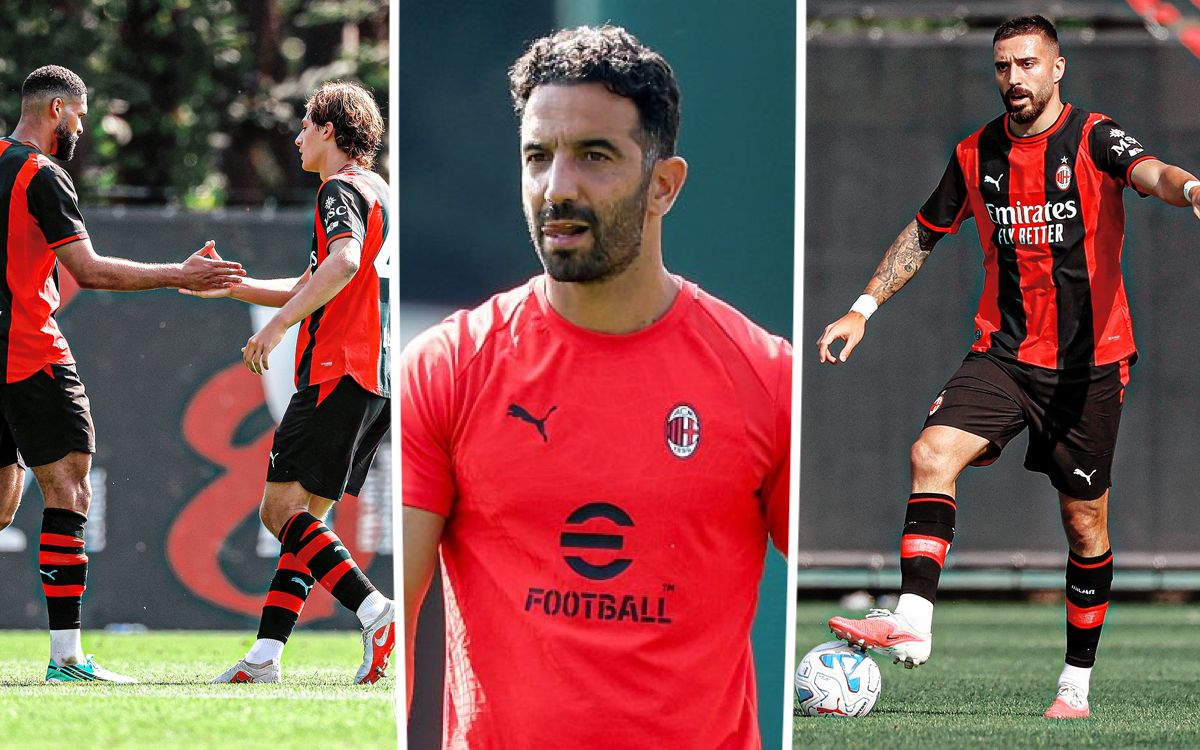

Once an exception, twice a clue, now the proof: Amorim trials clear 4-2-3-1 again
A mid-international break training friendly doesn’t usually generate many headlines, especially when it ends in a rather tame 1-1 draw.
Despite this, some interesting signs have filtered out from Milan’s game against Padova, which took place on Friday lunchtime at Milanello. Beyond the result against the Serie B side – which is not a surprise given the depleted ranks – the set-up of the team and role of individuals caused intrigue.
In the first half, Ruben Amorim named the following team: P. Terracciano, Gabbia, Gila, Tomori, Diawara, Loftus-Cheek, Comotto, F. Terracciano, Idrissi, Hutchinson, Pulisic. If an indication of the fact 15 players (plus the injured Alexis Saelemaekers) were unavailable was needed, that was it.
It was a test that the two clubs deliberately described on their respective official websites as a ‘joint training session’ and not even as a friendly match. Despite this, we can perhaps deduce from the positions of certain players some experiments that Amorim was trying out.
A four seen again
The 3-0 win over Lecce before the break demonstrated some of that tactical flexibility that Amorim suggested he knows he needs to show in order to get more out of the squad.
In the build-up phase, Milan would temporarily resemble a back four, with De Winter and Pavlović splitting wide to allow Estupiñán and Gila to push higher up the pitch. The idea was to bait Lecce into pressing high before suddenly increasing the tempo of circulation.
It was something Koni De Winter also confirmed after the game, proving it was by instruction. The reason is quite a simple one: to have more fluidity in attacking positions and be less readable on the wings with the overlapping runs of Estupinan and Gila.
Furthermore, Milan did it to be less predictable in their playmaking when coming out from the back. If with the 3-4-2-1 the origin of the play was often confined to the central areas (Luka Modric or Ardon Jashari dropping deep, Gila on the centre-right), spreading the Spaniard so wide gave the opponent far fewer reference points.
According to La Gazzetta dello Sport, a clear 4-2-3-1 was observed at Milanello today, as follows: P. Terracciano; Tomori, Gila, Gabbia Diawara; Loftus-Cheek, Comotto; F. Terracciano, Idrissi, Hutchinson; Pulisic. Ossola, Pereira, and Vos came on in the second half.
It was a line-up that was experimental, perhaps by necessity or perhaps as a genuine fact-finding mission. Christian Pulisic operating as a centre-forward for example is a solution already mentioned by the coach in recent weeks as being viable. His movement drags defenders around, making him false-nine type.
Meanwhile, Ruben Loftus-Cheek operated as a midfielder in the double pivot. Having struggled in recent outings as an attacking midfielder, there is a suggestion that the Englishman could make use of his physicality and his stride by playing a bit deeper, rather than behind the striker where technical intricacy is needed.
Fikayo Tomori and Sankhoun Diawara played, but not in their usual positions: the former was at right-back and the latter was at left-back. Although this isn’t something we can see being repeated at great volume, it is perhaps a concerted effort to get them used to playing out in wider areas when they are given minutes.
Omari Hutchinson got the nod to play as a playmaker but his position was a very free one, with the Nottingham Forest loanee shuttling across the forward line to again try and free spaces for Idrissi and Pulisic.
The most notable aspect was that this wasn’t a team that morphed occasionally into a 4-2-3-1: it was the structure visible almost throughout. Was it by choice or forced by absences? The next match in Reggio Emilia against Sassuolo will tell us more.