
Italy vs France: The tactics board - Esposito double punishes French transition flaws
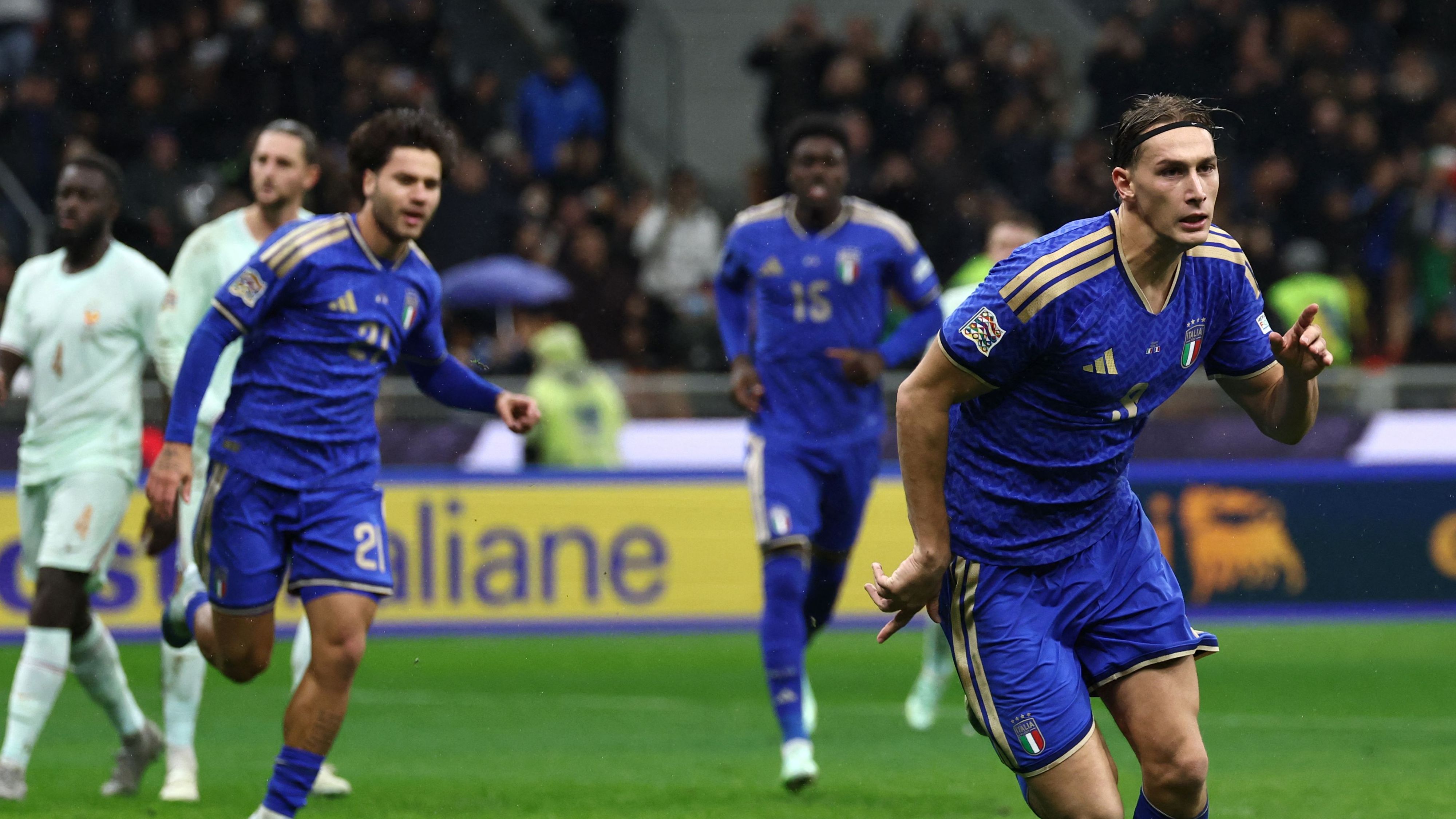
Italy secured a commanding 3-1 victory over France at the San Siro, overcoming an early Michael Olise strike through tactical discipline and superior efficiency in the final third. Francesco Esposito proved the difference-maker, leading a clinical Azzurri side that exploited France's inability to manage defensive transitions.
The tactical narrative at the San Siro was defined by a contrast between Italian structural rigidity and French individual flair. Roberto Mancini sought to control the half-spaces and exploit the wide areas through his full-backs, prioritising a compact mid-block that could spring into rapid counter-attacks. Despite Italy only seeing 35% of the ball, their intent was clear: allow France the sterile possession and strike clinically when the visitors' high defensive line became stretched.
Zinedine Zidane, meanwhile, aimed to leverage France's technical superiority in midfield. By deploying a 4-2-3-1 that often morphed into a 4-3-3, his objective was to create overloads in central areas to release Michael Olise and Bradley Barcola. However, while France dominated the ball with 65% possession and recorded 18 shots, they lacked the structural integrity to withstand Italy’s verticality, particularly after losing their initial lead established by Olise in the 10th minute.
Italy's tactical setup
Italy lined up in a disciplined 4-3-3 that prioritised verticality over ball retention. Mancini’s side operated with a clear defensive trigger: as soon as the French double-pivot of Adrien Rabiot and Lucas Da Cunha received the ball with their backs to goal, Sandro Tonali and Nicolo Barella would aggressively step up to squeeze the space. This mid-to-high press was designed not to win the ball immediately, but to force hurried passes into the congested central channels where Bastoni and Scalvini excelled in aerial duels and interceptions.
In build-up, Italy used the width provided by Michael Kayode and Riccardo Calafiori to bypass the French press. The key pattern involved pulling the French wingers deep, creating room for Davide Frattesi to make late runs into the box - a tactic that bore fruit for the second goal. By utilising Esposito as a focal point, Italy could play long to relieve pressure, using his hold-up play to bring Nicolo Cambiaghi into the game. The defensive shape remained a narrow 4-5-1 out of possession, which successfully nullified the threat of RayanCherki in the hole, forcing France to circulate the ball harmlessly across their backline for large periods of the second half.
France's tactical setup
Zidane’s France utilised a 4-2-3-1 system that focused on asymmetrical attacking rotations. With Olise and Barcola staying wide, the intent was to stretch the Italian back four and create gaps for Cherki to exploit between the lines. Early on, this worked perfectly; Olise’s 10th-minute opener was a direct result of France winning the second ball and finding space in the Italian box before the Azzurri could reset their defensive shape.
However, the French setup suffered from a significant tactical flaw: the lack of cover in defensive transitions. As Malo Gusto and Adrien Truffert pushed high to provide width, the two central defenders, Dayot Upamecano and Jeremy Jacquet, were frequently left isolated against Italy's front three. Despite having 589 passes compared to Italy's 316, France’s possession was often "U-shaped" - moving from side to side without penetrating the Italian low block. Defensively, France struggled with their pressing triggers; when the first line of the press was bypassed, the midfield often failed to track the late runs of Frattesi, leading to Italy's go-ahead goal in the 63rd minute. The absence of a natural defensive anchor like Aurelien Tchouameni was felt acutely as Italy repeatedly broke through the centre.
The tactical chess match
The defining tactical battle was won in the transition phase. Roberto Mancini understood that France’s dominance of the ball was their greatest vulnerability. By conceding 65% possession, Italy effectively drew the French full-backs into advanced positions, creating vast oceans of space behind them. The mismatch occurred when Italy’s wingers, particularly Cambiaghi, occupied the French centre-backs, leaving the half-spaces open for Barella and Frattesi to exploit.
Italy’s xG of 2.54 compared to France's 1.88 underscores that while France had more shots (18 to 11), Italy created far higher-quality openings. The decision to play with a high line cost Zinedine Zidane dearly; Esposito’s first goal in the 26th minute was a direct result of a quick vertical transition that caught the French defence unorganised. Mancini’s gamble to sacrifice possession for structural integrity and counter-attacking speed was the decisive factor in neutralising France's superior individual talent.
In-game adjustments
The match shifted significantly in the 62nd minute when Mancini introduced Federico Dimarco and Antonio Vergara. The introduction of Dimarco, in particular, was a masterstroke. Replacing Cambiaghi but occupying a high-wingback role, Dimarco provided the assist for Frattesi just one minute after entering the pitch. This change allowed Italy to move into a temporary 3-5-2 shape when defending, providing better coverage against France's wide overloads.
Zidane responded with a flurry of substitutions in the 77th minute, bringing on Andy Diouf, Eduardo Camavinga, and Sael Kumbedi to inject energy and better ball recovery. However, these changes were reactive rather than proactive. By the time France adjusted their shape to account for Italy's threat on the break, the Azzurri had already earned a penalty, which Esposito converted in the 75th minute to make it 3-1. France’s late shift to a more direct 4-4-2 following the introduction of Eli Junior Kroupi failed to break down a seasoned Italian defence that grew more compact as the clock ticked down.
Ultimately, the match was decided by Italy’s superior spatial awareness. While France possessed the ball, Italy possessed the space. Mancini’s ability to identify the weakness in France’s transition defence - and the clinical finishing of Esposito - allowed the Azzurri to turn a deficit into a comfortable victory. France’s tactical inflexibility, despite their territorial dominance, served as a reminder that possession without penetration is a liability against a well-coached Italian side.