


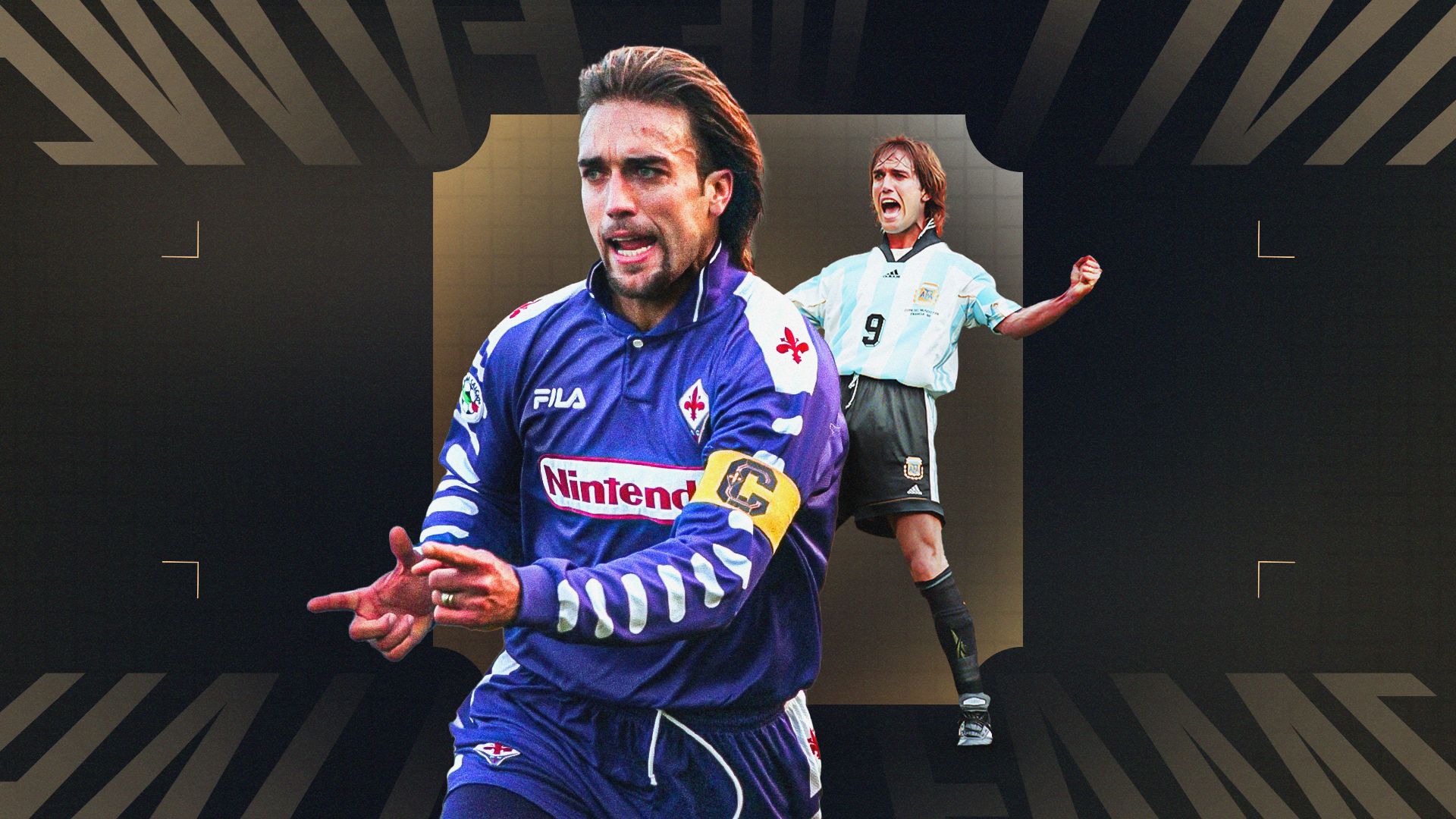

Hall of Fame XIX – Gabriel Batistuta, the centre-forward who did not enjoy playing football
“I did not enjoy playing football.” Coming from Gabriel Omar Batistuta, the words seem almost impossible to reconcile with what we watched on football pitches for years.
Batistuta could make thousands leap from their seats and turn a goal into far more than a goal. The Lion King treated football as a responsibility. He took it seriously, gave himself no leeway and never settled for less. Watching that power, those shots and those celebrations, we had plenty of fun.
Years before his name carried such weight or his face became one of football's most recognisable, I first saw Batistuta play during the Copa América in the summer of 1991, on a small television in a seaside house. I was young, with no real way to judge a striker's quality. But as I watched Argentina play, one question lodged in my mind: “How can he be so much better than everyone else?” Argentina went on to win the tournament and Batistuta finished as its top scorer, with six goals. The record confirms the result, but cannot capture that child's astonishment. It has never faded.
Batistuta never portrayed himself as a talent destined for greatness, one of those players for whom football seems a birthright. He forged himself through hard work, discipline and relentless self-demands. He had immense talent, but knowing that was never enough: he had to prove it every time, preferably with a goal, then another.
In Florence, that mentality meant more than goals. Batistuta was a centre-forward who could strike the ball with astonishing ferocity, but he conveyed power in everything he did, even without the ball: in his running, the way he planted his feet and shielded possession, and his ability to withstand a defender's challenge before breaking forward. His body seemed built to overpower opponents. Every movement held force ready to explode, a sensation as immediate to those in the stadium as the sound of one of his shots striking the crossbar or hitting the back of the net.
His celebrations carried that same power. They never seemed tacked on after a goal, but flowed from it. There was the run towards the corner flag, the warrior's pose that would become a statue beneath the Curva Fiesole and the machine-gun gesture he used to celebrate goals. Each had the same unrestrained energy. Batistuta did not just score. Every time the ball went in, he seemed to release something.
The machine-gun gesture had a more personal story behind it. Luciano Dati, Fiorentina's long-serving masseur, had formed a special bond with Batistuta. He even followed him to France during the 1998 World Cup, reaching him and treating him in secret at Argentina's training camp. Their closeness also gave rise to the nickname 007: Dati had a shirt made with the number seven drawn to look like a gun and, jokingly, asked Batistuta to shoot at him when he scored. The centre-forward obliged on 20 September 1998, in Vicenza, miming a machine gun in celebration for the first time. The gesture became one of his trademarks. Batistuta's shirt also bore a goal counter, which Luciano Dati updated after every goal. Match by match, it made visible the Argentine centre-forward's pursuit of a tally that never seemed enough. Those celebrations also showed his bond with someone who stood by him away from the spotlight.
Even a Batistuta hat-trick could be overshadowed by an image from the same match. On 21 June 1994, at the World Cup in the United States, Argentina beat Greece 4-0. Batistuta scored three goals, two in the first half and a late penalty, but another celebration, Diego Maradona's, became the match's defining image. After Argentina's third goal, the Diez ran towards a camera and shouted out his joy, creating one of the tournament's most famous scenes. Batistuta's hat-trick remains in the record books, while Maradona's dash lives on in the memories of those who watched that World Cup. Nothing against Diego, of course, but Batistuta scored three times that day and another man's celebration took the spotlight. Football's memory chose one image and left everything else, even a hat-trick, a step behind.
Another image from Batistuta's time at Fiorentina tells a different story. On 7 February 1999, at the Franchi, Fiorentina drew 0-0 with AC Milan in a match that marked a turning point in the season of Giovanni Trapattoni's side, who were still top of the table. Late on, Batistuta raced towards goal, but his run stopped abruptly: he injured his left knee and had to leave the pitch. One moment he was bearing down on goal. The next he lay on the Franchi turf. At that same moment, Fiorentina's pursuit of a Serie A title also seemed to stop, just as Florence had begun to believe they could win it. His injury was not the only reason that dream faded, and Fiorentina still finished third in the league. But that fall captured a season and a city suddenly facing an enormous obstacle when they seemed capable of going all the way.
The title that had eluded him in Florence came with Roma in the 2000-01 season. Batistuta helped them win Serie A with 20 league goals and scored in the final match, a 3-1 win over Parma that gave Roma their third title. It was not the triumph he had dreamed of in a Fiorentina shirt. For years, he had driven a team and a city towards a goal they never reached, but the Roma title completed the journey of a centre-forward who left a profound mark wherever he played. He finally won the title in Rome without losing his bond with Florence, where his name had come to mean more than that of a great striker.
His words still surprise those fortunate enough to have watched him play. He did not enjoy himself or allow himself to, feeling the weight of responsibility towards those who had paid to see him. He brought absolute seriousness, discipline and a hunger to demand ever more of himself to the game. Meanwhile, those watching on screens and from the stands enjoyed every moment, waiting for his next shot as though it might bring something they would never see again.
Perhaps Gabriel Batistuta did not enjoy playing football. But he certainly made it a joy for us to watch.
I still return to that seaside house, that television and the child who could not yet explain why, but knew he was watching something different: “How can he be so much better than everyone else?” More than 30 years have passed, and that question has lost none of its force.


