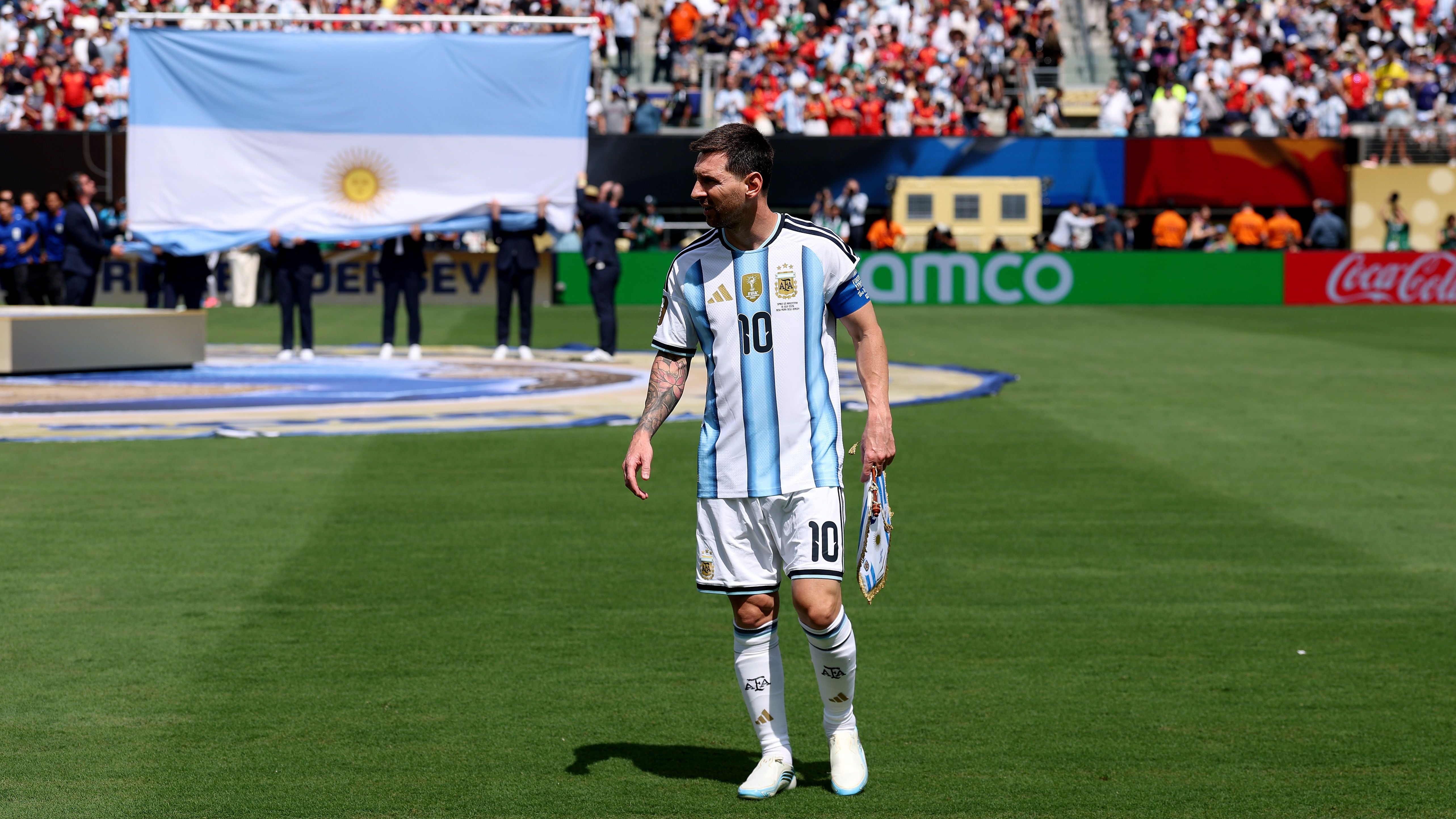

From harsh comparisons to the status of the greats: Messi bids farewell to Argentina without a perfect ending
Lionel Messi brought the curtain down on an exceptional international career today, announcing his retirement shortly after inspiring Argentina to a second successive World Cup final.
He is thirty-nine now, two decades on from his first appearance on football's biggest stage. And he has chosen to write the final word, having long since mended a complicated relationship with the Albiceleste that once threatened to derail his career.
Maradona's shadow and an entire legacy: denied the perfect farewell
The Reuters agency published a report shedding light on Messi's remarkable career. The record eight-time Ballon d'Or winner now retires as a World Cup champion and a two-time Copa América winner, the man who stepped out of Diego Maradona's immense shadow to forge an Argentine legacy entirely his own.
Defeat to Spain in the 2026 World Cup final denied Messi the perfect farewell and a second world crown. But after a career that reshaped Barcelona, Argentina and modern football itself, he had precious little left to prove.
Four years ago in Qatar, he finally lifted the trophy he had chased his whole career. He scored seven goals in the tournament and two in the final against France before Argentina triumphed on penalties. That was the crowning moment of an exceptional career and the peak of one of football's most compelling stories of perseverance. For all his successes with Barcelona, where his genius delivered every major individual and collective honour going, Messi's relationship with the Argentina shirt was for years defined as much by what he had not won as by what he had. He reached the 2014 World Cup final in Brazil, only for Argentina to lose to Germany after extra time. Back-to-back Copa América final defeats in 2015 and 2016 then deepened the fear that international glory might slip through his hands.
Messi the record-breaker: Scaloni's side changes the story
The second of those defeats, against Chile on penalties, broke him. Messi retired, if only briefly. "The national team is over for me," he said. It was not over, though. He came back, and the story slowly changed.
Lionel Scaloni built a team around his captain without leaning on him entirely. He surrounded the ageing number 10 with energy, drive and collective commitment, and those qualities let his genius flourish.
Everything turned at the Copa América 2021. Argentina beat Brazil at the Maracanã, and Messi had his first major international title with the senior side.
The report continued: "Then came the World Cup 18 months later. Messi was superb in Qatar, delivering goals, decisive assists and moments of inspiration, as Argentina recovered from a shocking defeat in their opening match against Saudi Arabia to reach the final. He scored twice against France, before scoring in the penalty shootout, to finally lift the trophy that had become the missing piece in his case to stand alongside, or above, the greatest players in football. And for Argentina, this triumph completed Messi's transformation too."
A shy teenager: the comparisons with Maradona have not disappeared.. but!
That shy teenager who left Rosario for Barcelona at thirteen, sometimes cast in his own country as more Catalan than Argentine, became the undisputed captain of the national team.
The tears and frustrations of previous failures turned into songs, murals and celebrations. Comparisons with Maradona did not disappear, but they no longer carried the same accusatory weight. Messi became Messi of Argentina. He could have stopped then. Instead he carried on, moving from Paris Saint-Germain to Inter Miami, helping Argentina retain the Copa América in 2024 before one final tilt at the World Cup.
By 2026, the explosive pace that used to leave defenders helpless had inevitably faded. He adapted. He walked more, waited more, picked his moments, conserving his energy while younger legs around him did the work. His essential qualities remained: his awareness of space, the accuracy of his passing, his ability to change a match with a single touch. In return, Argentina changed with him.
A veteran team: battle-hardened
The team that reached the final on 19 July is no longer merely a group of players looking to Messi for salvation. Battles have forged a seasoned side, one accustomed to winning and shaped over years of playing alongside its captain.
That transformation let Messi extend his international career far beyond what once seemed possible, and leave the game on his own terms. His numbers place him among the giants of international football. Yet statistics alone cannot capture his journey from expectation to rejection, then from heartache to adoration. For years, every defeat was cast as proof of what separated him from Maradona.
In the end, that debate became largely irrelevant. One of them led Argentina to the World Cup in 1986. The other did so in 2022 after years of trying, then returned four years later to carry his country to within touching distance of another title. He leaves the national team a man who shaped the history of Argentine football.