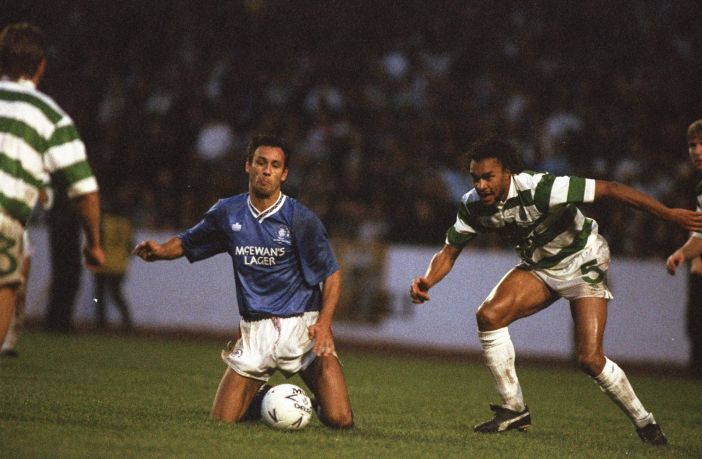

Ex-Celt Paul Elliot on experiencing racism in sectarian stained Scotland
Former Celtic defender Paul Elliot is currently backing a new welcoming campaign aimed at Kicking Racism out of Football, and has been speaking in depth about his own experiences in the game, in an era when the cancer that is racism was unfortunately rife.
Paul was the first black captain in the English top flight, and gave some insight into the abuse he received himself on a regular basis, with one tale describing the moment a supporter through a banana at him.
The former Charlton, Luton, Aston Villa, and Chelsea defender recalled “He thought it would destroy my game. I took a bite, threw it back – then scored the winner against his team.”
Billy McNeill signed Paul for Celtic in 1989 for a fee believed to be £600,000 from Italian side Pisa, and he became the first black player to play for the club in the modern era.
By the time Paul had left Celtic in 1991, he had become a popular figure among the Celtic supporters, but spoke of his experiences when he first arrived, and the mix of racism and sectarianism that was rife in the Scottish game.
Unfortunately some Celtic supporters were also guilty of spouting racist nonsense, but thankfully only the minority, but even then it was still a stain on our club, and thankfully we’ve come a long way since those days.
“In Scotland it was racism combined with sectarianism. I was Celtic’s first black player in the modern era, the first black Player Of The Year. But you already had sectarianism inbuilt. There was this dark side, a hundred years of history before me and that perpetuated racism,” Paul Elliott said, as reported by Glasgow Live.
“My childhood friend Mark Walters was playing for Rangers. That added to the whole intensity, we were the two pioneers, two high profile black players playing for the biggest clubs in Scotland. We had the most horrific abuse, I even got abuse from a minority of Celtic fans.
“I remember how some of our fans utterly abused Mark and vice versa. People even asked me socially: ‘Why are you talking to him?’ I said he was one of my best mates in football since playing together for England at 15. Now they have seven or eight black players. It’s become the norm.
“I was 25 years of age and what was the best way to get people onside? The quality of what you do on the field of play. It was all those accolades I won there , leveraging my power to make that contribution and say to people: ‘Don’t judge me by the colour of my skin but by my ability on the pitch’.
Despite his experience with racism in this country, Paul has nothing but good memories of the Scottish public.
Paul Elliott said: “My memory is that most of them were the most wonderful people you could ever meet in terms of their humour, their fun loving. Now it’s fantastic. They have embraced diversity.
“Look at the number of black players across the Scottish Premier League, I am very proud of that because it’s the legacy of what I achieved, giving other clubs the confidence to go out and sign black players. It’s the same with Mark as well.
“I am also proud of how many people say they remember me with such affection. I go back every year to the Player Of The Year awards. They are wonderful people but it’s like everywhere, the majority are decent, it’s the minority.”
Paul Elliott was signed by Billy McNeill from Serie A side Pisa in 1989 for a fee of £650,000. The former Luton Town and Aston Villa man didn’t have the best of times in Italy, but the experience he picked up in the then best league in the world made him a better all round player.
And so it proved at Celtic, despite not having the best of starts mainly due to injury, he proved himself a very popular player amongst the supporters with his sterling performances. He was strong, tall and athletic and always gave one hundred percent. He was also a goal threat grabbing 5 goals in his 66 appearances for the club.
Two of them most notably against Rangers although we did lose both games, one of them the league cup final of 1990. Paul like a few players at that time suffered by playing in a poor side, and deserved much better. He along with Paul McStay and John Collins had far better quality than the rest of the team.
Paul Elliott sadly only spent two seasons at the club and left due to personal reasons, which was a shame as he was the best central defender to play for the club in that era. He would have graced any Celtic side, he was that good.
He signed for Chelsea in 1991 for £1.25 million much to the disappointment of the Celtic support. But Paul was homesick and wanted what was best for him and his family so a move back to his native London made sense for him and the supporters bear him no grudge.
Big things were expected of Paul in England but sadly his career ended after sustaining a serious knee injury after a tackle by Liverpool’s Dean Saunders in September 1992. He typically battled to come back, but two years later he sadly had to announce his retirement from the game at the age of 30.
Paul Elliott will always be fondly remembered by the Celtic supporters who had the pleasure to see him in the Hoops, and I am certainly one of them.