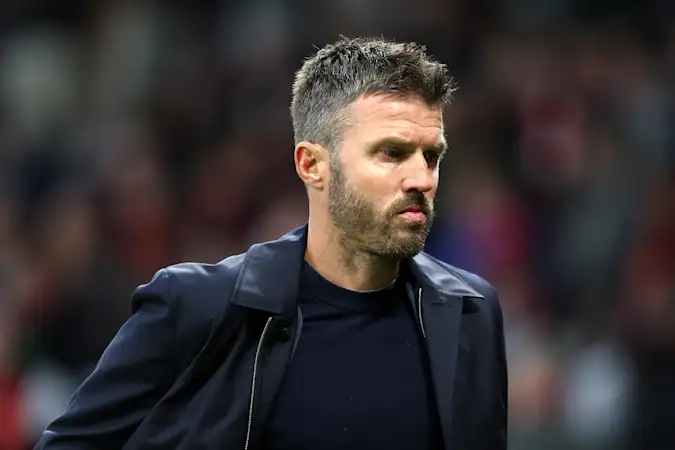
Manchester United’s defeat to Atletico in the Spanish capital on Tuesday night has halted their early momentum in this season’s Champions League campaign. After beating Sabah on Matchday 1, the loss marks Michael Carrick’s first European defeat as the club’s permanent manager.
The reverse against Diego Simeone’s men has placed the Old Trafford outfit further under the microscope. Although Carrick earned the right to be considered for the United job permanently over the summer, he has yet to reproduce last season’s form.
That has already led observers to question how long the former United midfielder will remain in charge at the Theatre of Dreams. If the club’s sluggish start to the season continues, could it mean another managerial nightmare in the red half of Manchester?
Of course, nobody knows how long Carrick’s tenure will last at United, but with a club of this stature, we can at least look at its history to understand the circumstances under which his predecessors departed.
Since Sir Alex Ferguson brought his legendary spell at Old Trafford to an end in 2013, six permanent managers have tried and failed to restore United to their former heights – none of the half-dozen has overseen Premier League title success during that spell.
From David Moyes to Ruben Amorim, each has experienced a different journey, but all have ultimately been judged against the expectations that come with managing one of football’s biggest clubs.
Yet managerial dismissals rarely tell the full story on their own. League position, overall win percentage and the run of results immediately before departure can offer a clearer picture of how each tenure was unfolding when the club decided to act.
With Carrick now facing questions of his own, how does his current record compare with the final 10 Premier League matches of the six permanent managers who came before him? Do the numbers suggest that he is following a familiar path?
WIN PERCENTAGE
Manager | P | W | D | L | Win % |
David Moyes | 51 | 27 | 9 | 15 | 52.94% |
Louis van Gaal | 103 | 54 | 25 | 24 | 52.43% |
José Mourinho | 144 | 84 | 32 | 28 | 58.33% |
Ole Gunnar Solskjær | 168 | 91 | 37 | 40 | 54.17% |
Erik ten Hag | 128 | 70 | 23 | 35 | 54.69% |
Ruben Amorim | 63 | 24 | 18 | 21 | 38.10% |
Michael Carrick | 26 | 14 | 6 | 6 | 53.85% |
Win percentage offers one way to assess a manager’s record, but it does not tell the whole story at Manchester United. With only 26 games in permanent charge, Carrick’s figures are based on a smaller sample than those of most of his predecessors.
His 53.85% win rate places him fourth among the seven managers in this comparison. Jose Mourinho, Erik ten Hag and Ole Gunnar Solskjær all recorded higher percentages during their respective tenures, yet none restored United to Premier League title-winning status.
These figures demonstrate that even a relatively strong win rate offers no guarantee of success against the expectations at Old Trafford, and if we were to rank the table in order of win percentage, it would look as follows:
Manager | P | W | D | L | Win % |
José Mourinho | 144 | 84 | 32 | 28 | 58.33% |
Erik ten Hag | 128 | 70 | 23 | 35 | 54.69% |
Ole Gunnar Solskjær | 168 | 91 | 37 | 40 | 54.17% |
Michael Carrick | 26 | 14 | 6 | 6 | 53.85% |
David Moyes | 51 | 27 | 9 | 15 | 52.94% |
Louis van Gaal | 103 | 54 | 25 | 24 | 52.43% |
Ruben Amorim | 63 | 24 | 18 | 21 | 38.10% |
José Mourinho came closest to the 60% benchmark before his dismissal in December 2018. Across 144 competitive games in charge, the Portuguese manager recorded 84 wins, giving him a win percentage of 58.33%.
Mourinho’s win percentage puts him comfortably ahead of Erik ten Hag in second as the Dutchman earned 70 wins from 128 attempts to give him a win percentage of 54.69% - 0.52 percentage points higher than Ole Gunnar Solskjaer in third.
Ole Gunnar Solskjær’s win percentage is only marginally higher than Carrick’s. The Wallsend-born manager has recorded 14 wins in his 26 games in permanent charge, giving him a win rate of 53.85%. For further context, Carrick recorded 12 wins in 17 matches during his interim spell last season.
Then again, Carrick’s record is not as poor as David Moyes’ record, and with the Scot only being handed 25 more games in charge of United than the club’s current boss, his 51 visits to the technical area only recorded 27 wins (52.94%).
Moyes’ win percentage was just 0.51 percentage points higher than that of Louis van Gaal. The Dutchman managed more than twice as many games as Moyes, but recorded 54 wins from 103 matches, leaving him sixth in the ranking.
Which leaves us with Ruben Amorim bringing up the rear, and with the former Sporting manager only getting 63 games in charge, a return of 24 wins resulted in a win percentage of just 38.10% or just under four wins for every 10 games overseen.
Another interesting feature in this table is the fact that even reaching 100 games in charge seems to be some form of milestone in the post-Ferguson era. Van Gaal only just got over the marker; the three men with the highest win percentages were also members of the century club.
The same luxury was not afforded to either Moyes or Amorim, and on current form, it seems unlikely that Carrick will be an esteemed member of the club either. However, there is arguably a better way to compare the seven managers, and this is by looking at how they fared in each of their final 10 league games:
THE END OF THE ROAD
Manager | W | D | L | Points | PPG | Immediate trigger/context |
Louis van Gaal | 6 | 1 | 3 | 19 | 1.9 | Season-end dismissal after fifth-place finish; FA Cup winner |
David Moyes | 5 | 2 | 3 | 17 | 1.7 | 0-2 away defeat to Everton |
José Mourinho | 4 | 4 | 2 | 16 | 1.6 | 1-3 away defeat to Liverpool |
Michael Carrick | 4 | 4 | 2 | 16 | 1.6 | N/A |
Erik ten Hag | 4 | 2 | 4 | 14 | 1.4 | 1-2 away defeat to West Ham; won 2024 FA Cup |
Ruben Amorim | 3 | 5 | 2 | 14 | 1.4 | 1-1 away draw with Leeds United |
Ole Gunnar Solskjær | 4 | 1 | 5 | 13 | 1.3 | 1-4 away defeat to Watford |
Louis van Gaal may have made the best of it by picking up 19 points from the last 30 he contested; he also managed to win the FA Cup in 2016. However, that success over Crystal Palace was not enough to keep him in the job after also missing out on Champions League qualification.
His record was 0.2 PPG better than that of David Moyes, who lasted less than a whole season in charge as Sir Alex Ferguson’s direct predecessor. The final straw was a 2-0 defeat at former club Everton after picking up 17 points from the last 30 on offer.
That record was still better than that of Jose Mourinho, as he collected 16 points from 30. However, a 3-1 away defeat to arch-rivals Liverpool was considered the final straw as the ‘Special One’ lost some of his gleam at Anfield.
While that 1.6 PPG is the same as what Michael Carrick finds himself on at the time of writing. His last 10 league outings have also returned four wins, four draws and two losses – the same as Mourinho before he was elbowed out of Old Trafford.
Carrick’s own record is still better than that of the remaining trio of Erik ten Hag, Ruben Amorim and Ole Gunnar Solskjaer, but the worrying thing is that he is within the range of results associated with previous dismissals
Then again, the greater concern will be the league position that each of the managers had placed United in before their departure, and if you were operating on this metric alone, the picture does not look good for United’s current boss.
Only Erik ten Hag had a worse league position before his sacking, as the former Ajax boss had the Red Devils sitting in 14th before the club’s board deemed that enough was enough. At the time of writing, United sit 13th in the Premier League.
Set those two outliers aside and every other manager in the comparison departed with United sitting between fifth and seventh in the table. That is a striking pattern, particularly when Carrick’s recent points return is comparable with Mourinho’s final 10 league matches.
The evidence does not establish that Carrick is destined to follow his predecessors, but it does highlight the tension between respectable recent results and an underwhelming league position. At Old Trafford, the standard is not simply to avoid a collapse. It is to compete at the top end of the table.
Perhaps that is the real problem for Manchester United. The expectation remains that the club should be challenging for the biggest honours, but the managerial history since Ferguson suggests that meeting that expectation has become increasingly difficult.
For Carrick, the challenge is to turn a decent run of results into a meaningful improvement in the league table before history begins to catch up with him. The overriding question is whether he will be given enough time to do so.