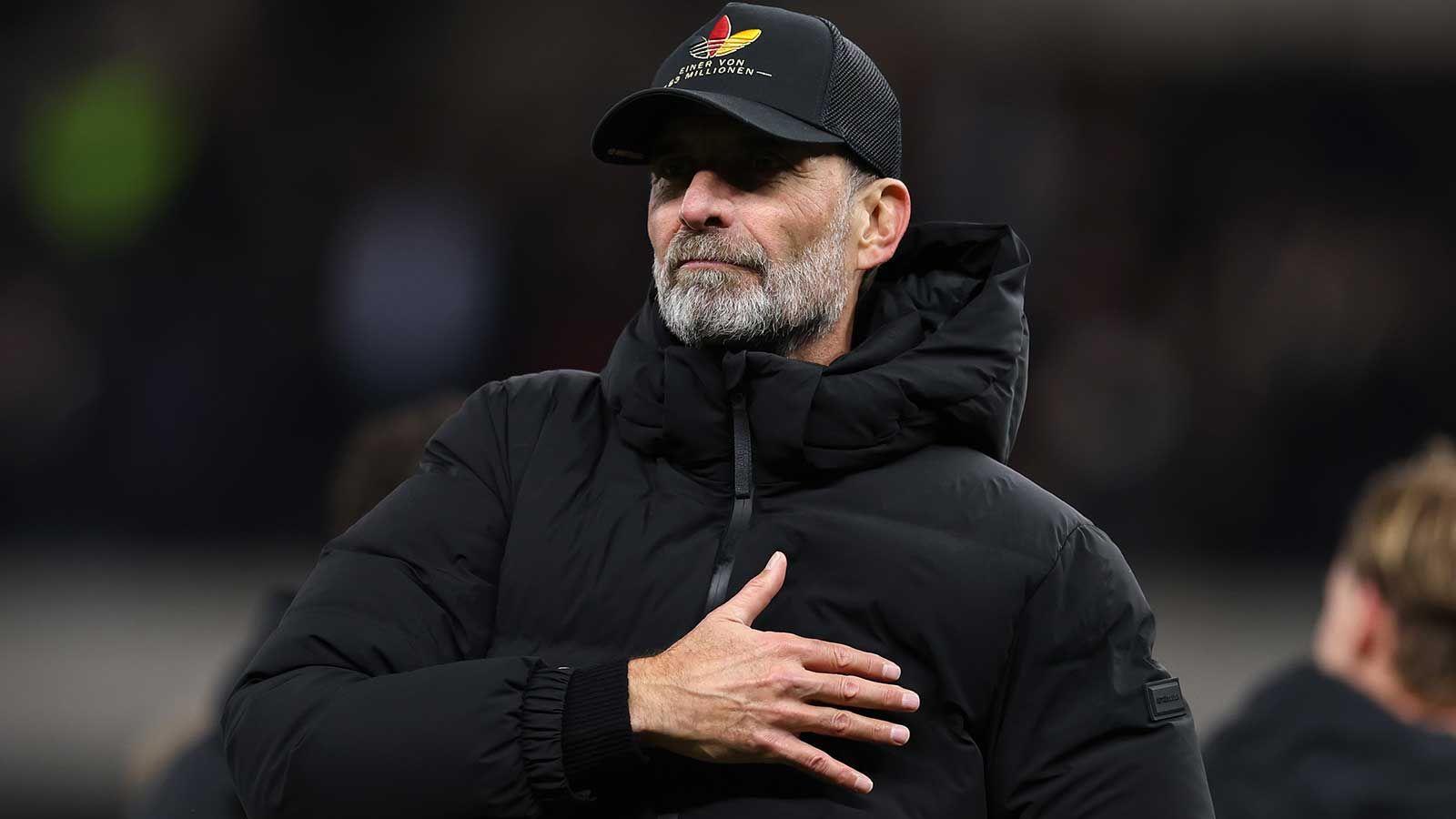

Jürgen Klopp achieves on a Monday in November what Julian Nagelsmann needed a home Euros to do: Three aspects of a stirring Germany win
Jürgen Klopp has sparked on an ordinary Monday evening in November the kind of euphoria Julian Nagelsmann only truly achieved at the home Euros. Plus: a spine-tingling moment for a Berlin boy and a winner almost lost among the standout performers.
Neighbourly rivalry and the clash between Germany and the Netherlands gave this meeting an edge, as did the Nations League group standings. The stakes went a little beyond football, too. Still, a cold Monday evening in Berlin in mid-November was a long way from the significance of a major tournament on home soil.
Yet the crowd was buzzing even before Germany’s stirring 5-0 win. The Olympiastadion crackled before kick-off. Fans sang the anthem and waited in anticipation. This Germany team can stir that feeling on an ordinary November evening. They don't need a home Euros.
“When we ran out, every single person was already happy – unless they were wearing an orange shirt. But everyone else really was on our side,” Germany coach Jürgen Klopp said of the atmosphere in the capital after the match on ARD. Much of the credit belongs to him. He stirs emotions and builds a connection without seeming to try, perhaps because he never forces it.
His predecessor Julian Nagelsmann needed the extraordinary occasion of a home tournament to achieve something similar. Palpable euphoria emerged during his almost three-year tenure only around Euro 2024 in Germany. The sheer scale of the event generated much of that emotion. Nagelsmann and his players rode the wave, played a good tournament and thrilled the public.
It is hard to imagine a mid-November Nations League match having the same effect under Nagelsmann, despite his undoubted technical expertise. What does Klopp have that his predecessor did not? The difference is hard to pin down, but one thing stands out: Nagelsmann sometimes seemed to lack the humility towards the job that Klopp conveys so naturally.
They are at very different stages of their coaching careers. Nagelsmann sometimes seemed determined to give his team a solution for every situation, almost as if he wanted to win from the dugout and prove what a brilliant coach he is (as Uli Hoeneß might say). Klopp takes more of a back seat. He sets the direction, but trusts his players to find the answers on the pitch.
At times, Nagelsmann seemed to see the Germany job as the next rung on his career ladder. Since his first press conference, Klopp has given the impression that he neither needs nor wants to prove anything. He even stressed: “Jürgen Klopp has no career after the national team.”
That leaves Klopp free to work without fear of failure. It also makes the 59-year-old easy to believe when he says after the triumph over the Netherlands: “I coached three great clubs and could identify with them very easily. I loved working there, and now I am fortunate enough to work for my home country. What could be greater? There is nothing greater. And that is exactly how it felt.”
Klopp shows greater humility towards the job and knows he must bring the whole country behind the team. He puts that message across with a warmth that feels genuine: “This is a very special group right now. And I know people have heard that a few times before. Our responsibility now is to make that visible and keep it visible. We cannot change the world, but we can show a positive face. And we did that today. Everyone who was here today is going home with a smile,” the Germany coach said.
From playing on closed pitches to a first international goal at the place he dreamed of: Derry Scherhant's fairytale evening
Klopp also talks to his players more than Nagelsmann did. Several have said as much, from Niclas Füllkrug to Florian Wirtz. More importantly, he strengthens their belief in their abilities rather than letting his instructions leave them doubting themselves.
“The lads are still surprising themselves too. Derry Scherhant surely did not think he could put in an international performance like that, in both directions,” Klopp said of one of the stars against the Netherlands. A few months ago, SC Freiburg forward Derry Scherhant would hardly have expected to end the year with four Germany caps and a goal.
“What can I say? It could not have gone better. It is truly unbelievable, I enjoyed it enormously and I am simply overjoyed,” Scherhant told ARD shortly after the final whistle. In the 41st minute, he dribbled towards Real Madrid defender Denzel Dumfries and struck towards the far corner. The ball flew into the net to put Germany ahead.
Visibly moved, Scherhant dropped to his knees and spread his arms towards the sky. Once his team-mates had finished celebrating with him, he pointed firmly at the pitch: his stadium, his city, his home. “I once sat in the Olympiastadion with my best friend and said to him: ‘If I do not play here one day, I have done something wrong.’ I simply had the feeling that one day I had to be down there,” the Berlin-born player recently revealed in an interview with Sports Illustrated.
Back then, playing at the Olympiastadion still felt a long way off, even for Hertha BSC, let alone Germany. “I know what it feels like when you do not play in youth football, when you are overlooked,” Scherhant said of his journey at a Germany press conference a few days ago.
Hertha took no notice of him for years, leaving him to seek opportunities at smaller Berlin clubs. At Viktoria Berlin, he regularly sat on the bench for the under-17s, and his dream of turning professional seemed to drift further away. Scherhant kept working. Alongside club training, he honed his technique, dribbling and finishing: “We were constantly playing one-on-one or shooting at goal on the Tennis Borussia and Makkabi pitches. I still love both to this day,” he explained.
During the coronavirus period, while playing for Tennis Borussia and later Berliner SC, he had to find ways to train because many pitches were closed. “I climbed over the fence every day, dribbled and shot at goal again and again. As difficult as the coronavirus period was for everyone, it helped me a great deal as a footballer,” he once told Sport Bild. “If the authorities were checking one pitch, we simply moved to the other – the facilities are right next to each other,” he told Sports Illustrated.
Shortly afterwards, the then 17-year-old finally joined Hertha at the start of his second under-19 season. “It meant a lot to me to be allowed to move to Hertha at such a late stage – I was the first player in 13 or 14 years to join the club only in his second under-19 year,” Scherhant said.
He broke into Hertha's first team before moving to Freiburg in 2025. His recent Germany performances have made him not only an established Bundesliga player but, for now, a fixture in the national team. Scherhant revealed before the match at his Olympiastadion that he had secured 50 tickets for family and friends.
After those exhilarating 90 minutes, Scherhant celebrated his 24th birthday belatedly. He might have scored a second or even a third goal, but hit the post twice. Still, he produced an outstanding display, taking defenders on, threatening goal and keeping the Dutch back line busy.
“They can both play, my goodness,” Klopp said of Scherhant and his equally impressive fellow winger Brajan Gruda. “But the work they put in and had to put in today – it was immense. And that is what ultimately makes a team. Others can play football too. But in the end, it is about how much passion and effort you put into it,” Klopp said, praising the pair's work without the ball as well.
One big winner for Germany was almost overlooked amid the many standout performances
Scherhant and Gruda lead the way, with two more gifted options in Lennart Karl and Said El Mala for the wings that matter so much in Klopp's system. The new Germany coach is unlocking potential Nagelsmann could have tapped into but never fully embraced. Just a few months after the World Cup, when Leroy Sane was still a regular starter, another Germany appearance for the Galatasaray star in the medium term now feels a world away.
Philipp Treu has also suddenly solved the problem at right-back. He looked like an old hand against the Netherlands, showing remarkable reliability in only his fifth international. And the debates about Joshua Kimmich's best position that often caused friction under Nagelsmann? Those have gone, too. The captain has his place in central midfield and will stay there.
Aleksandar Pavlovic partnered Kimmich in midfield in both of the last two internationals, just as he does at Bayern Munich. The 22-year-old is a big winner from this international break, even if Gruda, Scherhant and Florian Wirtz drew more attention during the goal fest against the Netherlands.
As in the 3-1 win in Serbia, Pavlovic impressed in Berlin on Monday evening with his composure on the ball, intelligent passing, willingness to play forward and important runs off the ball. “For me, he has to be a leader in the way he plays. He is always moving, always trying to move the ball on cleanly,” World Cup winner and ARD pundit Bastian Schweinsteiger said of Pavlovic.
Schweinsteiger also praised the two midfielders' switches of play, which gave the wide players chances to take defenders on. Pavlovic's part in the move for the goal that made it 5-0 showed why. He made himself available for a throw-in halfway inside his own half, spotted space on the opposite flank, carried the ball and then switched it back right to Gruda, who drove forward as the move ended in a goal.
Klopp will have enjoyed that move. “Oh, he can play a bit too,” he had said in special praise of Pavlovic at the press conference after the 2-0 home win over Serbia in early October. “Even if you may have got used to the lad playing like that. I have not known him for very long.”
For now, Pavlovic has the edge over Felix Nmecha, who has also been in good form recently at Borussia Dortmund but has faced scrutiny, in the contest to play alongside Kimmich. Klopp appears to have found part of his team's spine, with players who also line up together at club level. “He has vision, is strong in challenges and covers a lot of ground,” Schweinsteiger continued in his praise of Pavlovic, before underlining his importance: “For me, he is a very important figure in the national team.”