


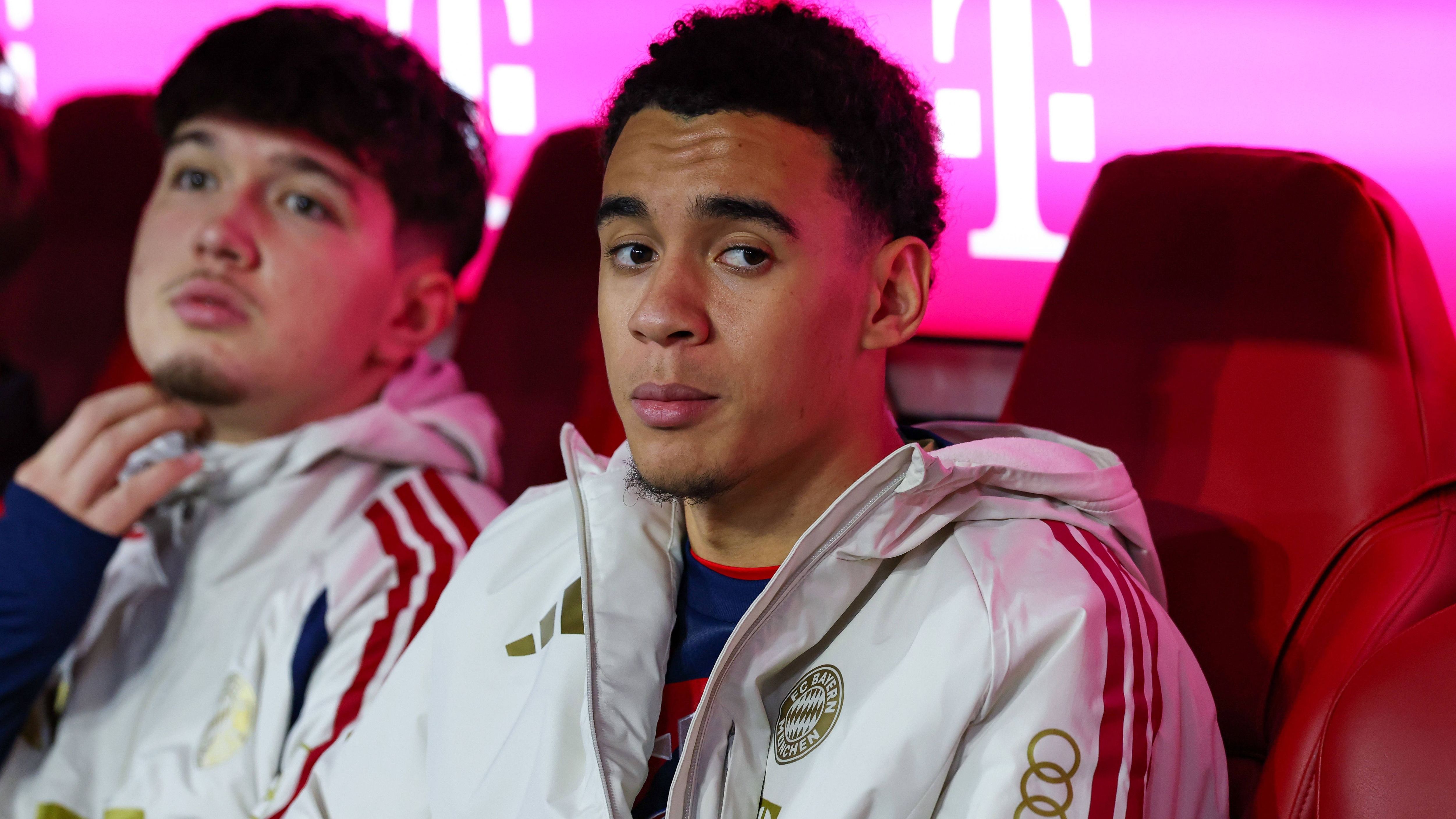

Bayern Munich’s bosses may have good reasons – but their approach to Jamal Musiala is utterly counterproductive
After Uli Hoeneß and Jan-Christian Dreesen, Karl-Heinz Rummenigge has also cast doubt on the once highly praised Jamal Musiala. His interview came at a bad time and revealed plenty. A comment piece.
Bayern Munich announced Jamal Musiala's contract extension on 14 February, of all days. Valentine's Day. Back then, in early 2025, the Bayern bosses seemed to have butterflies in their stomachs. President Herbert Hainer called the deal "a gift for the club and its fans" and said: "Compliments to our sporting management and executive board. Today is a very good day for Bayern Munich."
Those words belong to another time. Munich's leadership now appears united in thinking that Valentine's Day 2025 was a very bad day for Bayern Munich.
Musiala was then at the peak of his powers and one of the world's most promising players. His extension until 2030 guaranteed him an annual salary of €25 million. Since then, he has come nowhere close to justifying that sum, partly because of injuries and health problems for which he is not to blame. The bosses fear he may never justify it. That could mean another discussion about his salary, or, put plainly, a cut.
Munich's bosses are now pushing that view in a remarkable campaign. Club patriarch Uli Hoeneß led the charge two weeks ago, and chief executive Jan-Christian Dreesen followed on Wednesday. Karl-Heinz Rummenigge, who like Hoeneß sits on the supervisory board, then spoke to Sky and used the strongest language yet after Friday's 1-1 draw with 1. FC Köln. The campaign reveals plenty, but right now it is utterly counterproductive.
Rummenigge also undermines hopes of sporting success
Rummenigge's interview capped a disastrous evening for Bayern. At home to relegation candidates 1. FC Köln, they managed only a 1-1 draw. Bayern also lost their two best players, Harry Kane and Michael Olise. There has since been some reassurance over Olise, but Kane will be out for three to four months with a syndesmosis tear. That leaves an already stretched attack in even greater difficulty. Ismael Saibari and Serge Gnabry are also out for weeks, although Luis Diaz could at least return soon.
Musiala's comeback after a two-month injury absence was the one positive against Köln. Then Rummenigge spoiled it with an interview that seemed badly timed. Why escalate this issue now, when Bayern's situation is already so precarious?
For Musiala personally, Rummenigge's interview was troubling. Doubt, rather than confidence, now surrounds his long-awaited return. From the outside, it seems at odds with Bayern Munich's tradition of close-knit support. Instead, the club's highest ranks have effectively made Musiala a target.
Coach Vincent Kompany and sporting director Max Eberl, at least, strongly backed their injury-plagued player, as they had at the previous day's press conference. Their support also underlined the internal differences over Musiala.
Beyond its effect on Musiala personally, Rummenigge's intervention also undermines the injury-hit team's prospects. With so many players out, Musiala is inevitably one of Bayern's few sources of hope. Publicly casting doubt on him now, and so forcefully, is unlikely to help him produce the performances Bayern urgently need or improve their results in the coming matches.
What has happened between Bayern Munich and Jamal Musiala?
Rummenigge's interview makes one thing clear, whatever the timing: there is friction between Bayern Munich and Musiala, or his representatives. Something during the contract extension or afterwards must have displeased the bosses. They must have good reasons for what looks like a coordinated decision to speak out. Their comments also open the door to speculation of every kind, probably quite deliberately.
It is highly unusual for a club to question a mutually agreed contract to this extent. Even if the bosses consider Musiala's salary "no longer viable" without an upturn, as Rummenigge put it, how could they secure the reduction they appear to want?
Musiala would be highly unlikely to agree to a cut voluntarily. Why would he? Contracts are bets. Some pay off, others don't. Sometimes the club wins, sometimes the player does, sometimes both do and sometimes neither does. Everyone has to live with that, provided all sides were honest with one another when they signed.
Bayern Munich: serious doubts over Jamal Musiala's health
Musiala's health remains the central concern, especially after Rummenigge's words. He said of the 23-year-old: "What we know unfortunately suggests that it will be difficult to get back to the level he has so often shown here in this stadium." Read that sentence a second or third time and its full significance sinks in.
Rummenigge did not say what lay behind his assessment: Musiala's neurological dysfunction, the lingering effects of his fibula fracture in summer 2025, or his body's now general susceptibility to injury. Musiala's torn muscle fibre, suffered in mid-September, kept him out for eight weeks, considerably longer than normally expected for such an injury.


