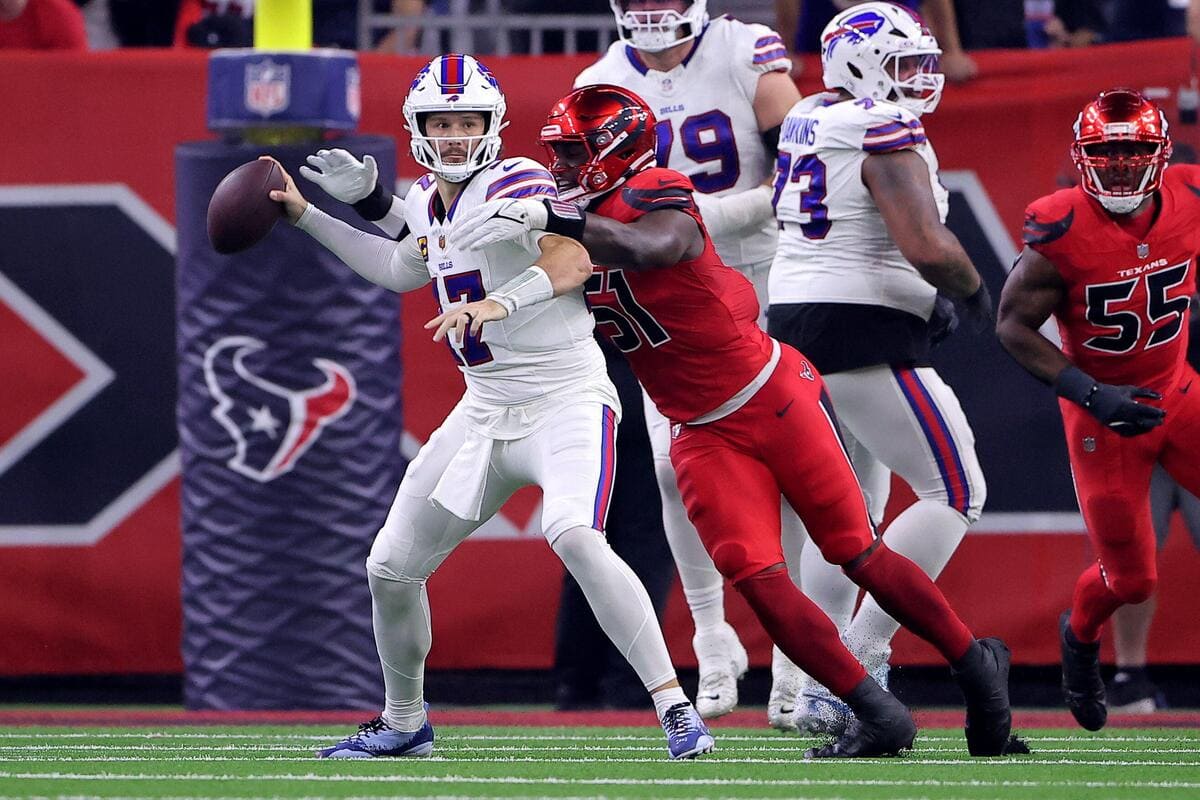
On February 3rd, the 2026 NFL Pro Bowl Games will take place in San Francisco, California. After a skills competition between the AFC and NFC, there will be a seven-on-seven flag football game. With superstars across the board set to participate in all the events, let's look at each positional group and determine which conference has the roster advantage going into next week.
Offense
Quarterbacks
AFC: Josh Allen (Bills), Justin Herbert (Chargers), Shedeur Sanders (Browns)
NFC: Jared Goff (Lions), Dak Prescott (Cowboys), Matthew Stafford (Rams)
The NFC clearly has the advantage when it comes to the quarterback position. Matthew Stafford will likely be named MVP at the NFL Honors on February 5th. On top of that, the NFC roster is equipped with the three regular-season passing leaders. As good as Josh Allen is, this is an exhibition flag football game that will likely not see him use his legs to generate offense. Taking away his running ability makes him a less effective QB. Lastly, the recent addition of Shedeur Sanders just proves how far the Pro Bowl has fallen. People have been comparing his selection to the selection of former Bears QB Mitchell Trubisky in 2018, but that isn't an apt comparison. Trubisky ranked third in QBR that year (71.0). This season, Shedeur Sanders finished the regular season with an 18.9 QBR, the lowest mark of any quarterback who started more than a third of his team's games. The Pro Bowl has devolved from a semi-entertaining All-Star exhibition game into a bastardized popularity contest. Needless to say, I am giving the NFC the edge in this matchup.
Advantage: NFC
Running Backs
AFC: De'Von Achane (Dolphins), James Cook (Bills), Jonathan Taylor (Colts)
NFC: Jahmyr Gibbs (Lions), Christian McCaffrey (49ers), Bijan Robinson (Falcons)
We rarely see teams establish the run in flag football games. Since players can be downed by simply having their flag belts ripped off, running backs don’t carry the same value in flag football games as they do in actual NFL games. Handoffs will be limited, but we’ll probably see running backs utilized more in the passing game. In that case, the NFC has an edge over the AFC. The NFC's running backs finished the season with twice as many receiving yards as the AFC's running backs (2,360 vs. 1,157). Plus, the NFC backs average a full yard more per reception than the AFC backs (9.15 vs. 7.92). In a traditional NFL game, I would favor the AFC because they have better pure runners, but in a flag football game, the NFC has the upper hand.
Advantage: NFC
Wide Receivers
AFC: Ja'Marr Chase (Bengals), Nico Collins (Texans), Tee Higgins (Bengals), Courtland Sutton (Broncos)
NFC: CeeDee Lamb (Cowboys), Puka Nacua (Rams), George Pickens (Cowboys), Jaxon Smith-Njigba (Seahawks), Amon-Ra St. Brown (Lions)
Considering the Seahawks are playing in the Super Bowl, I don't expect Jaxon Smith-Njigba to play a huge role in the 2026 NFL Pro Bowl Games. That's probably why Cowboys wideout CeeDee Lamb was added to the NFC's roster. Even with Smith-Njigba's expected absence, the NFC has a much better wide receiver group than the AFC. Puka Nacua has played like the best receiver in the NFL this year. CeeDee Lamb and George Pickens both went over 1,000 receiving yards this season. Amon-Ra St. Brown leads all Pro Bowl wide receivers in touchdown catches (11). In a game that will be dictated by passing and moving the ball through the air, the NFC's group of wideouts is more talented and statistically better than the AFC's wide receiver room.
Advantage: NFC
Tight Ends
AFC: Dalton Kincaid (Bills), Tyler Warren (Colts)
NFC: Jake Ferguson (Cowboys), Trey McBride (Cardinals)
Based on the original Pro Bowl selections (Travis Kelce and Brock Bowers in the AFC; George Kittle and Trey McBride in the NFC), I would've taken the AFC's tight ends without question. Now that three of the four tight ends initially selected for the Pro Bowl have been replaced, Trey McBride is undoubtedly the best player in this group. However, a part of tight end success comes from having an established rapport with the person throwing them the ball. In that case, the advantage goes to the AFC because Dalton Kincaid will get to spend most of the game catching passes from his quarterback, Josh Allen. On the NFC side, Dak Prescott will likely be a second-stringer and will not be able to throw the ball much to his tight end, Jake Ferguson. Also, Tyler Warren has more pure talent than any other tight end expected to play in the Pro Bowl this year.
Advantage: AFC
Offensive Line
AFC: Joe Alt (Chargers), Garrett Bolles (Broncos), Dion Dawkins (Bills), Creed Humphrey (Chiefs), Tyler Linderbaum (Ravens), Quinn Meinerz (Broncos), Quenton Nelson (Colts), Trey Smith (Chiefs)
NFC: Drew Dalman (Bears), Cam Jurgens (Eagles), Chris Lindstrom (Falcons), Penei Sewell (Lions), Tyler Smith (Cowboys), Joe Thuney (Bears), Tristan Wirfs (Buccaneers), Trent Williams (49ers)
Linemen being elected to the 2026 NFL Pro Bowl Games is just for show, if we're being honest. In seven-on-seven flag football games, there is only one offensive lineman on the field at a time. That's the center, and after they snap the ball to the quarterback, they take a knee and basically remove themselves from the active play. The linemen will likely be involved in the skills competition portion of the Pro Bowl Games. Since those events require more athleticism, I’m favoring the AFC over the NFC. The average AFC Pro Bowl lineman is a full year younger than the average NFC Pro Bowl Lineman (27.4 vs. 28.4). Though both groups average the same weight (315 lbs.), AFC linemen are taller than the NFC's linemen. The youth and height of the AFC's group make them a better option in skills competitions.
Advantage: AFC
Defense
Defensive Line
AFC: Zach Allen (Broncos), Will Anderson Jr. (Texans), Maxx Crosby (Raiders), Myles Garrett (Browns), Chris Jones (Chiefs), Jeffrey Simmons (Titans)
NFC: Jalen Carter (Eagles), Aidan Hutchinson (Lions), Micah Parsons (Packers), DeMarcus Lawrence (Seahawks), Leonard Williams (Seahawks), Quinnen Williams (Cowboys)
As is the case for offensive linemen, defensive linemen don't really play a part in the flag football game. They’ll be more involved in the skills competitions, and in that case, the AFC has a clear advantage. The NFC is without its best pass rusher, Micah Parsons, who is still recovering from a torn ACL. Myles Garrett and Will Anderson Jr. are athletic freaks. That's also true for Jeffrey Simmons, who had a ridiculous 11 sacks on the season despite being a defensive tackle. Also, DeMarcus Lawrence and Leonard Williams probably won't be too involved as they prepare for the Super Bowl. The AFC will have its full arsenal of weapons along the defensive front, while the NFC will likely have to go into the Pro Bowl Games without three of its best contributors.
Advantage: AFC
Outside Linebackers
AFC: Nik Bonitto (Broncos), Devin Lloyd (Jaguars), Tuli Tuipulotu (Chargers)
NFC: Brian Burns (Giants), Jared Verse (Rams), Byron Young (Rams)
The term outside linebacker doesn't mean what it used to. Long gone are the days of Derrick Brooks, Lance Briggs, and Joey Porter, who were true off-ball linebackers that could stop the run, drop into coverage, and rush the passer when asked to. Nowadays, outside linebackers are mostly just edge rushers who are tasked with getting after the passer. In fact, the only pure outside linebacker participating in the Pro Bowl is Devin Lloyd, and he had just 81 total tackles on the season. Nik Bonitto might be the best pass-rushing outside linebacker in this group, but Brian Burns, Jared Verse, and Byron Young are just as good as him in that category and can actually make a lot of contributions beyond just getting after the quarterback. Considering these guys will be asked to drop into coverage a lot during the actual flag football game, I'm favoring the NFC group.
Advantage: NFC
Inside Linebackers
AFC: Azeez Al-Shaair (Texans), Roquan Smith (Ravens)
NFC: Zack Baun (Eagles), Jack Campbell (Lions)
The inside linebackers are the true do-it-all players amongst NFL front-seven defenders. They have to be able to play the run and the pass while also calling plays for the defense. In terms of the flag football game, these guys need to be able to make "tackles," but more importantly, play well in pass coverage. Roquan Smith has long been viewed as one of the NFL's best linebackers in pass coverage. In fact, he’s the best coverage linebacker in the 2026 Pro Bowl. Meanwhile, Azeez Al-Shaair made a name for himself in that category, too, leading all Pro Bowl inside linebackers with nine passes defended this season. Though Baun and Campbell put up similar statistics, I’m leaning towards the AFC since Roquan Smith is still the best middle linebacker in the NFL, in my opinion.
Advantage: AFC
Cornerbacks
AFC: Kamari Lassiter (Texans), Derek Stingley Jr. (Texans), Pat Surtain II (Broncos), Denzel Ward (Browns)
NFC: Cooper DeJean (Eagles), Jaycee Horn (Panthers), Keisean Nixon (Packers), Nahshon Wright (Bears)
Defending the pass and recording interceptions are way more important for cornerbacks participating in the Pro Bowl than making tackles or laying hard hits on opposing players. The AFC's cornerback group is way better at pass coverage than the NFC's corners. Casual fans will think the NFC has the better group because they recorded more interceptions during the regular season (13 vs. 10). However, the AFC is better in pass coverage. The four AFC cornerbacks only averaged 36.5 receptions allowed during the regular season. As for the NFC, their cornerbacks allowed an average of 46.5 receptions this season, ten more than the AFC's group. Also, the NFC group gave up a reception once every 12.8 coverage snaps, while the AFC’s cornerbacks allowed a catch once every 15.2 snaps. The NFC might have had more exciting plays this season, but you want the AFC’s guys in a flag football game.
Advantage: AFC
Safeties
AFC: Calen Bullock (Texans), Kyle Hamilton (Ravens), Derwin James Jr. (Chargers)
NFC: Budda Baker (Cardinals), Kevin Byard (Bears), Antoine Winfield Jr. (Buccaneers)
In flag football games, the safeties have to be able to do everything. "Tackling" is important because they're the last line of defense, but they also have to be good in pass coverage. According to Pro Football Focus, Hamilton, Bullock, and James had an average safety grade of 78.8. That's well above the average grade of Baker, Byard, and Winfield (66.2). Plus, the AFC's safeties have a much lower passer rating allowed when targeted (76.9 vs 98.1). To put it in terms of quarterbacks this season, passers who target the NFC's safeties put up almost the same passer rating as Jalen Hurts (98.5). When QBs target the AFC's safeties, they have basically the same passer rating as Russell Wilson (77.4). Give me the group that makes opposing quarterbacks look like 2025-26 Russell Wilson.
Advantage: AFC
Special Teams
AFC: Cameron Dicker (Chargers), Chimere Dike (Titans), Ross Matiscik (Jaguars), Ben Skowronek (Steelers), Jordan Stout (Ravens)
NFC: Brandon Aubrey (Cowboys), Luke Gifford (49ers), KaVontae Turpin (Cowboys), Tress Way (Commanders), Jon Weeks (49ers)
The fact that Seattle's Rashid Shaheed isn't playing in the Pro Bowl Games makes this a slightly harder decision, but at the end of the day, it was always going to be the NFC. Brandon Aubrey is the best kicker in football, as proven by the fact that he made three of four field goal attempts this season from 60+ yards. The Cowboys have an insane amount of confidence in Aubrey, which is why he led the NFL in field goal attempts of at least 50 yards with 17 attempts. By comparison, the Chargers' Cameron Dicker didn’t attempt any 60+-yard field goals and only made five kicks of at least 50 yards. On attempts of 49 yards or less, Brandon Aubrey went 25/25, while Dicker was 33/35. Brandon Aubrey gives the NFC an edge on special teams.
Advantage: NFC
Best Roster
Offensively, the NFC is better, but the AFC has a better defense. If this were a traditional football game, I would be slightly inclined to give the AFC the roster advantage. But in a flag football game, the NFC is better positioned than the AFC. The NFC has the advantage at quarterback, wide receiver, and running back, giving them a stellar offensive attack. That’s noteworthy because there will be virtually no defense in this game. In 2023, the AFC and NFC combined for 68 points. In 2024, that number jumped to 123 points, an average of 61.5 points per team. Last year, the AFC and NFC scored 139 combined points, with the winning team putting up 76 points. Considering there will be an obvious emphasis on offense, an injured Josh Allen and Justin Herbert, combined with Shedeur Sanders, do not bode well for the AFC, while the NFC is led by Matthew Stafford, Dak Prescott, and Jared Goff. The NFC is better equipped for this game than the AFC.
Advantage: NFC