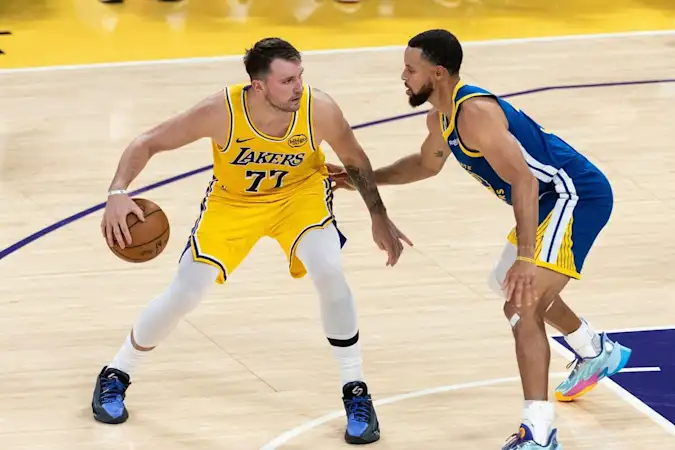
For decades, the NBA has flirted with Europe in the way global superpowers often do: exhibition games, branding partnerships, grassroots camps and academies, and the steady exportation of elite talent, which Europe is stuffed with. In fact, the NBA’s new main faces hail from France, Finland, Lithuania, Serbia, Germany and Slovenia, amongst other nations. This week, however, the conversation shifted. Reports emerged that the league is actively exploring NBA Europe - a fully fledged, NBA-run competition on European soil.
It is a proposal that, at first, sounds both thrilling and bewildering. An American league deepening its presence in a continent built on open pyramids, promotion and relegation, and fiercely protected domestic competitions. To understand why this idea excites some fans and alarms others, it first needs serious unpacking. So let’s tip off with the basics:
What is NBA Europe?
At its core, NBA Europe would be a new top-tier continental competition, created in partnership with FIBA, designed to sit alongside Europe’s domestic leagues rather than replace them. It is not a rebrand of the EuroLeague, nor a breakaway closed shop. Instead, it borrows heavily from football’s Champions League model: a premium tournament layered on top of national competitions, with qualification earned on the court.
At launch, the proposed structure would feature 16 teams. Between 10 and 12 would be permanent franchises, providing stability and long-term investment, while 4 to 6 places would remain open each season, accessible to any club competing in a FIBA-affiliated domestic league. Those spots would be earned either through performance in the Basketball Champions League or via an end-of-season qualifying tournament.
Crucially, participation would not require clubs to abandon their domestic leagues. Every team involved in NBA Europe would continue to compete nationally, preserving local rivalries, league integrity, and traditional pathways. Rather than draining domestic competitions of their best teams, the idea is to raise their stakes: win at home, and NBA Europe opens up.
Ownership, too, looks more evolutionary than revolutionary. Clubs would retain their financial and operational autonomy. There would, however, be a shared commercial framework, with media and sponsorship revenues from NBA Europe distributed at both team and league level, a model already familiar to European basketball, including the EuroLeague itself.
On the court, the competition would follow FIBA rules. Court dimensions, officiating standards, and game structure would align with international norms, ensuring continuity for players, coaches, and fans. This is not the NBA exporting its rulebook wholesale, but adapting its commercial strength to European sporting culture.
In essence, NBA Europe is best understood not as an American takeover, but as an attempt to connect fragmented European basketball into a clearer hierarchy, one where domestic success leads to continental opportunity, and where the world’s most powerful basketball brand acts less as an overlord and more as a catalyst.
The BAL Example
The NBA has tested an expansion model before, with the Basketball Africa League (BAL), launched in 2021. BAL is not simply a sponsorship project. It is a league in which the NBA handles governance, media rights, sponsorships and operational standards, while local clubs and federations provide teams and cultural legitimacy.
The results have been mixed but instructive. On the plus side, the BAL has improved infrastructure, professionalism and global visibility for African basketball. Broadcast quality has advanced significantly while players have gained pathways to professionalism and international recognition. Sponsors followed.
On the downside, the BAL has sometimes felt detached from local basketball ecosystems. Traditional leagues struggle to compete for attention. Financial dependence on the NBA created long-term uncertainty. Growth was real, but autonomy was not. NBA Europe would take learnings from the BAL and apply them to a continent where basketball culture is present and passionate.
The winners
The European basketball ecosystem
Perhaps the most significant winner is European basketball itself. Unlike the existing EuroLeague, which operates as a largely closed shop with long-term licences and limited access, the proposed NBA Europe model introduces something radical by comparison: qualification.
With 4–6 places available annually via merit, every FIBA-affiliated club in Europe gains a tangible incentive. Domestic leagues are no longer just survival exercises or feeder systems, they become gateways.
In theory, this lifts standards across the board. A title race in Britain, Germany, or Italy suddenly carries continental consequence. Unlike today’s fragmented landscape, where success does not always lead to upward mobility, performance would once again matter.
Domestic leagues and federations
As qualification is based on merit, domestic leagues may find themselves strengthened rather than hollowed out. The requirement that all participating clubs continue competing in their national leagues preserves local rivalries, traditions, and revenue streams.
More importantly, schedule alignment with domestic competitions and international windows resolves one of European basketball’s long-standing tensions: players being pulled between club and country. With FIBA centrally involved, the calendar finally makes sense. That alone is a quiet revolution.
It is no accident that federations in Spain, Italy, and Germany have publicly supported the project. For governing bodies long marginalised by EuroLeague politics, NBA Europe represents re-entry into the decision-making room.
Ambitious mid-tier clubs
If there is a romantic upside to NBA Europe, it lies here. Clubs outside the traditional elite, those without permanent EuroLeague licences or billionaire backing, are handed a ladder.
Win domestically. Qualify continentally. Share the stage with the best.
For cities and clubs stuck beneath Europe’s glass ceiling, this is an opportunity, not a threat.
And we hope to see new teams form in cities that perhaps do not already have a basketball culture… and this is where the fun really lies. Great for fans, prospective talent, grassroots systems, cities, sponsors… everyone benefits.
Fans
For supporters, particularly younger ones, NBA Europe offers coherence. A top-tier competition with clear entry routes, high production values, global visibility, and meaningful games, without sacrificing domestic identity.
This is not the NBA replacing European basketball. It is the NBA amplifying it.
The losers
Entrenched power structures
The clearest losers are not leagues or fans, but entrenched interests. A semi-open model challenges the comfort of permanence. Clubs that have benefited from long-term licences and guaranteed access face competition, sporting and commercial, they have not always had to earn.
Merit-based qualification has a habit of unsettling those accustomed to certainty.
Risk-averse owners
While teams retain financial and operational autonomy, shared commercial rights and revenue pooling require cooperation and long-term thinking. For owners used to unilateral control or short-term manoeuvring, this structure may feel restrictive.
Stability, after all, is only attractive if you believe you can compete within it.
The EuroLeague’s monopoly
The EuroLeague does not disappear in this model, but its dominance is challenged. NBA Europe offers an alternative peak, one aligned with FIBA, global broadcasters, and the most recognisable basketball brand in the world.
That alone alters the gravitational pull of European basketball. The centre no longer holds by default.
A Bright Expansion
Seen clearly, NBA Europe is less a takeover than a recalibration. It borrows the Champions League logic from football while staying true to basketball’s increasingly global identity, one that no longer flows in a single direction across the Atlantic.
There are still risks. No competition is immune to political tension, commercial imbalance, or the slow drift of power towards those best equipped to exploit it. But as clarified, this proposal is not about replacing domestic basketball or flattening its traditions. It is about creating clearer connections between local leagues, continental competition, and the wider global game.
At heart, this reflects the NBA’s long-term ambition: to develop talent everywhere, not just in Europe’s biggest capitals but in its smaller states, overlooked regions, and traditional basketball heartlands. Whether NBA Europe becomes the structure that finally unites a fragmented landscape is now a question for the sport itself, and for the fans watching closely.
We’d love to see more talent emerging from Europe, and this might be a fantastic way to gain exposure. Who knows where the next MVP hails from, but more competition, more big-brand exposure means kids can tune in, easily, and develop their game, within Europe, via the NBA too.
The Kids Are Alright
For all the talk of governance models and commercial frameworks, the most profound impact of NBA Europe may be felt far from boardrooms and balance sheets. It will be felt in living rooms, school playgrounds, and outdoor courts, where kids discover the game and decide whether it belongs to them.
Accessibility matters. A clearer, more open pathway, where a local club can rise into a continental competition and be seen across borders, gives young fans something tangible to follow. It turns basketball from a distant spectacle into a story that feels close to home. A child in Ljubljana, Limassol or Lahti does not just watch stars from elsewhere; they see clubs, cities and players who look and sound like them.
Visibility shapes ambition. When games are easier to watch, narratives easier to understand, and progression easier to imagine, participation grows. Kids do not just consume the sport, they join it. They pick up a ball, learn the names, and follow the journeys.
If NBA Europe succeeds, its quiet legacy may not be trophies or television deals, but a generation that grows up believing European basketball is not a side story, but the main event.
The views and opinions expressed in this article are those of the author and do not necessarily reflect the official editorial policy or position of LiveScore