The views and opinions expressed in this article are those of the author and do not necessarily reflect the official editorial policy or position of LiveScore.
An Ode to the All-Star Games of Yesterday
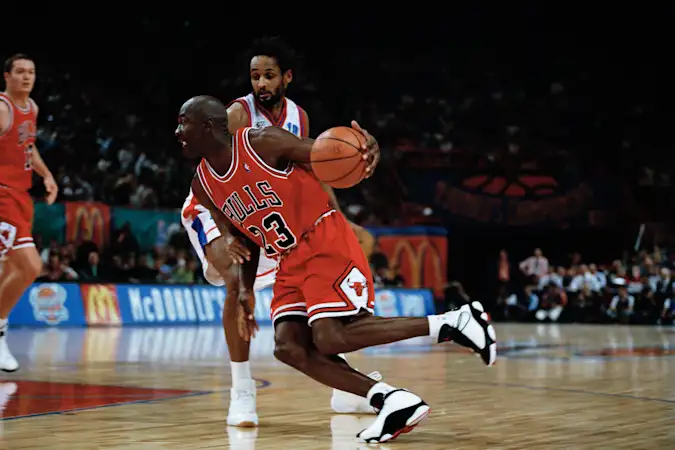
Growing up in Europe in the 1990s, the NBA All-Star Game felt like a window into another universe. No social media, no constant highlights, just one night a year when the best players on Earth gathered, and you stayed up late hoping the satellite signal wouldn’t drop. East vs West wasn’t a format, it was mythology. The jerseys mattered. The pride mattered.
We all still remember watching Kobe Bryant guard Michael Jordan in the 1998 All-Star Game. It wasn’t defence for show, it was a young star demanding recognition from the greatest who ever lived. That moment told us Kobe was real. That he belonged and that his aim to be the next great was genuine.
Then, in 2000 there was Allen Iverson, arriving at his first All-Star Game with cornrows, tattoos, baggy shorts, criticised then, celebrated now. His presence felt rebellious, but his game was undeniable. Iverson didn’t just play; he shifted culture. What once unsettled the league is now its heartbeat.
We collected posters, folded out of magazines, taped to our bedroom walls. Jordan soaring. Kobe coiled. Iverson crossing defenders into the floor. The next morning mattered too, box scores in newspapers, debates in schoolyards. You had to wait for greatness, and that waiting made it linger.
The 2026 All-Star format reflects a different world: a three-team mini-tournament, featuring two USA squads and a World team. It’s fast, global, and intentional. It doesn’t replace the past, it speaks to today’s audience, one raised on immediacy and diversity.
And through all of it stands LeBron James, still here, still selected, still relevant. His All-Star streak isn’t nostalgia, but it’s continuity. A living bridge between eras, reminding us that while formats change, greatness still shows up.
The Early 2000s: The All-Star Game as a Time Capsule
The early 2000s All-Star Games felt like a hinge in time, not quite the 1990s we mythologise, not yet the hyper-connected spectacle of today. And standing right in the doorway was Allen Iverson, the perfect bridge between eras. He carried the defiance of the ’90s into a league that was learning how to sell individuality without flinching.
Iverson in the early 2000s All-Star Games was a shock to the system, which later became the system. Cornrows, tattoos, unapologetic confidence: what once unsettled sponsors had become the league’s pulse. When he won All-Star MVP in 2001, leading a furious fourth-quarter comeback for the East, it felt like a statement. This wasn’t nostalgia. This was now.
Around him, the league was reshaping itself in real time. Kobe Bryant had moved from prodigy to peer, no longer chasing ghosts but creating his own. Shaquille O'Neal turned the All-Star Game into theatre, a smiling colossus who understood that dominance and joy didn’t have to cancel each other out. And then came Vince Carter, whose dunks in 2000 felt like a visual reset, a reminder that athleticism itself could be art.
What those All-Star Games captured wasn’t just talent, but transition. The league was loosening its grip, players were finding their voices, and the game was beginning to understand that identity was not something to be managed, but embraced. Fashion shifted. Music bled into broadcasts. Celebrations lingered longer. The All-Star Game became less about hierarchy and more about expression.
That’s why it works as a time capsule. Watch a 1996 All-Star Game and you see structure, pride, restraint. Watch 2001 and you see a release. Watch 2010 and you see branding. None of them are better or worse, they’re simply honest reflections of their moment.
What fans often miss isn’t a format, but a feeling. We miss the version of ourselves who waited for highlights, who argued over box scores, who taped posters to walls. The All-Star Game hasn’t lost its soul; it has documented our relationship with the sport as it’s grown.
In that sense, the All-Star Game doesn’t belong to one era. It belongs to memory. And like any good archive, its value lies not in resisting change, but in showing us, year by year, who the game was, and who we were when we watched it.
The 2026 All-Star Format: A Celebration for a Global Game
This year’s NBA All-Star Game has evolved, not on a whim, but in recognition of the world the NBA has become. In 2026, we have something the league has never tried before: three teams competing in a round-robin showcase, bringing together the best players in unique competitive groupings.
In this USA vs. World setup, there are two teams comprised of U.S. players (Team USA Stars and Team USA Stripes) and one team representing international talent (Team World). Each squad is made up of eight incredible players, headlined by household names like LeBron James, Stephen Curry, Kevin Durant, Luka Dončić, Giannis Antetokounmpo, Shai Gilgeous-Alexander, Nikola Jokić, and Victor Wembanyama, a constellation of stars that reads like a global index of excellence.
The structure is simple and energetic: these three teams face off in a round-robin of four games, each 12 minutes long. After the first three matchups, the two teams with the best records advance to a championship game. If all three emerge at 1-1, point differential serves as the tiebreaker.
There’s beauty in this format because it understands the All-Star Game not as a relic but as a living celebration of diversity, skill, and identity. The international influence on the NBA is undeniable, and seeing a team of world-bred superstars — players who grew up dreaming not just of the league but of representing their countries and cultures , offers a dimension that feels earned. Meanwhile, two different Team USA rosters mean Americans aren’t all lumped into a single squad — the game becomes about style, chemistry, and shared journeys, not just conference lines drawn on a map.
It also gives more fans concrete moments to latch onto. A mini-tournament invites narrative tension - which squad will rise? Who will hit the go-ahead bucket in Game 3? Rather than one long clock, we get a series of vibrant, electric bursts.
Most importantly, this format isn’t about erasing memory; it’s about expanding it. If the All-Star Game is about seeing the best gathered in one place, then having teams that reflect both heritage and the modern global mix brings fresh life to that celebration. It acknowledges that the NBA is truly world basketball, and that every corner of our planet now watches these games not as outsiders, but as equals in support, emotion, and pride.
LeBron: A Constant in a Changing World
If ever there was a bridge between the NBA of yesterday and the league of today, it walks, talks, and shoots from the heart of every offensive possession: LeBron James.
In 2026, LeBron isn’t just participating, he’s making history. This All-Star Game marks his 22nd consecutive selection, a figure that speaks not just to longevity but to relentless relevance. It’s a number that, when whispered in a young fan’s ear decades ago, might have sounded like fiction. But here it stands, concrete, luminous, unquestionable.
LeBron’s presence at yet another All-Star Weekend isn’t just about accumulation. It’s about continuity. He’s been a constant during eras of changing pace, changing styles, changing colours of the jerseys and contours of the game itself. From thundering into playoff battles in the 2000s to navigating the modern, positionless pace of today’s basketball, he remains a reference point, someone both generations can turn to and say, “There. That’s excellence.”
Across his All-Star career, his stats tell a story of impact: points scored, assists shared, rebounds hauled down in mid-air conflicts — All-Star stats that showcase not only skill but adaptability. LeBron doesn’t just pad numbers; he occupies moments — assists turning into highlight reels, defensive reads that become teaching clips, bucket after bucket in stretches where others wait for their turn to breathe.
Some see All-Star stats as glitzy numbers with little bearing on legacy. But for LeBron, they’re markers of trust, trust from fans who vote, trust from coaches who select him, trust from peers who respect his craft. They aren’t trophies, but they matter because they are chosen repeatedly, year after year.
And what a year to add another to the ledger, under a format that celebrates global basketball. LeBron finds himself on a Team USA roster alongside Steph Curry, Kevin Durant, Kawhi Leonard, and other elite talents, representing not just a nationality but a shared language of basketball artistry and grit.
Through every change in jerseys, rules, pace, and philosophy, his presence has been a bookmark across eras. From the stories we told about the ’90s legends when I was a boy, to the stories being written this very All-Star weekend, LeBron is part of the narrative thread that stitches generations together.
If the All-Star Game is about celebration, then LeBron’s streak is celebration embodied. It’s a testament to discipline, evolution, relevance. It reminds us all, whether we waited up late for grainy broadcasts or streamed the action live on giant screens, that some players don’t just play in eras: they define them.