The views and opinions expressed in this article are those of the author and do not necessarily reflect the official editorial policy or position of LiveScore.
As the regular season enters its final stretch, the bottom of the table features the Washington Wizards, Brooklyn Nets, Indiana Pacers and Sacramento Kings. Each has spent significant stretches with winning percentages hovering in the low .300s or worse. Poor records alone do not prove the intention of tanking, but context does. Veteran absences increase. Young players dominate late-game possessions. Development becomes the official language of April.
Tanking is strategic losing. It is the calculation that short-term defeat increases the probability of long-term gain through the draft lottery. The NBA’s system gives the three worst teams equal odds at the No 1 pick, with diminishing chances allocated down the standings. The intent is competitive balance. The incentive is obvious.
Why the Draft Encourages the Gamble
The draft was built to redistribute hope. In a closed league without relegation, struggling teams need a pathway back to relevance. The lottery is that mechanism. It prevents dynastic stagnation and gives weaker franchises access to elite prospects. The draft offers a way up, a rebalance and healthy competition, preventing dominance and predictability.
When it works, it transforms trajectories. The San Antonio Spurs won just 22 games before landing Victor Wembanyama. Within months, the franchise’s outlook shifted dramatically. Attendance rose. National broadcasts followed. The rebuild accelerated.
That example reinforces the belief across front offices that enduring a painful season can produce exponential reward.
This Season’s Bottom Four
This year’s lowest tier tells four slightly different stories. Washington’s record reflects a franchise prioritising future cohesion over present urgency. The Wizards are building toward next season around Trae Young and Anthony Davis, constructing a roster intended to compete beyond this campaign. Marginal wins in March do little to alter that timeline.
Brooklyn have leaned into asset accumulation. The Nets rank near the bottom of the league in net rating and defensive efficiency, statistical markers that align with a youth-heavy rotation and long-term planning. Sacramento and Indiana occupy a similar recalibration zone. Both have endured offensive inconsistency and extended losing runs that make lottery positioning more tempting than chasing a limited ceiling.
None of these approaches are irrational. They exist within the league’s incentive structure.
Historical Precedent
Tanking is nothing new. It has evolved. The 2011 to 2012 Charlotte Bobcats finished 7 and 59 in a shortened season, the lowest winning percentage in NBA history. The 2013 to 2014 Philadelphia 76ers won 19 games and followed with seasons of 18 and 10 victories as part of a deliberate rebuild that ultimately delivered Joel Embiid.
Go back further and the 1983 to 1984 race for Hakeem Olajuwon helped prompt the creation of the modern lottery in 1985. The league adjusted the rules to reduce blatant losing. The behaviour adapted rather than disappeared.
Adam Silver and the League’s Position
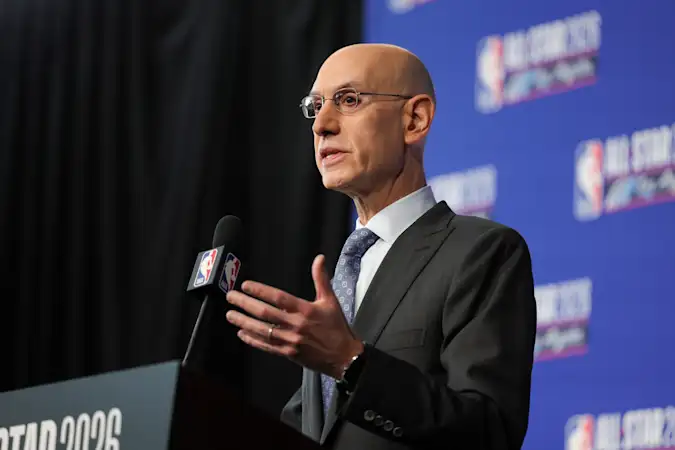
NBA Commissioner Adam Silver has addressed tanking candidly this season, acknowledging that what the league is seeing may be “worse this year than we’ve seen in recent memory.” He noted that fines levied against teams for questionable game conduct, including limiting minutes for top players in winnable situations, illustrate a broader challenge the league is taking seriously.
Silver underlined that the NBA is scrutinising behaviour and reminds teams of their “obligation… to the fans and to their partner teams.” He also emphasised that the league’s competition committee is “re-examining the whole approach to how the draft lottery works,” signalling that structural reforms are in play to better align incentives.
Importantly, Silver’s comments reflect a balanced view: the league recognises that teams must rebuild and plan for the future, while also reasserting the importance of competitiveness and integrity in every season.
The Quiet Cost
The danger of tanking is erosion. An 82-game season relies on credibility. When late-season matchups feel developmental rather than decisive, engagement softens. Attendance and viewership for games involving non-competitive teams consistently trail those with playoff stakes.
There is also a cultural impact. Young players benefit from opportunity, but sustained losing environments risk normalising reduced urgency. Development thrives in competitive settings, not in atmospheres where defeat serves long-term arithmetic.
A Structural Solution Without Tearing Down the Draft
If the league is serious about curbing tanking without dismantling the draft’s core purpose, the most credible path forward lies in tightening structural incentives rather than issuing symbolic fines.
Right now, several new concepts are being considered.
One concept would limit first-round pick protections to either the top four or the top fourteen plus designations. That would reduce the creative flexibility teams use to hedge risk across multiple seasons and discourage prolonged positioning around specific draft slots.
Another proposal would freeze lottery odds at the trade deadline or at a later fixed date. In practical terms, that would remove the incentive for post-deadline collapses. If a team’s odds are locked in by mid-February, there is no strategic benefit to losing aggressively in March and April.
There has also been discussion around prohibiting teams from earning a top-four draft pick in consecutive years or after three straight bottom-three finishes. Such a rule would directly target serial tanking cycles while still allowing struggling franchises access to elite talent within reason.
A related measure would prevent teams from selecting in the top four if they reached the Conference Finals the previous season. That adjustment would guard against sharp competitive drop-offs designed to exploit a single draft class.
Other ideas include calculating lottery odds based on two-year cumulative records rather than a single season. That approach would reward sustained struggle rather than sudden collapses. Extending the draft lottery pool to include team play has also been explored, as has further flattening the odds across all lottery participants.
None of these proposals dismantles the draft. They recalibrate incentives. The goal is not to punish rebuilding but to discourage overt manipulation.
The NBA has always evolved its lottery system in response to behaviour. If tanking adapts, so too must the rules. Competitive balance and competitive integrity do not have to be opposing forces. With thoughtful structural reform, they can reinforce one another. Because at its best, basketball is wonderfully simple: every night should matter.