The views and opinions expressed in this article are those of the author and do not necessarily reflect the official editorial policy or position of LiveScore.
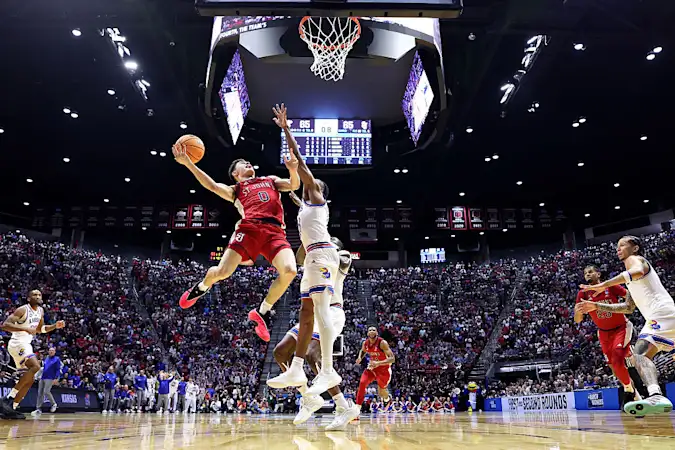
The tournament has reached the stage where every possession starts to feel like it has its own weather system. In the men’s NCAA Tournament, the Sweet 16 begins on Thursday, March 26, with the Elite Eight starting on Saturday, March 28. That matters, because this is the point where March Madness stops being just a bracket and turns into a national shop window for every kid grinding through organized, competitive basketball.
And the scale is enormous. ESPN’s Men’s Tournament Challenge set a new all-time record in 2026 with 26.6 million completed brackets, up from 24.4 million in 2025. That is not background noise. That is millions of people building their week around college basketball, millions of conversations at school, in training, in cars on the way to practice, and in gyms where young players start imagining themselves in those same moments.
Basketball gets louder in March
This is why March hits differently for kids. The game becomes impossible to ignore. ESPN report that the 2025 women’s NCAA Tournament averaged 1.2 million viewers, up 22% on 2023 and up 89% on 2022, underlining how fast the audience for college basketball is growing on the women’s side as well. March Madness is no longer just a men’s basketball tradition with a huge shadow. It is a wider basketball event, with more stars, more visibility and more pathways for young players to look at and say: that could be me one day.
The participation base behind those dreams is huge. The NFHS said high school sports participation hit a record 8,260,891 in 2024-25. Boys’ basketball accounted for 540,704 participants, while girls’ basketball remained one of the most-played sports with 356,240 players. Add those together and you have nearly 897,000 high school basketball players in the United States alone. Nearly nine hundred thousand kids, all looking at the same tournament, all seeing the same stage, all hearing the same message about what matters when the pressure starts chewing on your ankles.
The funnel is far tighter than the dream
This is where March Madness becomes more than entertainment. The NCAA estimates that only 3.6% of high school boys’ basketball players will go on to compete at any NCAA school, with only 1.0% making it to Division I. For girls, the numbers are 4.5% to any NCAA level and 1.4% to Division I. So even getting to college basketball is already like trying to pass through a keyhole while dribbling with your weak hand.
Then comes the really cold air. The NCAA estimates that only 1.1% of NCAA men’s basketball players are drafted into the NBA or another major pro league. The same dataset shows 19,213 NCAA men’s basketball players, around 4,270 draft-eligible players in a given cohort, and just 46 NCAA players selected in the 2023 NBA Draft. That is the pinnacle, and the funnel narrows into a pinprick. For the vast majority of kids watching March Madness, the NBA is still the shining summit on the mountain, but the numbers make clear just how steep the climb is.
For many players, this is the last great stage
That is why March carries such emotional weight. A huge section of players simply will not play organized competitive basketball again once their school or college run is over. If only 3.6% of boys’ high school players make any NCAA roster, then roughly 96.4% do not. If only 4.5% of girls’ high school players reach the NCAA, then about 95.5% do not. Even among those who do get to college, almost all will finish their competitive careers there rather than in the NBA or another major league. The tournament is not just about who rises. It is also about who is running out of basketball road.
That reality is exactly why kids in organized basketball care so much. They are not watching abstract talent. They are watching evidence. They are watching what poise looks like when legs are gone. They are watching how players defend without fouling, how they handle scouting, how they survive bad shooting nights, how they move without the ball, and how one loose rebound can tilt a season. March Madness teaches that the dream is alive, but that it asks for everything.
Why it matters so much for young players
This is the month when a school gym starts to feel connected to something bigger. A kid can be at Tuesday practice working on close-outs, then go home and watch the Sweet 16 and see those same details deciding national games two nights later. The connection is immediate. March Madness shrinks the distance between youth basketball and elite basketball, even if the actual odds remain brutal. It makes the ladder visible, rung by rung.
So yes, March Madness matters for dreams. It matters because the audience is massive. It matters because the player pool is massive. It matters because the college gate is narrow, and the NBA gate is narrower still. And it matters because for many players, this is the clearest picture they will ever get of where the sport can take them before their own competitive chapter closes. That is why kids watch so closely in March. Not just for the buzzer-beaters or the mascots or the bracket chaos, but because this month turns ambition into something they can see, measure and chase.