


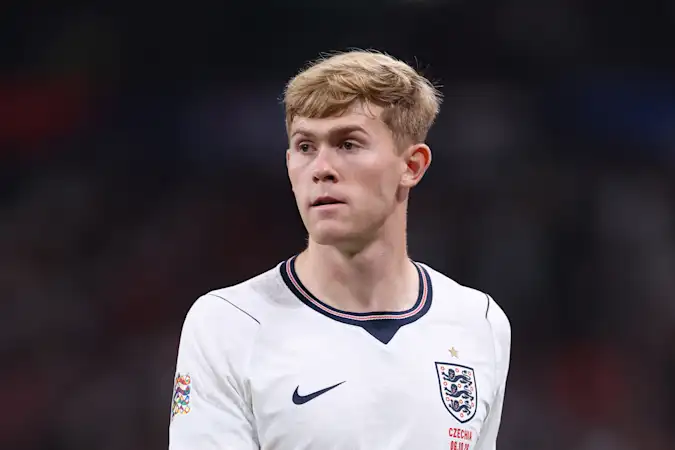
One of Thomas Tuchel’s biggest mistakes was not calling Lewis Hall up for England’s 2026 World Cup squad. Yes, Nico O’Reilly had shone at left-back for Manchester City. Djed Spence provided sufficient backup for the City man on the left side of defence.
Yet, it felt as though Tuchel was setting himself up for failure. Fast-forward to the present day, and there is no denying that Hall has now firmly established himself as first-choice. Granted, Tuchel was forced to rely on Hall for meetings with Czechia - twice - and Croatia owing to O’Reilly’s withdrawal.
However, in the matches at the end of September and the beginning of October, the Newcastle United man proved he’s worthy of being one of the first names on the England teamsheet.
Importance of the Hall-Gordon combination
For the most part, he was linking up with a familiar face down the left flank. Former Newcastle teammate Anthony Gordon has firmly established himself as starting left winger in Tuchel’s favoured 4-2-3-1 setup. The Barcelona man was directly involved in a goal in each of his three UEFA Nations League starts during the extended international break, scoring three times and providing one assist.
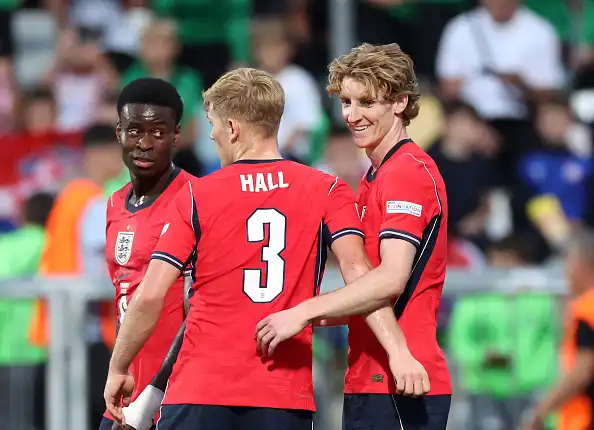
Crucially, there is a chemistry already in place that has been honed over time at club level. Tuchel doesn’t need to hope that both players will suitably adjust to their respective games. They are already well aware of the styles of play, the strengths and weaknesses. It’s an unheralded asset that will serve England well in the long run.
Gordon was replaced by Eberechi Eze for the final game of the international break as England ran out 3-0 winners at Wembley. Even the change of personnel didn’t impact the Newcastle man, as he provided the assist for Harry Kane’s second and the Three Lions’ third on Tuesday.
What’s ultimately key is that Hall has a winger in front of him that is prepared to cut inside from the left flank. This is a prerequisite for any left winger in the modern game, particularly one for a side that favours a 4-2-3-1 setup. Gordon, and by extension Eze, don’t need a second invitation to break infield when on the ball.
Hall's willingness to attack
The duo thrive when in possession and cutting onto their preferred right foot, thus dragging the opposition right-back away from their position. This is where Hall is at his absolute best for both club and country. He’s a full-back who is willing to bombard forward to exploit the space afforded to him by the widemen that cut inside.
While Hall created just three chances across his three UEFA Nations League appearances, that haul was level with Harry Kane and Bukayo Saka. Five completed take ons was the fourth most of all England players, a metric led by Gordon (8).
Player | Completed take ons |
|---|---|
Anthony Gordon | 8 |
Jude Bellingham | 7 |
Eberechi Eze | 6 |
Lewis Hall | 5 |
Morgan Rogers | 4 |
Elliot Anderson | 4 |
There is also the natural balance he brings to the side. O’Reilly may be left-footed, but he is a midfielder by trade. He’ll at times seek to invert into the middle of the park in order to provide midfield superiority. Granted, Hall started his career as a central midfielder, but he’s had more time to develop his game to establish himself as a bona fide elite left-back.
What’s more, Spence is right-footed, meaning he has that inclination to cut inside to utilise his stronger foot. It meant England lost a key attacking outlet down the left without a player to utilise his favoured foot during the World Cup. 36% of England’s World Cup attacks came down the left. That’s risen to 39% during the UEFA Nations League so far.
They favoured the left-hand-side in Hall’s three starts. In the only fixture he didn’t start - the 3-2 defeat to Spain - England attacked more down the right.
Crucial defensive work
Then there is the defensive side to Hall’s game that has benefitted Tuchel’s side in recent matches. Not only have England kept three successive clean sheets in the UEFA Nations League, Hall having started all three, no player has made more tackles than the Magpies man (6) across the opening four matches. He’s been dribbled past just once. Seven clearances is second only to Marc Guehi (9).
Player | Tackles |
|---|---|
Lewis Hall | 6 |
Elliot Anderson | 6 |
Alex Scott | 5 |
Marc Guehi | 5 |
Jarell Quansah | 4 |
By comparison, O’Reilly’s defensive fragilities were exposed during the aforementioned 3-2 loss to the 2026 World Cup winners at Wembley last month.
Not only has Hall gone some way to consolidating his spot as England’s starting left-back, he’s given Tuchel a reminder of his qualities, which were found wanting during the World Cup. That’s not to say England would have gone the distance in North America with Hall in the side. Conversely, they would have stood a much stronger chance of at least progressing beyond the semi-finals with the Newcastle man on the other side of the pond.
For the most, Tuchel seems to have learned from his left-back mistakes. Better late than never. And with Euro 2028 set to start creeping on the horizon, a tournament held in the United Kingdom and Ireland no less, Tuchel’s Hall realisation couldn’t have come at a better time as England look to land international silverware for the first time since 1966.



