
This Week In Lazio History: September 14-20
This week in Lazio history focuses on a demolition of Inter, a win in Istanbul and a special focus on a game against Arsenal. We also remember President Ballerini.
Matches of the Week
Date: Sunday, September 14, 1958 Venue: Stadio Olimpico, Rome Fixture: Lazio Juventus 2-0, Coppa Italia Semi Final Lazio shock the “Old Lady” and now dream of historic silverware.
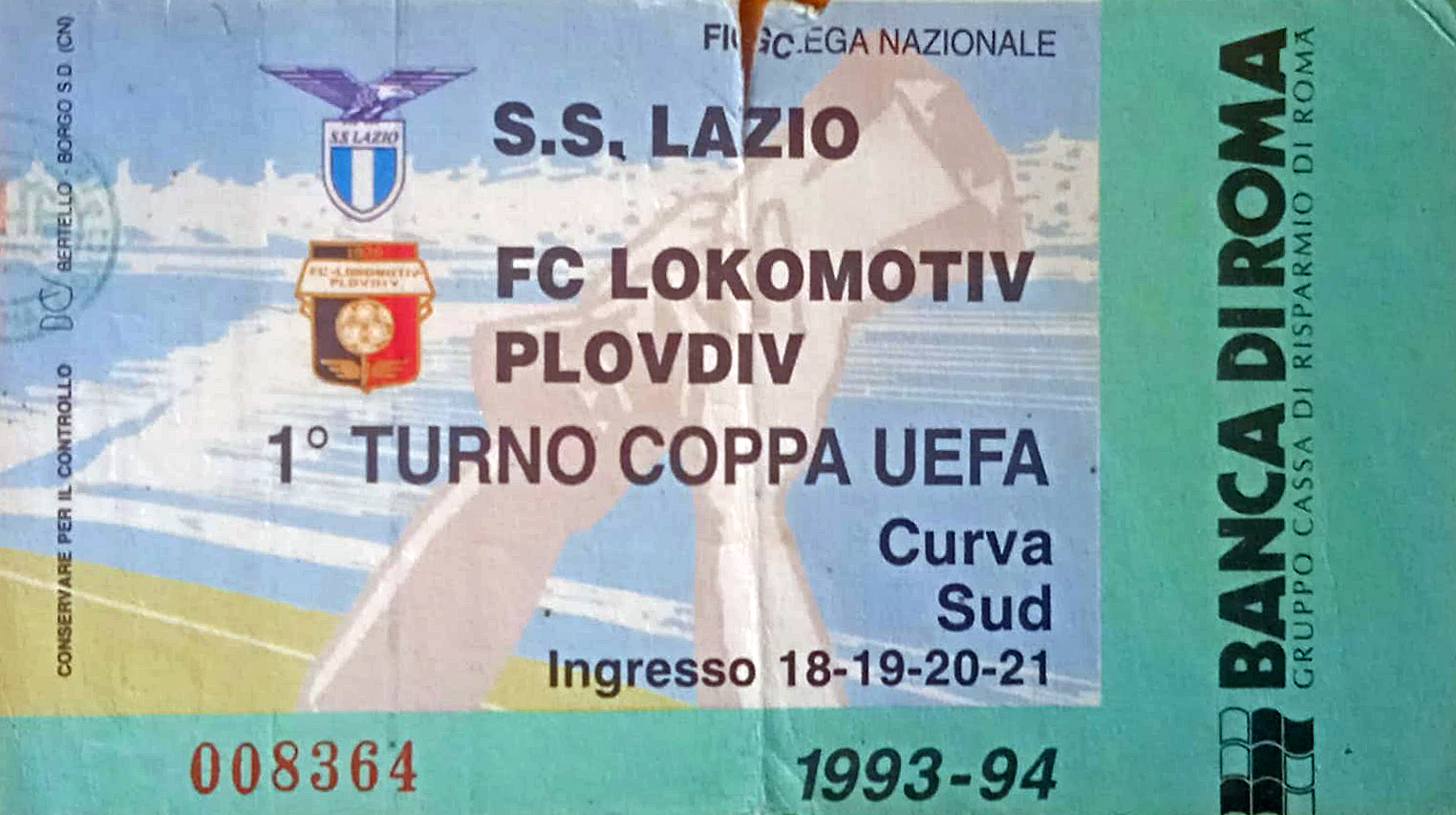
Date: Wednesday, September 15, 1993 Venue: Stadio Olimpico, Rome Fixture: Lazio Lokomotiv Plovdiv 2-0, UEFA Cup First Round In their return to European competions after 16 years, Lazio beat the Bulgarians 2-0 thanks to Casiraghi and Cravero, but it should have been more
Date: Tuesday, September 16, 2003 Venue: İnönü Stadium, Istanbul Fixture: Beşiktaş Lazio 0-2, Champions League Lazio win in Turkey thanks to Stam and Fiore.
Date: Sunday, September 18, 1983 Venue: Stadio Olimpico, Rome Fixture: Lazio Inter 3-0 Lazio demolish Inter 3-0 with goals from Giordano, Cupini and Laudrup.
Date: Sunday, September 19, 1999 Venue: Stadio Olimpico, Rome Fixture: Lazio Torino 3-0 Despite a non-vintage first half, Lazio lead by two goals at the break, then outclass Toro and finish them off with the Matador.
Match In Focus
Date: Wednesday, September 16, 1970 Venue: Stadio Olimpico, Rome Fixture: Lazio Arsenal 2-2, Fairs Cup First Round
After the 1969-70 season Lazio had qualified for the Fairs Cup.
The Inter-Cities Fairs Cup was a European football competition played from 1955 to 1971. The idea came from Ernst Tommen, FIFA Vice President, Ottorino Barassi, President of the Italian Football Federation, and Stanley Rous, English Football Association secretary.
Initially, the cup was used to promote international trade fairs. Until 1964, the clubs that played were either chosen by their Federations or invited by the organizers. After that the teams that played the Fairs Cup were based on league positions and the competition looked more like what the UEFA Cup would become.
Lazio, never lucky when international draws come along, had to face Arsenal in the first round. The Gunners had not done particularly well the previous season, finishing twelfth in the first division, but they had beaten Anderlecht to win the Fairs Cup.
The rivalry started the day before when Arsenal manager Bertie Mee in the press conference for the British press stated that the game against the Italians was going to be a real battle and he was sure that his players would be physically attacked on the pitch. This was because Juan Carlos Lorenzo, Lazio’s manager, in the World Cup of 1966 was the head coach of Argentina who were pretty brutal in the game against England. It was so bad that Sir Alf Ramsey described the Argentinians as animals.
These declarations certainly did not go down well with the Lazio team and since both Giorgio Chinaglia and Pino Wilson understood English, they could tell when the Arsenal players were making fun of them. In contrast, the Gunners claimed that they were foul-mouthed and spat at during the game.
Anyway, the match started with Lazio attacking with shots from outside the box from Ferruccio Mazzola, Chinaglia and Giuseppe Massa. In the 25th minute Pierpaolo Manservisi dribbled past a few defenders but once in front of the keeper shot directly at him, Chinaglia tried to score on the rebound but Frank McLintock managed to save into the corner. Long John was dangerous in the 33rd minute with a shot that hit the outside of the net.
After a good first half, Lazio had a blackout at the beginning of the second 45 minutes. In the 52nd minute, John Radford headed a lob over Michelangelo Sulfaro who was way too far out of the goal and gave the Gunners the lead. Which four minutes later became 2-0. George Armstrong ran down the left and crossed, Nello Governato was busy tying his bootlace, and Radford in complete solitude headed the ball into the net.
This one-two almost knocked Lazio out, but they pulled their socks up and started to press the Arsenal team. At this point enter Schulenburg, West German referee. After ignoring a blatant foul on Governato in the box, in the 66th minute, he claimed his masterpiece. After a Giuliano Fortunato-Massa-Chinaglia play, Long John tried a shot that was parried into the corner by Bob Wilson. On the subsequent corner, Mazzola crossed, Pat Rice intervened with a studs-up tackle on Franco Nanni who was about to shoot but Chinaglia then managed to score anyway. At that point the ref gave an indirect free kick to Lazio, not conceding the goal. Huge protests from the Lazio players and fans with an attempted pitch invasion.
Massa, Mazzola and Arrigo Dolso tried shots that shaved the woodwork and then Chinaglia decided to sort things out himself. In the 85th minute Dolso to Chinaglia, big whack, and Lazio reduced the deficit. Mazzola missed the equaliser a few seconds later but then Chinaglia in the 89th minute went solo, dribbled past a couple of players and went forward like a bulldozer. He went past Wilson and shot at goal, on the line McLintock saved with his hands, penalty. Long John made no mistake, Lazio 2 Arsenal 2.
After the match, there was an official dinner for the two teams. As they were leaving Ray Kennedy, maybe as a joke, kicked Giuseppe Papadopulo’s backside. His prompt reaction was an uppercut. This generated a massive brawl between the players. Papdopulo, Sulfaro and Rosario Di Vincenzo were forced to go to the hospital to be medicated.
The British press claimed that it was the Lazio players who started it, incited by Lorenzo, but one can also read a little vendetta by the Brits following the 1966 battle in the World Cup.
Lazio were eventually beaten 2-0 in the return match.
This would not be the only time that a game with the Brits ended up in a fight. It happened again three years later, but that is another story we will be writing about.
In Memory: Fortunato Ballerini
Onorato Fortunato Ballerini was born in Sant’ Angelo a Lecore (Florence) on October 26, 1852.
He was the son of a bourgeois Tuscan family. His family then moved to Rome to follow various businesses and Fortunato started to mix with some of the Roman middle and upper classes.
These young men were dedicated sportsmen and had a passion for running, gymnastics, swimming, rowing and mountain climbing. Ballardini by now was no longer a young man but was still a keen runner and climber.
Lazio were formed on January 9, 1900 as Società Podistica Lazio (a running club) and were the brainchild of Luigi Bigiarelli and a number of these young athletes. The club chose the colours of the Greek flag in honour of the first modern Olympics in 1896.
In 1901 one of the members, Bruno Seghettini, introduced a new object, a football. It was an absolute novelty for Rome and Lazio called up an assembly among their members to organise a football section. The president was Giuseppe Pedercini. Lazio officially started playing football on January 6, 1901.
Meanwhile, Bigiarelli had emigrated to Belgium, but on October 20 1902 Lazio’s destiny crossed paths with a bizarre character. A middle-aged man in elegant clothes and carrying an umbrella lined up for a 100 km walking competition, his name was Fortunato Ballerini.
The young members of Lazio, including Tito Masini, Sante Ancherani and Guido Baccani, were so impressed that when he crossed the finishing line, they approached him and asked if he would accept the role of president of their club.
Ballerini however politely declined as he was already involved and too busy with the Gymnastics Federation, of which he was administrator.
A couple of years later he finally accepted, on May 29 1904. He agreed in a “trattoria” (old style restaurant) in the Prati area where a few months later he would kiss the Lazio flag.
Meanwhile Ballerini was pursuing a career in the Ministry of Justice but the authorities did not approve of his passion for sport and so he never reached the highest levels.
Lazio however flourished, almost doubling the number of their athletes. Under Ballerini’s leadership Lazio started participating in numerous sporting competitions.
One of Ballerini’s achievements was obtaining the use of the playing field of Parco dei Daini in central Villa Borghese Park. Here Lazio challenged the young Scottish, Irish and English student priests and refined their skills.
Lazio became the shining light of Roman sport activities. In 1912 Ballerini was re-elected as president. An episode in 1913 again showed his leadership qualities. During a friendly against Audace in the Parco dei Daini, a shot by star centre-forward Sante Ancherani accidentally hit a noblewoman in the face. Unfortunately for Lazio she was the wife of the Prefect of Rome Police, Angelo Annaratone. Lazio were banned from playing in the park but then in 1914 Ballerini cleverly obtained building permission for the Rondinella ground in the Flaminio area and in the meantime to train and play at the Farnesina area plus new facilities for the rowing and swimming sections.
In 1913 and 1914 Lazio went close to winning the national football league but were defeated by Pro Vercelli and Casale.
In 1915 the war stopped all football leagues. Lazio had qualified for the final versus Genoa but the game was never played. The Scudetto was handed to Genoa as they were considered to be superior… a huge injustice that Lazio are still trying to rectify today.
As said, the First World War interrupted all sporting activities but Ballerini conceded the Rondinella area to grow vegetables for the war effort and also opened the club’s headquarters to assist the children of soldiers sent to the front.
Lazio’s reputation rose as did that of Ballerini. In 1916 Ballerini was awarded the “Commenda della Corona d’Italia” (an order of merit award bestowed by the King) and in 1921 Lazio as a club was recognised as a “Moral Institution” for their social, cultural and sporting merits.
Meanwhile, however things were changing in sport and there were divergences on the direction clubs like Lazio should take. Ballerini was a staunch defender of amateurism while others were for a more professional and modern approach. Ballerini, faithful to his Olympic ideals, in 1922 reluctantly resigned. The next president was Enrico Guamei.
Twenty years of presidency came to an end. Lazio had grown from a few lads on a park bench in Prati to a sports club with over 4,000 athletes in all kinds of disciplines.
A year after his resignation Lazio again went close to their first national football title but lost, this time to Genoa on the pitch.
His work and guidance proved crucial, as mentioned, in 1927. The fascist regime and Benito Mussolini decided that Rome as the capital should have one strong football club to compete with the dominance of the northern teams. Lazio’s uniqueness as a moral entity added to the intervention of high-ranking military officer Giorgio Vaccaro managed to avoid Lazio joining the number of local clubs which merged to become A.S Roma. Lazio remained fiercely proud and independent also thanks to Ballerini.
Ballerini continued to follow his passion for sport. At 69 he swam in the river Tiber in December with other Lazio athletes in a yearly swimming event. At 81 he was still mountain climbing in the Dolomites and running. A true sportsman, in the best Lazio tradition.
Ballerini died in Rome on September 19, 1940.
Birthdays This Week
Nello Governato, 14-9-1938, midfielder, Italy (1961-71, sports director 1983-85, 1992-02)
Şükrü Gülesin, 14-9-1922, forward, Turkey, 31 appearances, 16 goals (1951-52)
Alberto Fazio, 15-9-1918, midfielder, Argentina, 63 appearances (1940-43)
Roberto Galbiati, 16/9/1957, defender, Italy, 35 appearances (1985-86)
Giancarlo Marini, 16/9/1964, midfielder, Italy, 41 appearances, 1 goal (1982-85)
Karl-Heinz Riedle, 16/9/1965, forward, Germany, 94 appearances, 32 goals (1990-93)
Christos Mandas, 17/9/2001, goalkeeper, Greece, 39 appearances (since 2022)
Angelo Cupini, 18/9/1958, midfielder, Italy, 29 appearances, 3 goals (1983-84)
Enrico Vella, 18/9/1957, midfielder, Italy, 52 appearances, 6 goals (1982-83)
Ettore Agazzani, 19/9/1902, goalkeeper, Italy, 19 appearances (1922-23)
Tommaso Rocchi, 19/9/1971, forward, Italy, 293 appearances, 105 goals (2004-13)
Mauricio, 20/9/1988, defender, Brazil, 56 appearances (2015-18)
Carlo Parola, 20/9/1921, midfielder, Italy, 7 appearances (1955-56)
This Article Was Written by Dag Jenkins & Simon Basten from Lazio Stories. More Information on the Above Matches and Players can be found on LazioStories.com.