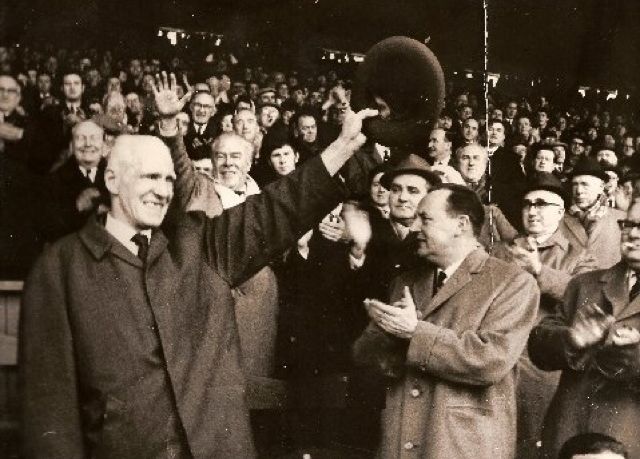

Robert Kelly never played for Celtic but dominated the club off the field
55 years ago (21 September 1971), a major figure in Celtic’s history died…
Robert Kelly was a man who never played for the Celts but dominated the club off the field. He is just one example of the many Kellys who have been synonymous with the Celtic story…
The first Kelly with Celtic connections is arguably the most significant. In the 1880s, James Kelly was one of Scotland’s most renowned players. He became part of the first XI to represent the Bhoys and was said to be the first player to sign for the club too.
As well as scoring in Celtic’s opening game, he also became the inaugural club captain and was involved in all the Bhoys’ maiden achievements, including winning the Scottish Cup and League.
After retiring, James Kelly became a member of the Celtic Board and eventually the chairman too.
As well as Celtic success, James Kelly also knew tragedy; two of his sons dying in connection with World War One.
One of these men – Frank – may have been expected to take his father’s place in Celtic folklore; Frank had played for the Bhoys and after retiring could well have also joined the Board.
However, his death meant that another son came to the fore: Robert Kelly.
Robert was born in Blantyre in 1902, one of ten children for James and Margaret Kelly. Robert had a very privileged life; he was privately educated at St Aloysius school and St Joseph’s in Dumfries before becoming a stockbroker by profession.
Robert played Junior football although an arm injury limited his sporting career. Unlike his father and brother, he never got a chance to pull on the famous green-and-white jersey.
However, in 1932, Robert became a formal part of the club. James Kelly died that year and this created a vacancy on the Board. It was decided that 30-year old Robert should replace his father.
Robert would serve for four decades on the Board, until his own death in 1971. In that time, he became one of the most significant administrators in Celtic’s history and also Scottish football too.
As a Board member with significant business expertise, Robert quickly gained the respect of other Board members. As such, in 1947 he was appointed chairman of the club, a role he would retain almost until his death.
In those days, the position of Celtic chairman was one of great responsibility and bestowed the holder with great power in the club. Robert was known to be the dominant decision maker, often making choices about players and team selections.
This certainly was the case throughout Jimmy McGrory’s time as manager. Numerous players from this era describe how anyone disliked by Robert would soon find themselves out of the club.
Indeed, in the late-1950s, Celtic’s youth system aimed to develop the next generation of stars at the club. They were widely known as ‘Kelly’s Kids’ due to the chairman’s influence.
Robert could often make very erratic team decisions. A good example concerns Willie Goldie, a reserve goalkeeper for Celtic in 1960.
Goldie went to watch an away game in Airdrie as a supporter but was spotted by Robert. The chairman was so impressed by his commitment that he decided to put Goldie in the team. Celtic lost 2-0 and the goalkeeper was blamed for the goals so never played again!
This changed in 1965. Celtic wanted Jock Stein back at the club but the ‘Big Man’ would only agree to this if he had full control; he certainly was not going to let the Board dictate who played each week.
Stein was granted his wish and Celtic went on to have unprecedented success, not least in Lisbon in 1967.
Still, Stein’s presence did not fully remove Robert’s influence. It was said that Jock would seriously listen to any opinions from the chairman, although the final decision rested with the manager. After Robert’s death, Stein said that “no man has done more for [Celtic]” than Kelly.
Robert would prove to be ruthless in his control of Celtic. But he was also a fierce advocate for the club and willing to pick battles when he believed this to be appropriate.
The most famous of these came in 1952, an event which came close to ending Celtic Football Club.
On New Year’s Day 1952, an Old Firm match ended in supporter violence, and not for the first time. The football and public authorities held an inquiry which included different recommendations, including that neither club display flags or banners which might incite the other.
In simple terms, this meant banning Celtic from flying the Irish tricolour. Under Robert Kelly’s leadership, the Celts declined to do so, even in the face of threats to close Celtic Park or suspend the club from playing football.
Kelly refused to back down, and was even given support from Rangers for this. Eventually, the Scottish FA relented and Robert’s reputation as a Celtic defender was cemented.
In later years, this same steel was shown when dealing with UEFA in the midst of a Cold War argument.
In 1968, the Soviet Union invaded Czechoslovakia, causing international outrage. Later that year, Celtic were paired with Ferencvaros of Hungary, another country under Soviet control.
In protest at the USSR’s actions, Kelly said Celtic would not play any side from Eastern Europe. This forced a redraw of the entire tournament to ensure this would not happen, and made Kelly a major figure not just at a Scottish level but in Europe too.
These attributes ensured Robert enjoyed influence outside of Glasgow’s east end. Despite often engaging in arguments with those running Scottish football, he was still a well-respected figure.
Kelly had a particularly significant connection with the Scottish League. In 1939 – before he became Celtic chairman – he was appointed to the Scottish League Management Committee. 11 years later, this led to him being chosen as President of the Scottish League.
Even his run-ins with the Scottish FA did not dampen the support he enjoyed from many in that organisation. This was evidenced in 1960 when he was appointed as President of the Scottish FA.
Heading up the two main organisations which run Scottish football was a testament to his political skills as much as his general administrative abilities.
In these roles, he took a variety of strong public positions, including opposing widespread TV coverage of games and also criticising the World Cup as a competition. He even initially denigrated the idea of Europe-wide competitions, despite Celtic’s eventual success at this level.
All of his efforts were recognised outside of football too. In 1969, he received a knighthood in the New Year’s Honours list for ‘services to Scottish football’.
However, by this time, age was beginning to catch up with him. In April 1971, he decided to step down as chairman and was instead granted the title of Celtic President. In September of that year, he died following a long illness when aged 68, just short of his 69th birthday.
Robert’s death did not end the Celtic and Kelly connection. When he retired from the Celtic Board, his position was filled by another Kelly – this time his nephew, Kevin. Like his uncle and great-uncle, Kevin would later serve as chairman. And in 1990, his cousin Michael Kelly also joined the Board.
Sadly for Celtic, these two Kellys did not enjoy the same reputation or success as James or Robert. They were part of the Celtic Board which faced crisis in the early-1990s and was eventually deposed in Fergus McCann’s takeover.
Robert Kelly’s time at Celtic is complicated. Many people decry him for autocratic control of the club and suggest he was to blame for Celtic’s lack of success in the 1950s. Others regard him as a passionate advocate for the Bhoys who helped oversee the glory of the 1960s.
Whatever your opinion, there is no doubt that despite never playing in green-and-white, he still holds a position as one of the most significant Celts of all time.