
George Square’s place in the story of Celtic
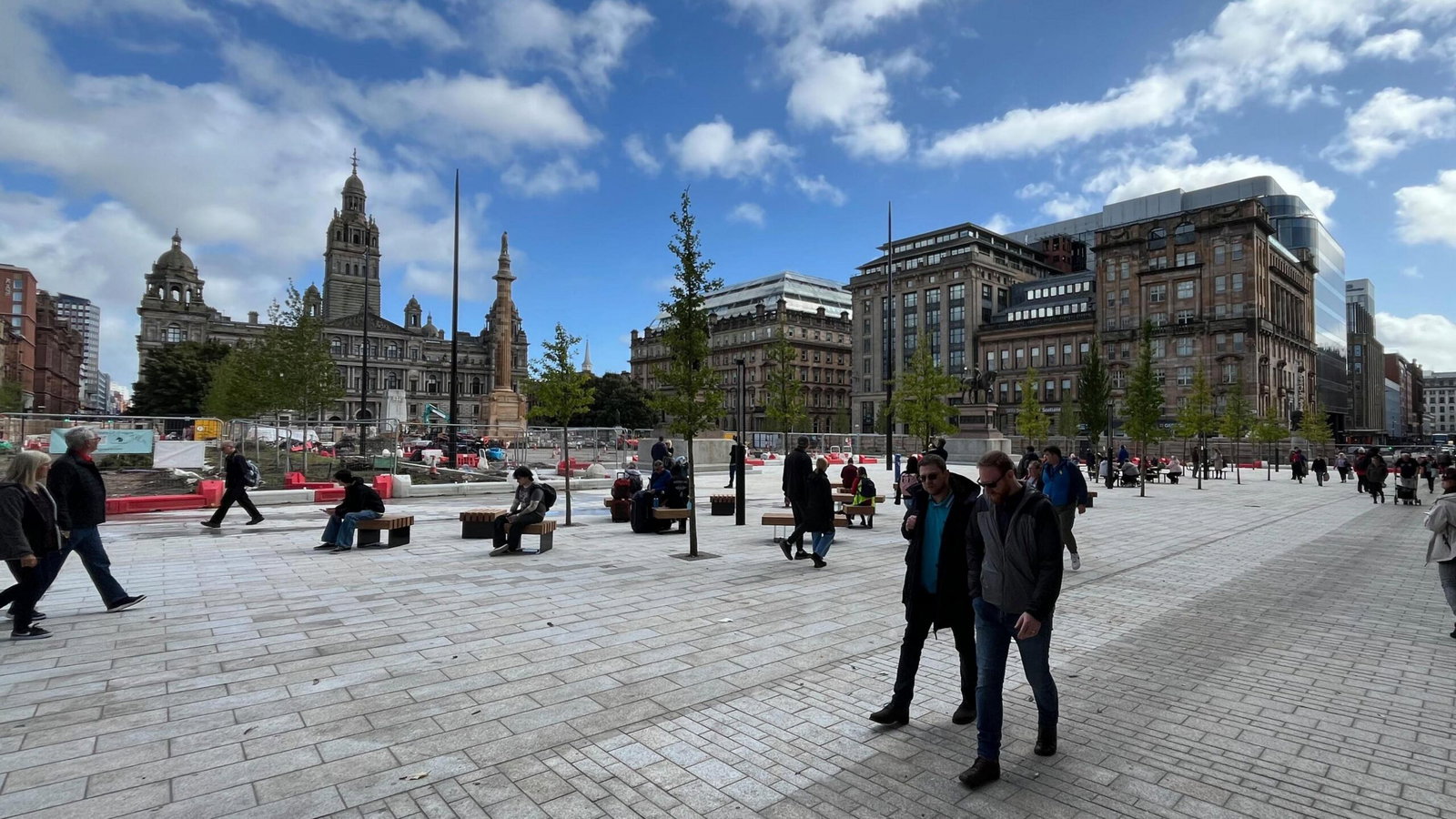
After a prolonged revamp, Glasgow’s George Square will finally reopen later this month…
As well as being the city’s most well-known civic space, it is a location that has numerous Celtic connections, in some cases going back to before the club had even played a game.
George Square was named after King George III. Its history back to the 1700s but its first direct Celtic connection came in May 1888 in an event which celebrated the opening of the Bhoys’ first home venue.
After being formed in November 1887, Celtic’s founders quickly secured land close to the current Celtic Park. Over the next few months, work was done to make this ready to host football games.
Eventually, this would feature terracing around the three sides of the ground and a 1000-seater open air stand which included a pavilion and dressing rooms.
A lavish dinner took place to celebrate the progress and rise of Celtic
On 8 May 1888, the venue was ready for its official unveiling. However, this match would not involve the Celts. Instead, Edinburgh Hibernian and north Glasgow side Cowlairs agreed to play the opening fixture, although a nil-nil draw meant the pitch was yet to celebrate a goal.
Following this game, numerous invited guests made their way to George Square. Their destination was the Royal Hotel, located on the north east corner of the square.
A lavish dinner took place to celebrate the progress and rise of Celtic, not least the opening of their ground. Attending the function were visitors from Hibs and Cowlairs, as well as numerous Celtic officials and other people too.
Although the ground had not yet been christened with a goal, this was soon to change. Fittingly, it was the Celts who scored this. 20 days later, Rangers came to Celtic Park to act as opponents in Celtic’s first game.
Celtic’s first game, first goal, first hat-trick and first win over Rangers
In an exciting match, seven goals were scored. Neil McCallum of Celtic got the opener. Captain James Kelly also scored and Tom Maley’s hat-trick meant the Bhoys first match ended in a 5-2 victory over the club that would become their greatest rivals.
Arguably the best known building on George Square is the City Chambers, home to Glasgow City Council, however this not yet built when the square first existed.
Instead, in a year well known to Celtic fans, the City Chambers was officially opened in August 1888, just weeks after the Bhoys’ first match.
The City Chambers has various clear Celtic links. Some Rangers fans may suggest that’s because the green-and-white men control the local council, but the truth is far simpler!
The Chambers is a building where Celtic have celebrated numerous trophy successes. In Celtic’s early years, the Glasgow Charity Cup was one of the most prominent competitions in which the Bhoys participated.
Each year, the Charity Cup was organised by local businessmen and politicians to raise funds for local good causes. It took place at the end of the season before a trophy ceremony was held in the City Chambers, usually with Glasgow’s Lord Provost handing over the trophy.
Celtic’s first time celebrating in the Charity Cup came in 1892
Celtic’s first time celebrating in the Charity Cup came in 1892. It was a notable occasion for various reasons.
The final was held at the original Celtic Park, with the Celts beating Rangers by two goals to nil. This was the first cup final that ever took place between the two sides, and it was also Celtic’s final victory at their maiden home before they moved to the modern day Celtic Park location.
One man had a particularly unlucky tale connected to this game and another one too. Just as Celtic first beat Rangers in a cup final in 1892, the Ibrox side first overcame the Celts in the Glasgow Cup Final of 1893.
Tom Dunbar played in both of these games. Sadly for him, he was twice on the losing side! Dunbar – whose brother Mick also played for Celtic – appeared for Rangers in 1892 before switching to the Celts the following season.
That season, the Bhoys also won the Scottish Cup and Glasgow Cup, giving them a ‘Holy Trinity’ of success
Later in June 1892, a Celtic party headed to the City Chambers to celebrate their win. After a series of speeches, they were given the trophy. This achievement helped secure their first Treble. That season, the Bhoys also won the Scottish Cup and Glasgow Cup, giving them a ‘Holy Trinity’ of success.
On various other occasions, the Celts claimed victory in the Charity Cup until its demise in the 1960s. Each time, the Bhoys marked their victory with a City Chambers ceremony.
It’s not just the Charity Cup that has led to Celtic celebrations in the City Chambers. After victory in Lisbon in 1967, a civic function was held there to mark the Bhoys’ success, and the same happened in 2017 to mark 50 years since the Bhoys’ European triumph.
George Square also included a salute to Celtic’s continental heroes. After victory, a flower display was added to the square which spelled out the words ‘Celtic – 1967 European champions’ and also had an floral image of the famous trophy.
In fact, it can be argued that the road to Lisbon also started for the Celts on George Square.
Nowadays, in-depth preparations are made for Celtic’s away games, with the team travelling together and usually staying together in a hotel the night before the match.
However, this was not always the case in decades gone by. On 7 May 1966, Celtic were heading to Motherwell for the final league game of the season. Before this, the team met up at the North British Hotel on George Square, which later became the Millennium Hotel.
Following this breakfast meeting, they travelled to Fir Park. The match was goalless until the last minute when Bobby’s Lennox’s goal gave Celtic the win and also confirmed their first league title since 1954, and Jock Stein’s first as Celtic boss.
As a result of this 1966 success, the Celts entered the following season’s European Cup, and the rest, as they say, is history.
George Square has also been witness to numerous Celtic fan moments, including key actions which helped bring about changes to the Celtic board.
Back in the early 1990s, Celtic were in dire straits. A crumbling stadium and financial strife meant they were well behind Rangers, and in fact numerous other Scottish clubs too.
Celtic fans campaigned to bring about change, with different groups having George Square links.
Save Our Celts and George Square
Save Our Celts was the first campaign group started. Its inaugural meeting took place in the Sundowners pub which sat at the top of Queen Street next to the square.
This group made some progress in showing fan disquiet, but it did not bring about the desired change. This eventually led to the establishment of Celts for Change, a much more high profile organisation.
One of their campaign events involved the Bank of Scotland on George Square, which is now the Counting House pub. A protest rally was held at the venue, with the Celtic group asking to speak to the manager.
At first, this request was denied. However, on being told that the hundreds of Celtic fans were going to come into the bank to open a new account before then coming back to close them, that decision quickly changed!
In truth, it was a publicity stunt but one which kept the topic in the news.
Of course in 1994, change would eventually come. Fergus McCann – with support from others such as John Keane – saw off the old Board and built a new, modern Celtic. When McCann first came to Scotland, his bank was the Clydesdale Bank, just off George Square.
As well as all of these notable locations, sometimes Celtic fans have used George Square itself for celebrations and club events. In 2019, there was a huge huddle held by fans in the square to celebrate the Bhoys’ most recent league title, their eighth in a row. It was so large that it spilled onto nearby roads.
And three years before this, there was an official Celtic FC event in the square. What was described as a Family FanZone was organised ahead of a Champions League game at Celtic Park. 7000 supporters turned out to cheer players and former players, along with entertainments such as an inflatable football pitch and crazy foot golf.
In fact, as well as George Square, other parts of Glasgow city centre have witnessed numerous momentous Celtic stories. If you want to learn more about these, you can take part in a free walking tour. Visit the Celtic Walking Tours website to find out more information about future events.