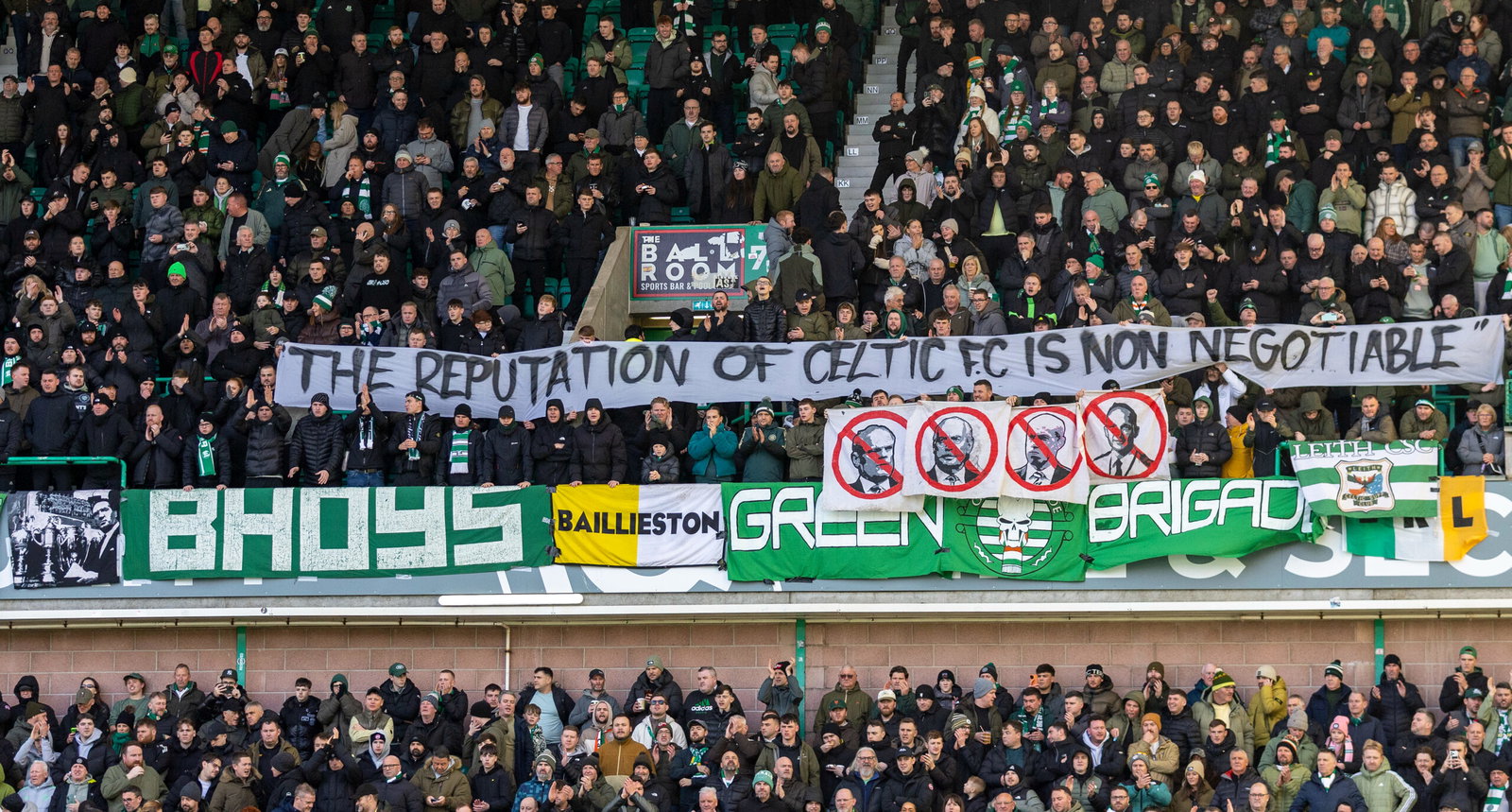

Celtic supporters question Board’s transparency following Greenock event
Members of the Celtic hierarchy braved the wrath of supporters at last night’s sit down with over one hundred fans at a Q&A meeting Around 120 fans from six supporters’ clubs attended the meeting at the Greenock Celtic Supporters Club on Monday night and raised issues including recruitment, transfer policy, communications and the club’s ambitions and strategy.
Manager Martin O’Neill, and Chairman Brian Wilson were joined by Chief Executive Michael Nicholson, Chief Financial Officer Chris McKay and other club officials in a two-and-a-half-hour question and answer session with frustrated supporters.
Wilson, having shedded the interim tag, said afterwards: “We were grateful to the Greenock Celtic Supporters’ Club for hosting this event in a way that allowed everyone to make their points, many of them critical, and to ask searching questions which we did our best to answer.”
“We didn’t expect an easy ride and didn’t get one, but the meeting was conducted in a constructive and mutually respectful way and the messages delivered by supporters will be taken on board and learned from.”
Nicholson was just as upbeat about the meeting saying:
“Everyone in the room wants the best for Celtic and that was evident.
It’s all well and good the likes of the new Chairman and the CEO coming out afterwards and preaching about taking on board the supporters concerns, but we’ve heard this spiel far too often. If they want to improve the relationship with the supporters then they need to massively improve the way the club operates, and we all know deep down that nothing will ever change with this board.
The situation is the same as it was before, and that would be that change is urgently required at the top of the Celtic park tree. Now it’s onto the Celtic AGM to see if the concerns of the supporters are addressed.
Celtic Supporters Question Board’s Transparency Following Greenock Meeting: “You Want Better Communication, But Where Are the Minutes?”….
Online reaction to Celtic’s meeting with supporters in Greenock has been dominated by questions over transparency, accountability and the decision not to make a recording or publish minutes of the discussions.
The dust had barely settled on Monday night’s meeting between Celtic’s board, manager Martin O’Neill and representatives of several supporters’ clubs in Greenock before another debate began among the wider Celtic support.
While the club was keen to highlight what it described as a constructive and mutually respectful two-and-a-half-hour discussion, many supporters who were not in attendance were left asking a fairly straightforward question.
What exactly was said?
Around 120 supporters attended the meeting at Greenock Celtic Supporters’ Club, where chairman Brian Wilson, chief executive Michael Nicholson, chief financial officer Chris McKay and manager Martin O’Neill faced questions on recruitment, transfer policy, communication and the club’s wider ambitions.
The club subsequently published a short statement describing the meeting as an opportunity for supporters to raise concerns and ask searching questions. Wilson acknowledged that the board had not received an easy ride, adding that the messages delivered by supporters would be taken on board and learned from.
However, for many Celtic supporters, that statement simply wasn’t enough.
The biggest source of frustration has been the lack of a comprehensive public record of the meeting. There were no published minutes, no publicly available recording and no film of the discussions to allow the wider support to hear the questions and, more importantly, the answers provided by the club’s senior figures.
There were also reported restrictions on recording and filming at the event, and this was insisted upon by Celtic FC. This has created an uncomfortable contradiction for a board which has repeatedly acknowledged the need to improve communication with the supporters.
How can a football club talk about rebuilding relationships and improving transparency while allowing an important discussion involving its senior leadership to remain largely behind closed doors?
It is a question that has been repeatedly raised across Celtic-related social media and supporters’ websites throughout the day. One particularly pointed response captured the mood of many supporters:
“You want better communication but can’t post minutes of the meeting.”
It is a criticism that goes to the heart of the issue. Nobody is suggesting that the supporters who attended Greenock should not have been given the opportunity to question the board. Indeed, those who took part deserve credit for putting difficult subjects on the table.
The concern is that the rest of the Celtic support has effectively been excluded from the conversation. Celtic has hundreds of thousands of followers around the world, most contributing financially to the club through season tickets, merchandise, television subscriptions and travelling to support the team.
Yet those supporters have been left relying on second-hand accounts, social media posts and the club’s own carefully worded summary to understand what happened. One supporter questioned why the club appeared to be communicating with selected supporters’ clubs rather than making the discussion accessible to the wider fanbase.
Another asked whether the meeting had been minuted and whether supporters would be able to listen to or watch a recording. Others expressed frustration that similar promises about improved communication had been made before, without the level of change they wanted to see.
The reaction has not been entirely negative, however. Some supporters welcomed the fact that Nicholson, Wilson, McKay and O’Neill were prepared to sit down and answer questions for more than two hours. Reports from those who attended suggested that difficult subjects were raised and that the atmosphere, although challenging, remained respectful.
There was also some encouragement that Martin O’Neill had personally requested to attend. His willingness to meet supporters was noted by those who believe the manager should not be isolated from the concerns of the Celtic support.
Nevertheless, the more optimistic interpretation has struggled to silence the wider questions about the board’s approach. A particularly important issue is the distinction between engagement and accountability.
Engagement means meeting supporters, listening to their concerns and allowing them to ask questions. Accountability means explaining decisions, providing evidence of progress and allowing supporters to judge whether promises have been delivered.
The Greenock meeting may have achieved the first, but the absence of a detailed public account has left serious questions about the second. There is also the question of representation.
The supporters who attended were there on behalf of their respective clubs, and their participation should be respected. However, they cannot reasonably be expected to speak for every Celtic supporter, particularly those who are not members of an organised supporters’ club.
The wider support includes season-ticket holders, independent supporters, fan organisations and people who follow Celtic from overseas. Many of these people have equally strong opinions about the club’s direction and deserve meaningful opportunities to be heard.
Celtic has indicated that further details about its Celtic Connect engagement initiative and additional Fans’ Forums will be announced. That could provide an opportunity to address some of the criticism, but supporters will want to see something more substantial than another announcement promising better communication.
A published summary of the questions asked, the answers provided and any commitments made would be a reasonable starting point. If the board genuinely wants to rebuild confidence, it should be prepared to demonstrate that difficult conversations lead to tangible outcomes.
The criticism is also being amplified by Celtic-related online outlets and supporters on social media, with several questioning whether the Greenock meeting represents genuine openness or simply another controlled exercise in public relations.
The wider frustration is not necessarily directed at the supporters’ clubs involved. It is directed at a board which many supporters believe has failed to communicate adequately with them over a prolonged period.
And that distinction is important. Those supporters deserved their meeting. The wider support deserves to know what happened at it. There is no reason why the two should be mutually exclusive.
Indeed, publishing proper minutes or an edited recording, with appropriate safeguards for individual privacy, would have demonstrated that the club was serious about opening up communication rather than simply talking about doing so.
Celtic’s board has been given an opportunity to begin repairing its relationship with the support. But the reaction since Monday evening demonstrates just how much work remains to be done. For many supporters, the issue is no longer simply about transfer windows, recruitment mistakes or disappointing performances on the pitch. It is about trust.
They want to know who is making the important decisions, what the club’s long-term strategy actually is and whether those in positions of authority are prepared to answer difficult questions publicly. The board cannot expect supporters to accept a brief statement saying that everything was constructive and that lessons will be learned without providing some substance behind those words.
If the message from Greenock was that Celtic needs to improve communication, then the immediate response should be to communicate what happened in Greenock.
The meeting may have lasted two and a half hours, but the wider Celtic support is still waiting for the full conversation. And until that happens, the board’s promise of greater transparency will remain just that – a promise.