


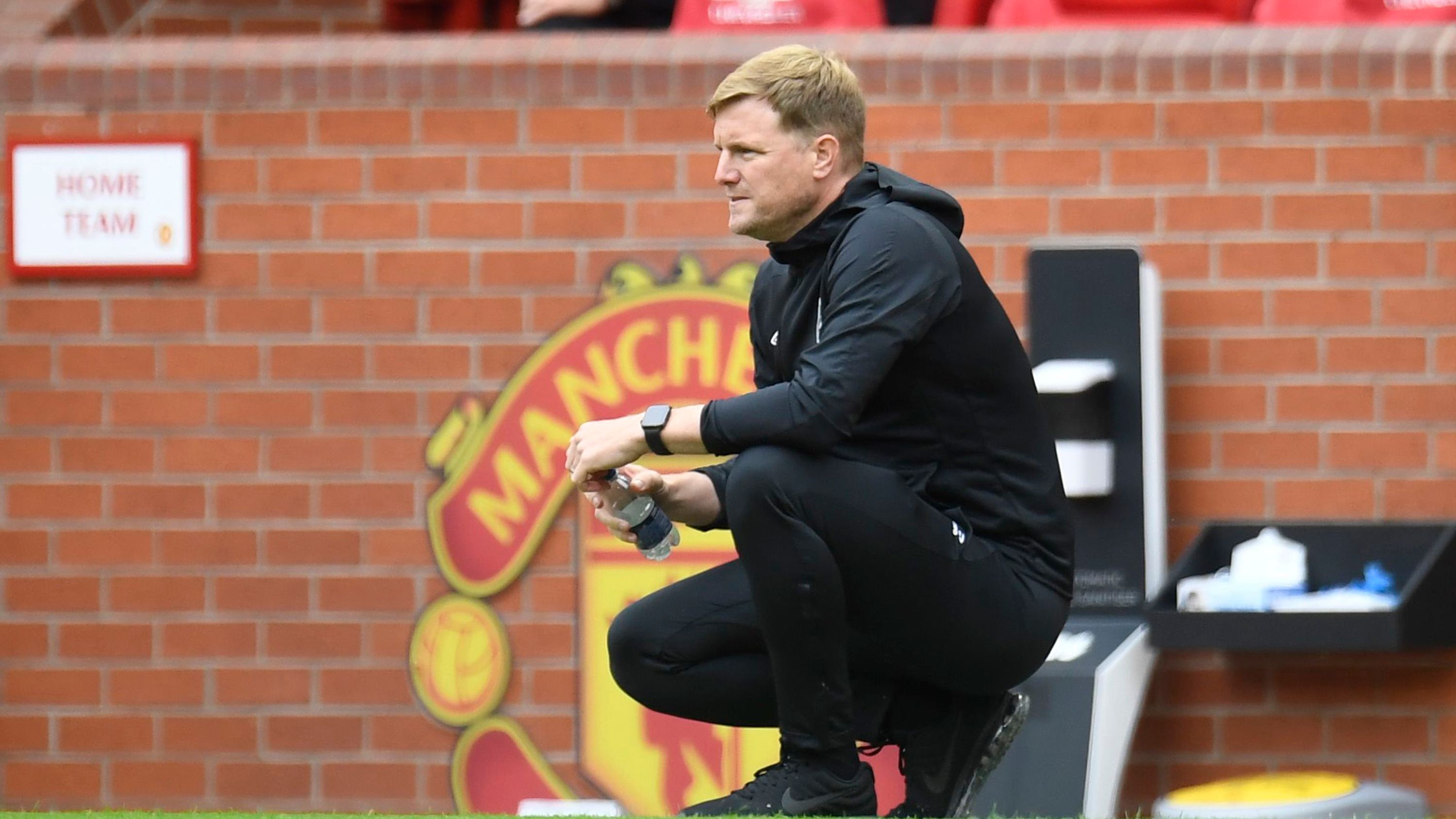

Minefield at Old Trafford: can Eddie Howe survive the Manchester United trap?
Disputes, powers and financial crises
The question echoing through the corridors of Manchester United no longer stops at which coach can drag the team back towards silverware. It now stretches to the very nature of the project the club wants to build, and whether its management can pick the right man to lead it. Michael Carrick faces mounting pressure as results and performances slide, and the name of Eddie Howe has begun to force its way forward as one of the leading candidates to replace him should the board decide to pull the trigger.
From a technical standpoint, the choice of Howe makes plenty of sense. He has transformed a team fighting for Premier League survival into a Champions League contender, and he delivered the EFL Cup along the way.
The move to Old Trafford, though, represents a different beast entirely. It isn't just about fan and media pressure. It's about the administrative structure inside the club, the powers the coach will be handed, and his ability to manage a squad shaped by a long line of managers in quick succession.
One camp sees Howe as the man to restore discipline and stability at United. Another doubts whether he has the personality or the experience to take on one of the biggest jobs in world football. Between the two, several big questions arise: what can the English coach add to the Red Devils? What obstacles might stop him succeeding? And will he be willing to surrender the influence he grew used to at Newcastle?
Ratcliffe's British project: have the calculations within Old Trafford changed?
When Sir Jim Ratcliffe became co-owner of Manchester United in 2024, one idea sat at the heart of his project: rebuilding the team around British players to form a local core capable of giving the club a clear identity over the long term.
Reality proved harder than the plan. The cost of signing local players shot up, and Michael Carrick, the first British coach to take permanent charge in the Ineos era, has struggled.
As the team's form has dipped, doubts have grown over how committed Ratcliffe remains to that original vision. Will the board keep searching for a British coach, or turn to options with different backgrounds?
Should Carrick fail to stop the slide and lose his job, Eddie Howe would be one of the names pushed hardest. He's a British coach with vast Premier League experience, a man who has proven he can build teams, develop players and deliver results beyond his resources.
His nationality and his grasp of English football matter, but what really counts is what he delivered at Bournemouth and Newcastle. In both jobs he built a competitive project despite wildly different circumstances and budgets.
From saving Bournemouth to making Newcastle's glories
Eddie Howe's coaching record demands attention. He didn't land his current standing by walking into a major club. He carved his path gradually, through jobs packed with challenges.
In January 2009, Howe took charge of Bournemouth in brutal circumstances, with the club threatened by relegation from the English second division. He flipped the equation, driving the team on an extraordinary rise that ended with promotion to the Premier League in 2015.
Promotion was only the start. Howe established Bournemouth firmly among the elite despite limited resources, before leaving the club for the second time in 2020.
A year later came a fresh opportunity at Newcastle United, a club mired in poor results and scrapping to avoid relegation. Howe changed their reality in remarkable fashion.
He returned the club to the competitive picture, led them to the Champions League on two occasions, and won the EFL Cup in 2025, ending a 56-year wait since the team's last major triumph.
All of this hands Howe a deep store of knowledge in rebuilding sides, a quality that could make him a fit for United. The club doesn't just suffer from poor results. It needs to reshape its technical identity and restore a culture of competition.
Fan division: does Howe lack the Manchester United name?
For all his successes, floating Howe as Carrick's successor hasn't won unanimous backing around Manchester United.
Some fans argue the 48-year-old lacks the media weight or the coaching history to take charge of a club this size. They want a bigger name, a figure more seasoned in handling stars and the pressure of fighting for major honours.
That scepticism reached some of the club's former stars. Paul Scholes and Nicky Butt showed little enthusiasm for appointing Howe on their own podcast, even though they had backed signing him when Ruben Amorim was sacked last January.
Roy Keane took the other side, suggesting Howe could be a suitable choice to lead the team. Several former Premier League players backed him too, among them Darren Bent, Gareth Barry and Jack Wilshere.
The split lays bare how hard it is to judge candidates for the United job. Some look at a coach's fame and his record with the big clubs. Others focus on his real ability to develop players, improve performance and build a side that can compete.
Fan debate alone won't settle Carrick's future or the identity of his successor. The responsibility sits with chief executive Omar Berrada, sporting director Jason Wilcox and director of recruitment Christopher Vivell.
A decision on Carrick is expected to be the first step, while the outcome of Saturday's clash against Chelsea may shape the direction the club takes in the coming phase.
The bill for departure and signing: the financial obstacle facing Manchester United
Picking the new coach won't be a purely technical call. Finances will weigh heavily on the identity of the man who takes charge at Manchester United.
Should the club dispense with Carrick, they'll have to settle his dues and those of his backroom staff, before weighing up the costs of hiring a new manager.
The sums don't stop there. Signing Eddie Howe could mean paying compensation to Newcastle United under the terms agreed between the two parties when he left the club in the summer.
Multiple sources told «BBC Sport» that Newcastle built in a graduated compensation mechanism, designed to protect their interests should Howe jump straight to another club, with the required figure dropping over time.
According to the available information, that compensation began at £6 million, before halving to roughly £3 million today.
The figure runs to a timetable that ends, per the circulating reports, before the end of the current season. After that, any club or national team can sign Howe without paying Newcastle a penny.
Financially, £3 million is unlikely to be a genuine obstacle for Manchester United, given how freely the club spends in the transfer market.
The issue runs deeper than the compensation alone. The management has burned through large sums appointing and sacking coaches in recent years, without ever landing the technical stability it craves.
That's why Berrada and Wilcox must tread carefully, and avoid a costly new experiment that offers no guarantee of the improvement they're chasing.
Powers and the administrative structure: will Howe accept giving up his influence?
This could be the most sensitive point in any Howe move to Manchester United. The English coach is used to wielding wide influence over the footballing side at his clubs, including a major say in signings.
At Bournemouth, Howe's role went far beyond setting tactics and running matches. He picked the players to suit his project, a process that brought in names such as Nathan Aké, Callum Wilson and Tyrone Mings, before selling them on for significant profit.
Newcastle told a similar story. Howe played a prominent role in signing Bruno Guimarães, Anthony Gordon, Sandro Tonali and Alexander Isak, deals that lifted the team's quality and its market value.
His impact stretched beyond recruitment. He developed others within the squad, such as Dan Burn, Lewis Hall and Tino Livramento, some of whom went on to represent the England senior national team.
United present a different picture. The club runs a clear administrative structure of Omar Berrada, Jason Wilcox and Christopher Vivell, which means the new coach won't automatically inherit the sweeping powers he enjoyed in his previous jobs.
So an important question surfaces: will Howe be ready to work within a system that splits responsibility between the sporting side and the coaching staff, or will he see his reduced influence as a barrier to his ideas?
Working with a sporting director, though, shouldn't be alien territory for him. He collaborated with Richard Hughes and Neil Blake at Bournemouth, and worked at Newcastle alongside prominent figures including Dan Ashworth, Amanda Staveley and Mehrdad Ghodoussi.
The structure at Old Trafford, then, won't necessarily feel strange. The real difference may lie in the scale of administrative interference and how power is carved up inside one of the biggest clubs on the planet.
Wilcox prefers Howe, and Nagelsmann competes for the position
Inside Manchester United, Howe's name clearly interests some officials. Yet there's no full agreement on which coach best suits the project ahead.
Reports suggest Jason Wilcox, the sporting director, leans towards Howe, viewing him as a man equipped to handle the Premier League and rebuild the team.
Christopher Vivell, the director of recruitment, points elsewhere. He favours Julian Nagelsmann, the former Bayern Munich and Germany coach, a very different option in terms of philosophy and European pedigree.
The recommendations are expected to land with chief executive Omar Berrada, before the final decision reaches co-owner Sir Jim Ratcliffe and co-chairmen Joel and Avram Glazer.
What's at stake goes beyond a name. The choice will reveal the kind of project the board wants: a coach with deep Premier League experience, or a figure with a fresh tactical vision and the ability to compete on the biggest stages.
The negativity around Howe's candidacy doesn't seem rooted in clear technical reasons alone. It has coincided with fan fury towards Wilcox, particularly after the 3-0 home defeat to Bournemouth and the criticism of administrative and sporting decisions that followed.
The absent Ferguson legacy: the greatest challenge is not changing the coach
Behind the noise around Carrick, Howe and Nagelsmann lies a deeper crisis: Manchester United's ability to build a long-term project, at a time when coaching continuity has become a rarity in modern football.
Sir Alex Ferguson remains the ultimate proof of what technical stability can deliver. He built an exceptional career at Aberdeen before moving to England to take charge of Manchester United in November 1986.
Since Ferguson walked away, though, the club has failed to find anyone able to reproduce that model, despite a procession of coaches and the different schools of thought each tried to impose.
Fan frustration at the decisions made has only grown since Ratcliffe took his minority stake in early 2024. The board backed a string of coaches, including Erik ten Hag, Ruben Amorim and Michael Carrick, without finding the stability it wanted.
Plenty of supporters believe the problem runs deeper than the coach. It's the administrative structure, the way the recruitment file is run, and the difficulty of forging a cohesive team from players signed under different coaching regimes.
The current squad carries the legacy of six former permanent coaches, each with his own philosophy, style and technical demands, which makes life harder for any newcomer.
Here Howe could find himself facing a challenge far bigger than improving results or restoring discipline in the dressing room. He would need to unite a group of players who were not all chosen according to a single vision, while working inside an administrative system that won't necessarily hand him full control over squad-building.
In the end, Eddie Howe looks an obvious candidate to succeed Carrick, just as he may be a strong contender for the England job should it fall vacant.
The real question isn't whether Howe is a good coach. He's already proven that at Bournemouth and Newcastle. It's whether Manchester United can offer the right environment to make his project work, and whether the man himself is ready to take on what might be the biggest adventure of his career.
Howe may be the man to rebuild the Red Devils. But his appointment will count for nothing if the administrative and technical problems that toppled his predecessors remain. That, perhaps, is the truth Ratcliffe and his board must settle before they choose the next name.


