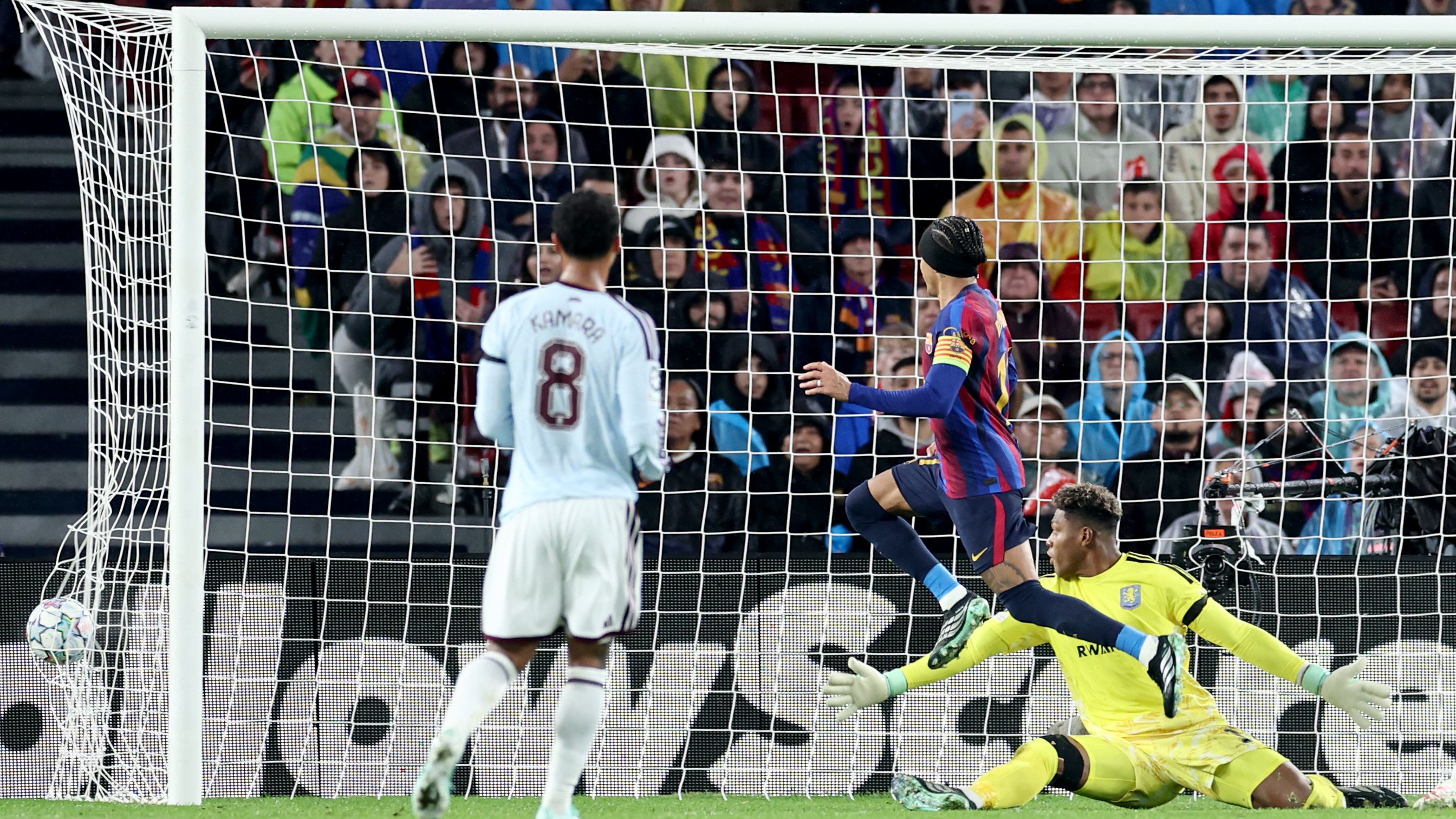

Barcelona vs Aston Villa: The tactics board - How Hansi Flick exploited Emery's high line and unleashed Lamine Yamal and Raphinha
Barcelona dismantled Aston Villa with a clinical 3-0 victory at the Spotify Camp Nou, driven by Lamine Yamal's early brilliance and a Raphinha brace. The tactical battle saw Hansi Flick's fluid 4-2-3-1 exploit the spaces behind Unai Emery’s disciplined but vulnerable high defensive line.
The tactical narrative at the Spotify Camp Nou was a clash between Barcelona's relentless verticality and Aston Villa's rigid defensive structure. Flick sought to control the game through high-tempo transitions and overloading the half-spaces, utilizing the creative gravity of Pedri and Lamine Yamal to pull Villa's compact block out of shape. By maintaining a high defensive line of their own, Barcelona intended to compress the pitch and force turnovers in the attacking third.
Unai Emery, conversely, arrived with a blueprint focused on defensive resilience and vertical counter-attacks. Villa’s primary objective was to maintain a narrow mid-block to deny Barcelona central penetration, while looking to exploit the pace of Nicolas Jackson on the break. However, the plan was compromised as early as the seventh minute, forcing Villa to chase the game and inadvertently opening the very gaps they were designed to protect.
Barcelona's tactical setup
Flick deployed a 4-2-3-1 system that functioned more like a 2-3-5 in possession. The double pivot of Rodri and Fermin Lopez provided a platform for the full-backs, Joao Cancelo and Gerard Martin, to push high and wide. The primary tactical instruction was to create 1v1 situations for Yamal on the right flank. This bore fruit in the 7th minute when Yamal found the breakthrough, punishing Villa's left side.
Barcelona's pressing triggers were hyper-specific: whenever the ball was played into Villa's double pivot of Kamara and Gomes, Barcelona’s front four would initiate a coordinated man-oriented press, forcing long balls that Pau Cubarsi comfortably cleaned up.
The build-up play was orchestrated by Pedri, who constantly dropped between the lines to facilitate ball progression. Raphinha, operating as a nominal left winger but often drifting centrally, acted as a second striker. This movement was vital for the second and third goals, as he exploited the space created by Fermin Lopez’s decoy runs. The defensive shape was characterized by an extremely high line, which successfully caught Villa offside three times and limited the visitors to just a single shot on target despite their nine attempts.
Aston Villa's tactical setup
Emery matched Barcelona’s 4-2-3-1 formation but with a vastly different application. Villa focused on a compact horizontal and vertical distance between their defensive and midfield lines. Matty Cash and Ian Maatsen were instructed to stay home to counter the threat of Barcelona’s wide men, but Maatsen struggled early against Yamal’s trickery. In possession, Villa looked to use Boubacar Kamara as the primary outlet to find John McGinn and Emiliano Buendia in the pockets, but they were frequently swamped by Barcelona's counter-press.
The plan relied heavily on the athleticism of Nicolas Jackson to stretch the Barca backline. While Villa managed to earn eight corners, their lack of clinical edge in the final third was evident, recording an xG of just 0.78 compared to Barcelona's 1.96. The defensive high line, a hallmark of Emery’s Villa, eventually became their undoing.
As fatigue set in and the need to equalize grew, the distance between the defenders and goalkeeper Zion Suzuki increased, allowing Raphinha to run into depth for both of his second-half goals.
The tactical chess match
The match was decided by the battle for the half-spaces. Flick’s decision to give Raphinha a free role proved to be the winning move. By drifting inside, Raphinha forced Villa’s centre-backs, Victor Nilsson Lindelof and Pau Torres, into uncomfortable decisions: either step out and leave space behind, or drop deep and allow Raphinha to receive between the lines. They chose the latter for much of the first half, but the sustained pressure eventually led to the breakdown of their shape.
Emery’s tactical gamble was to keep the high line even after going behind. He banked on his side’s ability to catch Barcelona offside, but Flick countered this by using third-man runs. Instead of the ball-carrier looking for the direct pass, Barcelona used Lopez as a bridge to find Raphinha in stride. This systematic dismantling of the offside trap allowed Barcelona to kill the game off in a twelve-minute window in the second half.
In-game adjustments
Flick showed proactive game management at half-time, replacing Rodri with Marc Bernal to add fresh legs to the base of midfield. This allowed Barcelona to maintain their high-intensity press which had begun to flag late in the first half. The introduction of Gavi and Frenkie de Jong later in the match solidified the central areas, shifting the team into a more possession-oriented 4-3-3 to see out the result. These changes effectively stifled any hope of a Villa comeback by depriving them of the ball.
Emery responded with a triple substitution in the 62nd minute, introducing Leon Goretzka, Ibrahima Mbaye, and Ross Barkley. The intent was to add physicality and better ball retention in the middle of the park. However, just two minutes after these changes, Raphinha scored his second goal to make it 3-0, effectively rendering the tactical shift moot. The late introduction of Tammy Abraham for Jackson was a final roll of the dice to go more direct, but against a settled Barcelona block, it failed to produce a breakthrough.
Conclusion
Ultimately, Barcelona's superior execution of the transition phase decided the contest. While Emery’s defensive structure was organized, it could not withstand the individual brilliance of Yamal and the intelligent movement of Raphinha. The 65% possession enjoyed by the hosts allowed them to dictate the tempo and wait for the inevitable lapses in Villa’s high line. Flick won the tactical battle by manipulating Villa’s defensive spacing, ensuring that his side’s 1.96 xG was converted into a dominant three-goal margin, moving them above Villa in the Champions League standings.