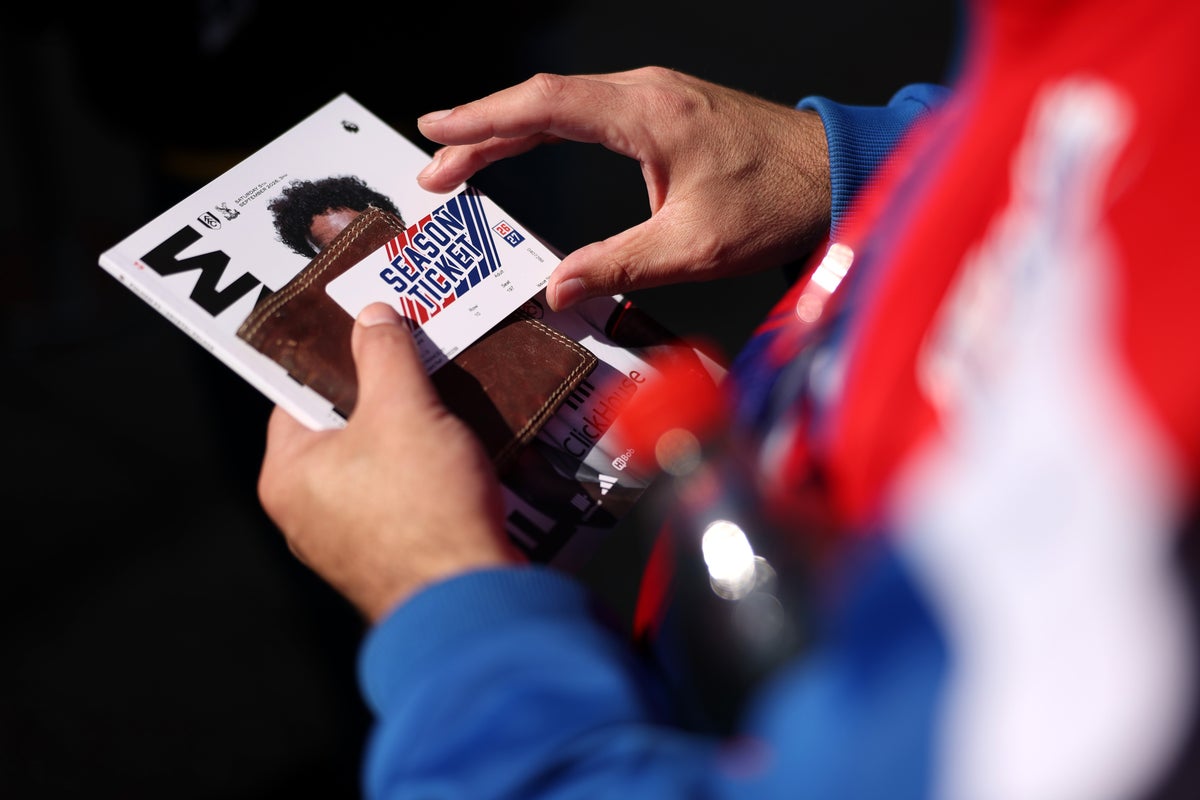

The biggest fear behind the Premier League’s controversial move to digital football tickets
It is described as the Premier League’s “secret civil war”, except it’s very public. So much so that it affects the majority of those who fill stadiums every single week. It affects the lifeblood of football… but then the entire point is that this isn’t something tangible you can touch.
This season’s full introduction of digital tickets has affected fan behaviour and community.
You can see it in queues outside games. You can hear it in discussions on the difficulty of “passing on” tickets, and arguably even atmosphere.
Duncan Drasdo of the Manchester United Supporters Trust says, “it absolutely impacts fan culture”.
The Football Supporters’ Association say they are “monitoring” how it progresses but it all plays into a deeper sense, that there is a long-term aim to eventually end season tickets altogether.
Multiple clubs contacted for this article strenuously dispute this, and many are quite strident on their position.
The move comes from a vote in the summer of 2024, where there was effusive support for the mandatory introduction of digital tickets from the start of this season. This essentially means doing away with old physical tickets - although clubs can still give them out in special cases - for ones now scanned. And, if holders can’t go, they can pass to selected family and friends, or put on the club exchange.
The other is increasing safety, and knowing everyone who is in the stadium. It inherently conditions better behaviour, since anyone can be tracked.
Fan groups accept parts of these arguments, and would acknowledge that a lot of their clubs directly engage, but sympathy has been eroded by direct experience. Almost immediately, there were long queues outside games, many of which have lingered. Most pertinently, though, there is the sudden negating of what has long been normal. Every season-ticket holder will know it, as will those who use their tickets. “Passing on” is a lot more difficult, as clubs increase obligation for the ticket to be used in some form.
“And passing it on is absolutely fan culture,” says Gareth Roberts, of Liverpool’s Spirit of Shankly group. Drasdo adds: “It’s what creates community.”
A common complaint is that it now involves more laborious processes, and doing it unofficially potentially risks a ban, when you used to be able to just hand it to someone.
“Not just talking about Liverpool here, but I do know of fans who do get worried about it,” Roberts says. “There are so many rules and regulations to take in, it’s almost like taking an exam. It feels a heavy load to be a supporter.
“Through not filling in the initial form as they wanted, I have one mate who can’t go to Champions League games and two who can’t go to cups. The assumption is that everyone is digitally literate, but they don’t.”
This has practical concerns, too, if a fan can’t go at short notice.
“We’ve been saying there should be ways to do this,” Roberts says. “You’re not setting up a business and earning from this. OK, there are touts but they have to think of ways to not impinge on traditional fans.”
Darren Epstein, a Gold Rep at Arsenal, says the complication of it all is under-appreciated: “In days gone by, we’d be talking about managers and tactics. Now it’s when away tickets go on sale, collections, ID checks, and points - points being the loyalty points you get on buying an away ticket.
“It feels like a constant battle to ensure you get to a game. Although, changes have undoubtedly improved the ability of many fans to get to games they never have been able to before, which many of course feel is a good thing.”
A connected complaint is that this is one more factor affecting traditional atmospheres.
“If it’s the club re-selling the ticket on the exchange, it changes the profile of the support, introducing a random fan into a group of mates,” Drasdo says. “In the old standing sections you were able to congregate with friends but the introduction of all-seater stadia meant people got split up by where their seats were and we lost that mobility which is the key to atmosphere."
Tom Concannon of the FSA, speaking as a Newcastle United fan, says: “Atmospheres are worsening because of it in my opinion. Tickets are going to those wanting to experience the atmosphere rather than contribute to it.” Roberts adds: “Atmosphere is dependent on youth vibrancy. The Kop is pretty old now.”
Even in simple terms, it’s a lot harder to pass on tickets to children who may not have a phone, but that clubs actively need to get that match-day buzz. Fan representatives would similarly say it doesn’t help that the Premier League’s clubs’ ticketing working group only has heads of ticketing on it, rather than actual match-going fans.
Such concern feeds into a deeper tension in all of this, between being a supporter and being a customer. An irony is that it means fans have less control over what they pay for. As one executive says, “if you’ve bought your season ticket, you should have no obligation to sit in the seat”.
Another perspective is that clubs are being more strict and trying to get control of every ticket they can. One industry figure points to how the same data from digital tickets has allowed clubs to see just how often tickets are passed on, and it has stunned them. One club has estimated that 20-25 per cent of tickets are passed on, which they also see as running contrary to what a season ticket is supposed to be.
Or, as some fans put, they realised they could monetise. Tickets not passed on can be put on the ticket exchange, where FSA research shows prices are considerably higher than the average for a season-ticket seat.
Club sources would say they deliberately decoupled the season-ticket price from match-by-match, to recognise the value of a season-ticket holder.
Drasdo offers a different view: “A common phrase we hear from our fans is ‘the club are the biggest touts of all’, which is essentially a reaction to the restrictions on usage and the premium prices we see when season ticket holders' tickets are resold by the club.
“A major problem we’ve had at United is stretching the gap in price between season ticket holders and member ticket prices which causes the club to focus on how season ticket holders pass on their tickets when not personally attending.”
Another knock-on has been what Roberts describes as the “normalisation” of fans who don’t have season tickets paying fees to become members to go into lotteries for tickets. Some clubs even charge for transferring. Most clubs have unlimited membership, meaning there is actually less chance of getting a ticket.
“We’ll never really know how many tickets end up in the hands of actual fans,” Concannon says. “Hospitality numbers are on the rise.”
Clubs would nevertheless insist they are acutely conscious of this, and they have to allow opportunities for fans on long waiting lists, or who otherwise feel shut out of being able to go to games. That has fostered tension between supporters, as well as between supporters and clubs. Fans who speak out often find themselves shouted down by others who say “if you don’t pay it, I will”.
And yet such demand comes at a different cost, as anecdotal evidence suggests a lot of long-time supporters are being worn down. “There’s an underbelly of that growing, that clubs don’t realise,” Roberts argues. “If you’re constantly made to jump through these hoops.”
Such weariness has even been deepened by two other concerns. One is this long-time fear that clubs actually want to get rid of season tickets, so they can sell more seats for higher prices. Club sources are adamant that is not the case, as illustrated by how season tickets stripped from some fans are redistributed to those on the waiting list. Whether that is true or not, a step like this could serve as a halfway step for the future.
Clubs themselves would point to escalating player costs and fans wanting the best possible team on the pitch but, as with redundancies, this is dismissed. “A nonsense notion,” Concannon says, “£25 from every fan at every Premier League game only just paid the agents’ bills last season.”
One chief executive actually links the entire issue to the financial rules. “The point of forcing bums on seats should be atmosphere,” they say. “The ugly extra money-making for clubs is not on. Clubs do need protection - if they had cost-control protection they would not be fleecing fans.”
Some clubs would accept there could have been better communication. For now, if you go to a game this weekend, it’s what a lot of fans are talking about.