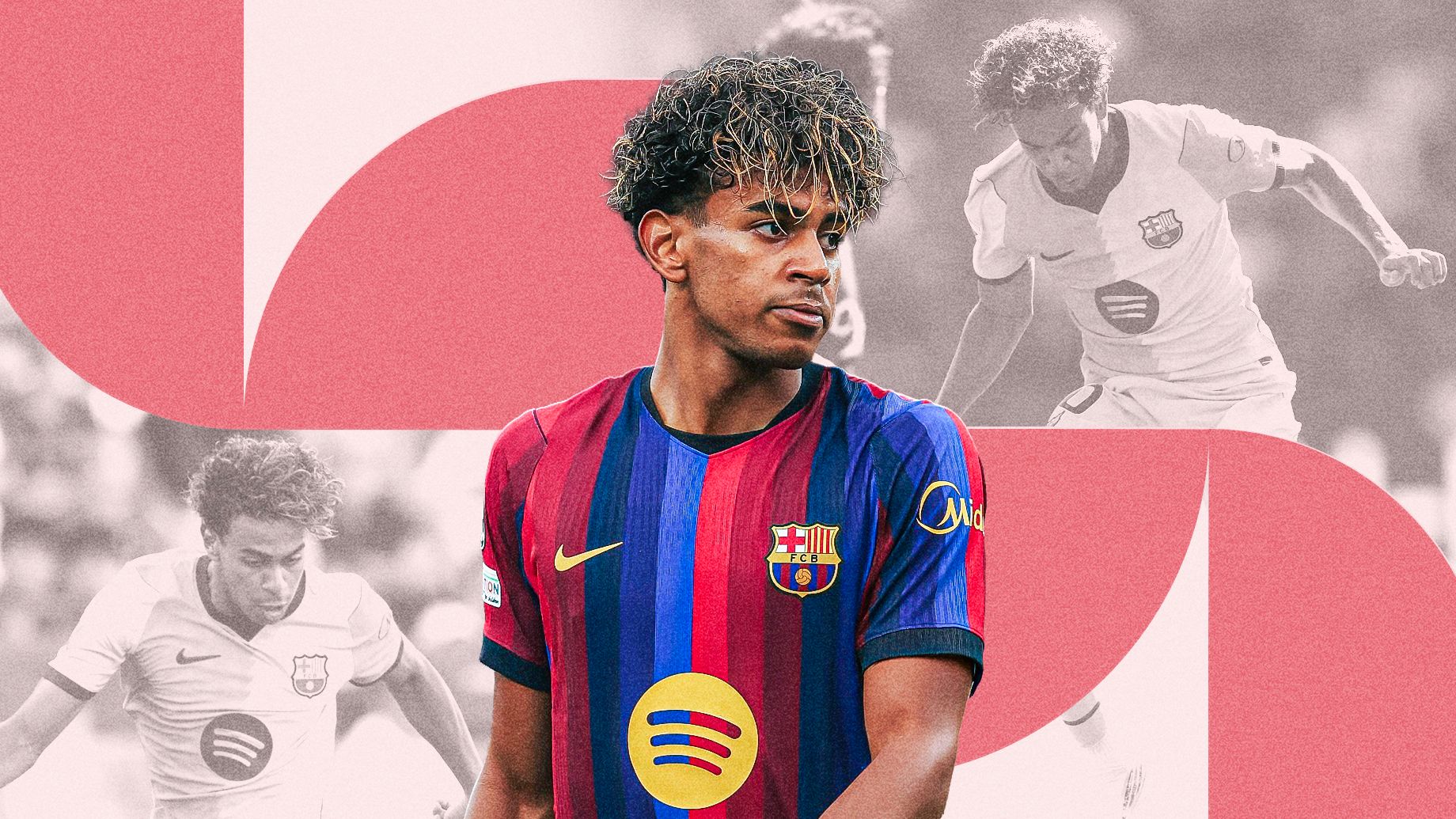

Raphinha the latest example: are the fans moving against Yamal's direction?
An open debate around two contradictory viewpoints
Lamine Yamal opened a controversial door shortly before the Ballon d'Or winner was announced, questioning the criteria behind the award. Too much focus on goals and titles, he argued, risks pulling it away from its essential core: choosing the best player in the world.
The Barcelona star told "Movistar Plus" that winning the Champions League makes a team the best, so the club gets its own award. The Ballon d'Or should go to the best individual player, he insisted, not necessarily the one who scored 80 goals, because the season's top scorer already collects the top scorer award.
Yamal's remarks don't stand alone in this debate. They partly echo the view of Kylian Mbappé, though the France star leans harder on goals and numbers. Read: Mbappé: I am the best in the world, and I score more than Raphinha and Dembélé
Opposite direction
Mbappé takes a different view to Yamal. He sees the Ballon d'Or as an individual award, but he insists that scoring goals and winning titles aren't contradictory choices. He wants both. His goalscoring figures, he argues, earn him the right to enter the race as a genuine contender.
At the 2026 World Cup, Mbappé scored 10 goals to finish as the tournament's top scorer. He also ended the season as the leading marksman in both La Liga and the Champions League.
Two very different visions of the Ballon d'Or now stand side by side. One player believes influence in a match can't be reduced to a goal tally. The other believes goalscoring output and decisiveness are numbers you simply can't ignore when the debate turns to the best player in the world.
Raphinha's hat-trick reveals the paradox
Barcelona's latest match against Sevilla offered a practical example of this debate.
Barcelona ground out a hard-fought 3-1 win over Sevilla, and Raphinha topped the headlines after scoring all three goals, two of them created by Lamine Yamal.
The fans' man of the match poll told its own story. Raphinha collected 35,756 votes out of 38,646, roughly 92.5% of the total.
Yamal delivered a technically stunning performance of his own. Two assists, six key passes, three big chances, five shots and a strike off the post. Most importantly, he played the biggest role in dismantling the Andalusian fortress with mesmerising dribbles and a genius link-up between the elements of the system, making him Barca's true attacking maestro.
The irony here is not that Raphinha did not deserve the praise. Quite the opposite. He scored a hat-trick that carried Barcelona to victory and played a more than brilliant match for which he deserves praise and commendation to the highest degree.
Yamal, though, was directly involved in two of the three goals, both statistically and in terms of influence, and created the greater part of the attacking threat that produced the decisive outcome.
For anyone who watched the match, Raphinha provided the final touch, while Yamal was the reason behind this decisive result.
And here the real question begins.
Does the audience unconsciously focus on the final scene?
Fan voting in a single match may not settle how players are evaluated, but it lays bare the nature of public perception.
A goalscorer's impact is visible and direct. Judging the player who creates the chances, imposes his dominance and slides in the final pass demands a deeper reading of the match.
This isn't a problem for Yamal or Raphinha alone.
The issue runs wider, and it comes down to how you define the "best player".
Is the best the man who proves most decisive in front of goal? Or the one who shapes the game, even without putting the ball in the net?
Recent Ballon d'Or history offers no single answer.
Different models
Between 2016 and 2025, the award threw up winners of wildly different profiles.
Cristiano Ronaldo took it in 2016 and 2017, two seasons in which he married prolific goalscoring with major silverware.
Luka Modric offered a different model in 2018. The Croatian was no prolific scorer, yet he paired his Real Madrid campaign with a run to the World Cup final, and he also picked up the award for best player at the tournament.
Karim Benzema proved another case of the criteria aligning in 2022. He dragged Real Madrid to the UEFA Champions League and the Spanish league title, and he ranked among Europe's leading marksmen.
Two years later, the vote fell to Rodri. The midfielder was never in the running for the top scorer title, but he combined the Premier League with the European Championship with Spain, and won the award for best player at Euro 2024.
Lionel Messi, meanwhile, won in 2019, then 2021, then 2023. The 2022 World Cup stood as the most prominent collective factor in his latest triumph, while the UEFA Champions League was absent from those victories.
Ousmane Dembele came out on top in the 2025 edition. He tallied 35 goals, 16 assists and five titles with Paris Saint-Germain, including the UEFA Champions League, finishing ahead of Yamal in second.
History, then, offers no rule that the goalscorer always wins. Nor does it offer the opposite: that the most creative player necessarily beats the one with the numbers.
What do the official award criteria say?
Most important of all is that the Ballon d'Or's own regulations do not make goals or trophies a single, standalone criterion.
The official criteria for the 2026 edition put individual performances and their decisive, impressive character first, followed by collective performance and titles, then conduct and sportsmanship.
That distinction matters enormously.
Goals naturally fall within the assessment of individual performance and decisiveness, but they are not a separate item granting a player an automatic advantage.
Titles work the same way. Winning the UEFA Champions League or the World Cup can weigh heavily in the assessment, but on its own it does not settle the award.
The voting mechanism itself confirms this is no public vote.
A panel of 100 specialist journalists determines the Ballon d'Or, each representing one of the top 100 countries in FIFA's men's ranking. Every journalist picks 10 players from a list of 30 nominees, with different points awarded for each position.
Who will win?
The Ballon d'Or battle, in the end, is not merely a struggle between "goals" and "performance". It is a clash between two different ways of defining the best player.
One view holds that the most productive and decisive player in terms of numbers should carry greater weight in the assessment.
The other looks at the complete picture: creating chances, influencing the flow of play, changing a match, and turning up in the big moments, even when the player's name is nowhere among the goalscorers.
Raphinha offered a clear example of the value of the final touch.
Yamal, in the same match, showed the value of influence.
The Ballon d'Or's official criteria place individual performance and influence side by side at the forefront, followed by team performance and titles, without making either an automatic rule.
Herein lies the paradox worth debating: is the best player the one who scores the goal, or the one who makes victory possible?
The answer will not come from the vote of one match's fans, nor from goals alone. It will come from the way 100 journalists choose to interpret the meaning of "the best player in the world" when they cast their votes.