


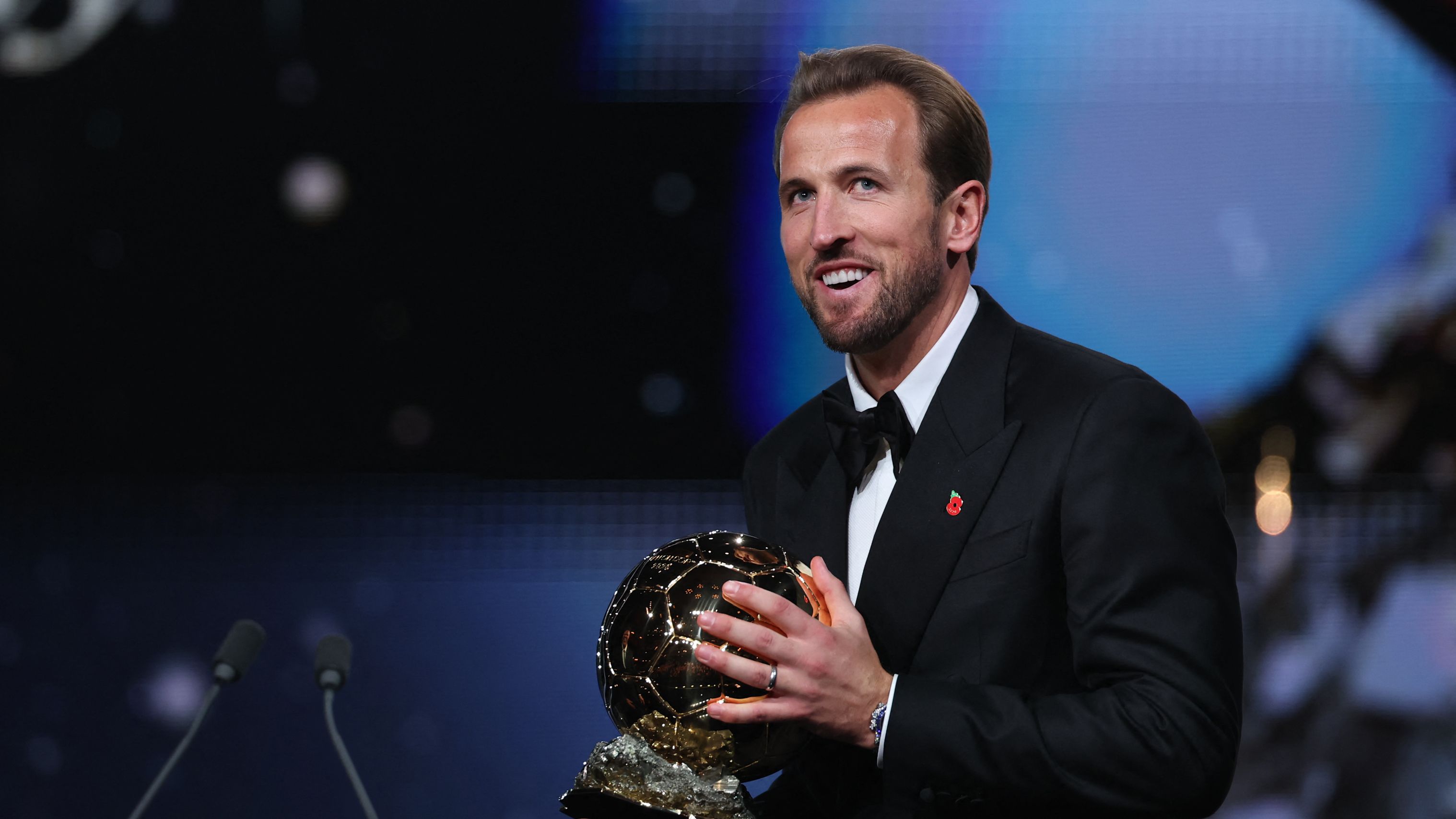

Harry Kane beats Mbappé and Yamal in cold blood: how he defied the odds and snatched the Ballon d'Or
The Englishman breaks a 25-year wait without a Champions League or World Cup!
Goals alone rarely open the doors to glory, and trophies do not guarantee a seat on the throne of the world's best. Harry Kane decided to write his own tale. He surpassed the expectations that had trailed him for years, transforming from a striker whose ability to reach the summit some had doubted into a Ballon d'Or winner, holder of the most prestigious individual award in the game.
England had waited a quarter of a century. Not since Michael Owen in 2001 had one of their players claimed the prize, and the Bayern Munich striker and national team captain ended that drought at a ceremony in London, becoming the fifth Englishman to do so amid fierce competition from the biggest stars in world football.
Kane's crowning was no mere reward for an exceptional goalscoring season. It carried a different story. The award came despite his failure to win some of the biggest titles, at a time when expectations leaned towards other names, among them France's Kylian Mbappé and Spain's Lamine Yamal.
So how did Kane turn the equation on its head? What made his numbers enough to tip the scales in his favour? And does this crowning mark the beginning of a new era for the English striker, or will retaining the Ballon d'Or prove the toughest test of his career?
25 years of waiting: Kane brings the Ballon d'Or back to England
Harry Kane has written his name into English football history. The Bayern Munich striker is the first Englishman to win the Ballon d'Or since Michael Owen in 2001, ending a 25-year wait and putting England back at the sharp end of the game's most prestigious individual prize.
Kane becomes only the fifth English player to claim the award, following Stanley Matthews in 1956, Bobby Charlton in 1966 and Kevin Keegan in 1978 and 1979. His story stands apart from theirs, built on goals, relentless consistency and the knack of delivering across more than one competition.
Other British winners stretch the list further. Scotland's Denis Law took the prize in 1964 and Northern Ireland's George Best followed in 1968, two more names that left their mark on the award's history.
France's Kylian Mbappé, the Real Madrid striker, finished second. Spain's Lamine Yamal came third, the Barcelona teenager forcing his way into the conversation among the frontrunners thanks to his dazzling talent and his impact on the Catalan side.
Kane made no attempt to hide his astonishment. "Many did not expect me to reach here, and perhaps I myself did not expect to reach this level," he told DAZN.
"I went through a lot of ups and downs, especially at the start of my career," he added. "I was never that player whom people regarded as a future great star, as is the case with some players today".
The England striker continued: "I had to be patient and work hard. On many occasions I had to wrestle with myself, and I had to overcome that through self-belief and determination".
That journey, he explained, kept him humble and grounded even at the top, and he insisted the constant hunger to develop and improve was among the biggest reasons for his success.
Fans and the media were not alone in marking the moment. Thomas Tuchel, the England manager, voiced his delight at his captain's crowning, calling the award "a great honour".
Prince William joined the praise too, describing the former Tottenham Hotspur striker as "a wonderful captain and an exceptional player", a nod to the standing Kane now enjoys inside English football and well beyond it.
An exceptional season in numbers: 61 goals with Bayern Munich
Harry Kane's Ballon d'Or did not come down to impressions or popularity. It rested on goalscoring numbers so exceptional that they carried him clear of his rivals last season, in one of the finest individual campaigns of his career.
The England striker scored 61 goals in 51 matches for Bayern Munich last season, a club record for a single campaign. He also outscored every other player in Europe's big five leagues by a margin of 19 goals, according to the season's figures.
Consider the scale of it. Kane matched the tally Cristiano Ronaldo managed with Real Madrid 11 years ago, when the Portuguese struck 61 in a single season. That places the England striker alongside one of the most prolific goalscorers the game has seen.
In the Bundesliga, Kane topped the charts with 36 goals, 17 clear of his nearest rival. It was a tally that laid bare his dominance over every other forward and his knack for turning chances into goals week after week.
He added 14 in the Champions League, driving Bayern Munich to the semi-finals even if the side fell short of the final and the continental crown.
Ten goals followed in the German Cup, three of them in the final as Bayern thrashed Stuttgart 3-0, according to the season's data. He also chipped in with a goal in the German Super Cup.
Kane did not simply rack up goals in one competition. He imposed himself across every tournament he entered, becoming the most prominent figure in the Bavarian system, according to "BBC Sport".
Those numbers carry extra weight given Bayern Munich's history. The shirt has been worn over the years by legendary strikers such as Gerd Müller and Karl-Heinz Rummenigge, right through to Robert Lewandowski, who left his own extraordinary mark on the club's scoring record.
Even so, Kane beat the club's previous single-season figures. He became the first Bayern Munich player to win the Ballon d'Or since Rummenigge in 1981, returning the award to the Bavarian giants' trophy cabinet after a long wait.
73 goals in a single season: an achievement that places Kane among the legends
Kane's numbers did not stop at Bayern Munich. Add his England goals and the overall total climbs to 73 for the season, along with eight assists in 65 matches for club and country.
Twelve of those goals came with England during the same period, six of them at the World Cup. His brilliance, then, was not tied to the German club alone. It carried over to the international stage too.
That tally places the English striker on an exceptional list of the greatest goalscorers in football history. Only one player has scored more in a single season across Europe's major leagues: Lionel Messi, who netted 82 goals for Barcelona and Argentina in 2011-2012.
Gerd Müller scored 72 during the 1972-1973 campaign, while Cristiano Ronaldo hit 66 in both 2011-2012 and 2014-2015. Brazil's Ronaldo managed the same in 1996-1997.
Norway's Erling Haaland also makes the list with 64 goals in 2022-2023, matched by Uruguay's Luis Suarez in 2015-2016.
Put simply, Kane did not just enjoy a good season. He came within touching distance of numbers posted by names that reshaped modern football, and that gives his Ballon d'Or case serious weight.
Alan Shearer, the former England striker, was in no doubt. "Harry Kane should be the winner of the Ballon d'Or," he told BBC Sport.
"His numbers over the last twelve to eighteen months have been absolutely staggering, whether with Bayern Munich or with the England national team," Shearer added. "For that reason, he deserves to win it."
Danny Murphy, another former England man, called Kane's goalscoring relentless. He reckons the striker produced one of the best seasons of his career, and that the award would be a deserved reward for it.
Kane has adapted superbly at Bayern Munich since joining, Murphy noted, branding him the best out-and-out striker in the world over the last twelve months.
Without a Champions League or a World Cup: why did Kane win?
Perhaps the most striking aspect of Harry Kane's crowning was his success in winning the Ballon d'Or without claiming one of the biggest titles that usually shape the identity of the award winner.
Most of the great individual triumphs have come tied to a UEFA Champions League, a World Cup or a continental crown. Kane reached the podium after Bayern Munich fell short in Europe, knocked out in the Champions League semi-final.
True, the German side swept the domestic double last season. Yet those titles carry nowhere near the weight of the Champions League in the Ballon d'Or race, which left Kane's individual numbers as the decisive factor tipping the balance his way.
That outcome proves the voting no longer leans solely on silverware. Voters weighed the level of individual performance, the impact on results, consistency across the season and the ability to produce exceptional numbers in every competition.
From its establishment in 1956 until 1995, the Ballon d'Or was open only to European players. Then the door swung open to players of all nationalities, a shift that widened the pool of candidates and changed the nature of the race.
Since then, World Cup years have handed the crown to the tournament's winner on four occasions. Messi's 2023 award stood as an exception, tied to the Qatar World Cup being staged in the winter of 2022.
A World Cup winner's victory was never inevitable, though. Messi, Cristiano Ronaldo and Luka Modric had all previously claimed the award in years when they did not lift the trophy.
This marks only the fifth time in the past twenty years that the prize has gone to a player who won neither the World Cup, the UEFA Champions League, the European Championship nor the Copa America, according to the tally in the report. Kane joins a list also linked to three of Messi's crownings.
Lamine Yamal stood among the leading candidates, boosted by his World Cup triumph with Spain according to the data provided and his brilliance with Barcelona. The award settled on Kane, whose individual case proved too strong to ignore.
Last year, Ousmane Dembele won the Ballon d'Or on the back of a Champions League triumph with Paris Saint-Germain. It showed just how heavily the big titles can sway the voting.
Kane's case was different. He imposed himself through goalscoring numbers unprecedented in Bayern Munich's history and an overall tally that ranks him among the finest scorers the game has ever seen. The absence of a European title, it turns out, need not cancel out the value of an exceptional season.
Celebration at Wembley: can he hold on to the Ballon d'Or?
Kane's crowning sparked widespread celebration back home. Wembley's arches glowed gold on Monday evening, a symbolic nod to the scale of what the England captain had achieved.
That celebration carried special weight. No English player had got near the Ballon d'Or since Owen lifted it at the start of this century, despite generation after generation of stars shining for club and country.
For Kane, the award crowns a career that was rarely straightforward. He has spoken openly about the struggles of his early days, and about not being tipped as one of the standout talents destined for the top.
Seen that way, the award looks like far more than recognition of a prolific season. It is a tribute to years of development, graft and patience that carried Kane to his place among the best strikers on the planet.
He had barely finished celebrating before talk turned to his chances of winning it two years running, fuelled by a blistering start with Bayern Munich this season.
The England striker has scored 10 goals in his first 12 matches for the German side. Add six goals in four UEFA Nations League outings with his country and his tally climbs to 16 in 16, according to the figures in the report.
Bayern have matched his individual brilliance with a flying start of their own, unbeaten in the Bundesliga and the Champions League. That keeps Kane firmly in the hunt for titles and records.
Should the club land the treble and Kane keep scoring at almost a goal a game, leaving him off the shortlist for the next award will be tough, especially with no World Cup, European Championship or Copa América on the calendar this season, according to the available data.
Retaining the Ballon d'Or is another matter entirely. It demands sustained individual brilliance, strong collective results and the ability to see off rivals who can tilt the race at any moment.
Set Messi and Ronaldo aside and the last man to win it in consecutive years was the Netherlands' Marco van Basten, crowned in 1988 and 1989. That gap underlines just how hard it is to do twice amid such fierce competition between the game's stars.
Yamal and Mbappé: a new rivalry on the horizon
Kane won't have the race for the next Ballon d'Or to himself. Lamine Yamal keeps climbing among the world's elite, and the report ranks him third among the current frontrunners.
The Spanish teenager has torn into the season, scoring 10 goals and setting up 10 more in 13 matches for Barcelona across La Liga and the Champions League. Those numbers show a player who hurts opponents just as easily by creating as by finishing.
Barcelona rank among the favourites for the Champions League, and lifting that trophy could tip the balance in Yamal's favour. He would need to hold his current level and keep churning out the numbers.
Win the award next year and Yamal will be 20, the youngest player ever crowned with the Ballon d'Or, according to the report's forecast. Ronaldo still holds the record, claiming it in 1997 at the age of 21.
Kylian Mbappe wants his first Ballon d'Or too. The Real Madrid striker has scored 14 goals in 13 matches for club and country, proof that he'll stay firmly in the mix.
This is no three-man fight. Arsenal and Paris Saint-Germain both loom large among the sides tipped to go deep in the Champions League. No Arsenal player has ever won the Ballon d'Or, while PSG could push their own stars into the conversation if they keep chasing the big trophies.
What makes Harry Kane's story different is that his road to the Ballon d'Or was never smooth or inevitable. It came from years of graft and growth, as the player himself has made clear.
He turned his finishing into a decisive weapon, established himself in one of Europe's toughest leagues, then kept shining on the continental and international stage until his figures stood comparison with the game's legends.
Bayern Munich handed him a fresh platform in a different competitive setting. That alone wasn't enough. He had to deliver an exceptional season for goals, impact and consistency.
Kane clinched the race despite the lack of major silverware last season, handing England their first Ballon d'Or since 2001 and dragging Bayern Munich back among the award's winners, decades after Rummenigge's crowning.
Record numbers, the weight of competition and the grind of staying on top now frame a new chapter for the England striker. He no longer has to prove he can reach the elite. The test is harder: holding his place among the world's best, and turning that first Ballon d'Or into the start of something historic.


