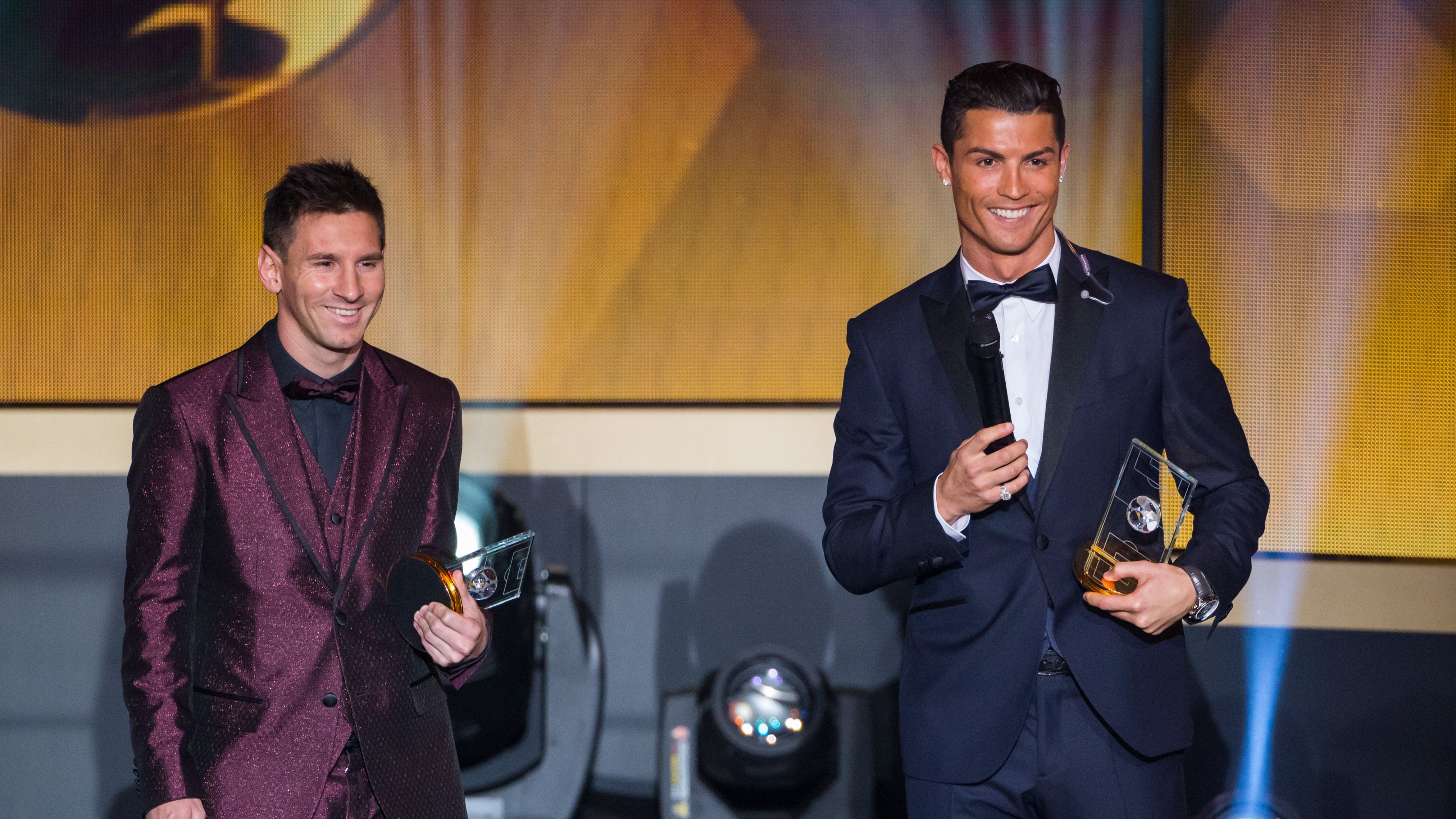

Surprise in the Ballon d'Or calculations: Cristiano Ronaldo surpasses Messi and Real Madrid sweep past Barcelona!
The Ballon d'Or is no longer merely an annual race in which the world's best players compete to seize football's most important individual honour. Over almost seven decades, it has turned into a historical record documenting the rise of legends, the shifting balance of power between clubs and national teams, and the eras during which particular names imposed their dominance on the game. But what if the comparison went beyond the number of times a player won the award? What if every participation, every high finish, and every brush with the summit counted, so that the history of the Ballon d'Or could be rewritten from an entirely different angle?
That question opens the door to a thrilling statistical showdown between football's giants, reaching past traditional comparisons to measure continuity and influence across generations. In a comprehensive statistical study, Santi García Cremades set out to reorder the award's historical landscape, converting players' positions in the annual vote into cumulative points. The method measures long-term presence rather than simply the number of Ballon d'Or trophies each star lifted.
The results threw up surprises worth pausing over. Real Madrid topped the list of the most influential clubs in the award's history, finishing clearly ahead of rivals Barcelona. Cristiano Ronaldo took first place in the individual points ranking, edging out Lionel Messi by a narrow margin, despite the Argentine's superiority in Ballon d'Or wins and average points per participation.
Germany imposed themselves at the top of the nationalities list, benefiting from a long legacy built by successive generations of stars. The figures also revealed clear differences between countries and clubs in how they built their historical presence, whether through a broad group of players or by relying on the genius of an exceptional star, according to the Spanish newspaper Marca.
A new equation redraws the history of the Ballon d'Or
The study analysed 69 editions of the Ballon d'Or held between 1956 and 2025, excluding 2020, when the award was not presented. It covered 2,099 player records across the various editions, representing 213 clubs and 66 countries or nationalities.
Rather than rely solely on the number of awards each player won, the researcher devised a system granting ascending points according to a player's position in the vote. First place earns 30 points, second 29, third 28, and so on, under a system named P30.
What makes this method significant is the value it places on continuity. It rewards players who stayed among the leading candidates over many years, even if they did not win it every time.
Seen this way, a player's value does not stop at the number of times he reached the summit. It extends to his ability to stay close to it, to compete with successive generations, and to hold his place within the elite circle.
The study therefore offers a different reading of the Ballon d'Or's history. It does not negate the importance of individual titles but adds another criterion that measures cumulative presence, revealing the gap between exceptional brilliance in specific seasons and sustained excellence across a long career.
Real Madrid, a historic empire that surpasses Barcelona
When it comes to cumulative influence in the history of the Ballon d'Or, Real Madrid leave little room for debate. They topped the ranking with a tally of 3,189 points, ahead of Barcelona in second on 2,717.
The gap between the two Spanish giants reflects the sheer breadth of Madrid's presence across successive generations. Juventus came third with 2,059 points, followed by Bayern Munich on 2,027, then Milan in fifth with 1,829.
Madrid's superiority rests not on a single golden phase or a handful of stars, but on their ability to keep the world's leading players on their books across different decades. The club appeared in the historical positions of the award in 57 editions, from the era of Alfredo Di Stéfano and Raymond Kopa right up to the age of Cristiano Ronaldo and the stars who wore the shirt in later periods.
One statistic reveals the secret behind this dominance. Cristiano Ronaldo racked up 261 points for Real Madrid during his time at the club, yet he contributed only 8.2% of their total historical tally of 3,189.
The club's standing, then, was not built on a single player, however great, but shaped through a long chain of stars who kept the team in the Ballon d'Or race and left their mark across different periods.
Barcelona, by contrast, owe a larger slice of their historical tally to Leo Messi, who contributed 14.9% of the club's total of 2,717 points. That reflects the Argentine's exceptional influence during one of the Catalan club's most prominent periods, without negating the contributions of the generations that kept it among Europe's elite.
Behind Real Madrid, Barcelona, Juventus, Bayern Munich and Milan came Manchester United in sixth with 1,636 points, then Inter Milan with 1,362, Liverpool with 1,098, Ajax with 734 and Manchester City with 719.
The list confirms that influence in the history of the Ballon d'Or is not necessarily tied to a single era or an individual name. It is shaped by the accumulation of achievements over many years.
Cristiano Ronaldo wins on points, and Messi settles the battle of awards
The comparison between Cristiano Ronaldo and Lionel Messi grows even more thrilling when measured by cumulative figures. The study handed the Portuguese top spot with 460 points, against 450 for his Argentine rival.
Ten points separate the two legends. That reflects a striking closeness between two exceptional careers that dominated world football for years, each redefining the standards of individual brilliance and continuity at the summit.
The picture changes when you move from total points to the number of wins and the average points per participation. Messi won the Ballon d'Or eight times, three more than Cristiano Ronaldo, and climbed onto the podium 14 times against the Portuguese's 12. He also leads on average points per participation, with 28.125 against Ronaldo's 25.556.
These figures expose a difference in the nature of the two stars' superiority. Cristiano benefited from the length of his competitive career and his ability to stay in contention over many years, which boosted his cumulative tally and gave him the edge in total points. Messi, by contrast, stood out for the high average of his results, the frequency with which he finished high in the vote, and his superiority in the number of wins.
This comparison offers no final verdict on who is the better of the two legends. It makes clear instead that the result shifts depending on the criterion. The cumulative figures favour Ronaldo, while the scales tip towards Messi on titles and average points. The rivalry remains open to multiple readings, even when a footballing career is reduced to precise statistical equations.
Germany sits on the throne of nationalities, with Italy and France in pursuit
At the level of national teams and nationalities, the top of the table shifts compared with the clubs' ranking. Germany occupied first place with 3,854 points, ahead of Italy on 3,229, then France with 2,976, England with 2,821 and Spain with 2,551.
These results reflect the historical influence of the European footballing schools on the Ballon d'Or. They also reveal the ability of some countries to produce successive generations of players who kept their presence in the vote across different decades.
Germany's leading position rests on a relatively wide spread of points among a group of stars rather than a single player hoarding most of the tally. Their biggest individual contributor accounts for just 8.3% of the overall points.
Italy follow the same pattern, where the most productive player amounts to just 6.9%, reflecting the depth of Italian stars in the award's records. The picture changes sharply, though, when you look at Portugal and Argentina.
Cristiano Ronaldo alone represents 29.9% of Portugal's total historical points, a measure of how much he shaped his country's record. Argentina look even more tied to their most prominent star, with Messi accounting for 44.5% of their total points in the ranking.
Put another way, close to half of the Argentine tally is linked to the imprint of a single player, who won the Ballon d'Or eight times and left an exceptional mark on the game. An important paradox emerges here. Germany and Italy built their historical weight through a diverse group of stars, while Portugal and Argentina leaned heavily on the presence of exceptional players who lifted their countries' tallies.
From Manchester United's dominance to Barcelona's golden age
The study does not stop at ranking clubs and nationalities across history. It splits the results into time periods to show how the centres of power moved from one club to another. Between 1956 and 1959, Real Madrid imposed their dominance with 260.5 points, riding the award's historical beginnings and the brilliance of their stars.
During the 1960s, the lead passed to Manchester United, who gathered 389 points in a decade that produced big names, including Bobby Charlton. The 1970s belonged to Bayern Munich, who harvested 541 points, driven by an exceptional generation led by Franz Beckenbauer, before Juventus seized the top of the 1980s with 452 points.
Milan took their turn in the 1990s, gathering 494 points during a period when the Italian club ranked among Europe's most prominent powers. As the new millennium dawned, Real Madrid reclaimed the lead, harvesting 649 points between 2000 and 2009 and confirming their knack for returning to the forefront in more than one era.
The decade from 2010 to 2019 brought an exceptional surge for Barcelona, who gathered 930 points, the highest tally any club recorded in any period covered by the study. The Messi era drove this dominance, bound up with the Catalan club's continuous presence at the top of the vote.
Real Madrid returned to the lead between 2021 and 2025 with 378 points, reclaiming a position they had held in earlier phases of the award's history.
Among nationalities, the periods brought parallel shifts. Hungary topped the opening phase, Italy dominated the 1960s, Germany the 1970s and 1980s, before Italy returned to the lead in the 1990s.
Brazil topped the first decade of the second millennium with 758 points, while Spain came out on top between 2010 and 2019 with 625. In the most recent period, France finished in front with 302 points.
These shifts make clear that the map of superiority in the Ballon d'Or is anything but fixed. It changes with the generations, the stars and the eras during which particular footballing schools impose their influence on the global stage.
Benfica hostage to the genius of Eusébio, and Real Madrid a model of continuity
The figures reveal another difference between clubs: the extent to which they lean on a single star to forge their historical standing. Portugal's Benfica stand out as the clearest example, with Eusébio contributing 53.8% of the club's total points in the history of the Ballon d'Or.
More than half of Benfica's historical tally, then, is linked to a single name. It shows the size of the mark Eusébio left on the club's history and his standing among the most prominent names football has known.
At Arsenal, Thierry Henry contributed 31.6% of the total points, while Kylian Mbappé accounts for 24.7% of Paris Saint-Germain's tally. At Manchester City, Kevin De Bruyne holds the largest share at 21.1%.
Clubs such as Real Madrid and Juventus, on the other hand, present a far more even spread. Their most influential player did not top 8.2% at Real Madrid and 8.1% at Juventus. Manchester United also show a relatively wide distribution, with Bobby Charlton contributing 12.7% of the club's total points.
These figures lay out two different models for building a footballing legacy. The first leans heavily on an exceptional star who leaves an indelible mark. The second rests on the succession of generations and the multiplicity of names capable of keeping the club among the elite. Neither diminishes the value of the achievements, but they reveal two different ways of forging historical standing.
Barcelona and Argentina, a relationship that goes beyond the boundaries of club and national team
When the club data intersects with the national data, striking relationships emerge that reveal the influence of certain footballing institutions on players from particular countries. At Bayern Munich, 75.1% of the total points trace back to German players, while Dutch players make up 73.6% of Ajax's historical influence. Both clubs carry clear local footballing traditions.
In Spain, Real Madrid and Barcelona dominate a large part of the national tally. Real Madrid's players represent 46.1% of the total points of Spanish players, against 28.1% for Barcelona's. Together, the two clubs account for close to three quarters of the total Spanish points.
The most prominent surprise appears in Argentina, where 42.9% of their players' total historical points were linked to stars who played for Barcelona. Once again, Messi's influence shapes the statistical relationship.
In Portugal, Benfica represent 27.2% of the country's historical presence in the Ballon d'Or ranking, while Real Madrid's share reaches 23.1%, a nod to the role both clubs played in launching Portuguese stars on the global stage.
These figures confirm that a club's influence does not stop at its own results or titles. It sometimes extends to shaping the historical presence of players of particular nationalities in individual awards.
Four clubs control half the points, and the dominance is no coincidence
The study also shows that individual recognition in the Ballon d'Or tends, in many cases, to concentrate within a limited group of clubs and countries.
On average, the four highest-ranked clubs in each edition command 50% of the total points awarded that year, while the top four nationalities receive 57.7%.
This concentration spikes in certain editions. The years 2010, 2014 and 2015 saw high levels of club dominance, while 1974, 1982 and 1990 stood out as periods marked by a heavier concentration of points among a limited number of nationalities.
These results reflect a recurring reality in football. The spotlight and the awards gather in certain periods around particular clubs and footballing schools, before the balance of power shifts with the emergence of new generations.
A distinction must be drawn, though, between what these statistics measure and what they do not. The P30 system tracks presence in Ballon d'Or rankings. It is not a direct measure of the titles clubs have won or an assessment of their collective performance across history.
The Ballon d'Or tells a history bigger than the names of the winners
Marca's study ultimately offers a different way of reading the history of the Ballon d'Or, moving from a roll call of winners to an analysis of the cumulative presence of players, clubs and nationalities.
Real Madrid top the ranking of clubs, Germany sit atop the nationalities ranking, and Cristiano Ronaldo gathers the largest number of individual points, while Messi retains the edge on the number of wins and average points per participation.
Behind these results, other stories emerge that matter just as much, from Benfica's reliance on the legacy of Eusébio, to the great influence of Thierry Henry at Arsenal, and the striking statistical relationship between Barcelona and Argentine football.
The study does not seek to abolish the traditional rankings or declare a final, indisputable order of the best players in history. It offers a fresh angle on greatness, one that weighs continuity and the ability to stay at the summit as the generations change.
Winning the Ballon d'Or marks the pinnacle of individual achievement in a given season. Holding a historical standing across long decades demands far more than an exceptional moment. It is a legacy that takes shape with the passing of time, forged in succession by different names, before their achievements turn into part of football's collective memory.