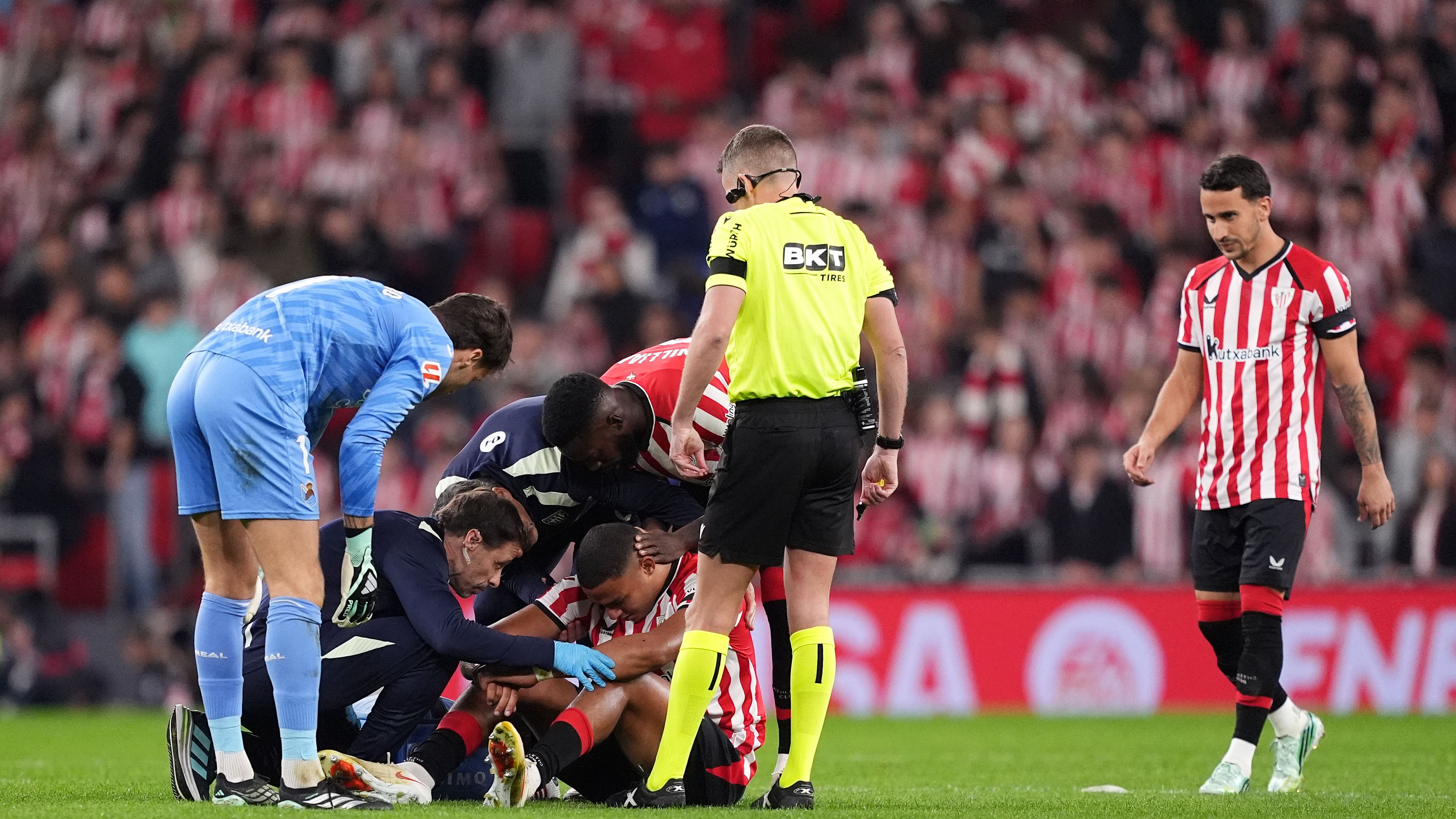

Official statement: La Liga referees' committee admits awarding an incorrect penalty
A technical error behind the crisis
The Technical Refereeing Committee of the Royal Spanish Football Federation has requested a report from Kinexon, the company behind the connected ball technology, to clarify what happened during Sunday's match between Athletic Bilbao and Real Sociedad at San Mamés. The game formed part of the eleventh round of the Spanish league, and the controversy centres on the penalty that led to the hosts' second goal.
According to the official website of the Royal Spanish Football Federation, the committee asked for the report to explain the malfunction that appeared in the connected ball technology during the match. The incident had sparked a row over which player last touched the ball before the penalty was given.
Before kick-off, the appointed video assistant referee ran the synchronisation process laid out in the protocol with the video technology operator, and detected no problem. This official had extensive experience with the technology, having worked with it at the World Cup and received specialised training on how it operates.
He was also the only Spaniard among the video technology referees to have officiated at World Cup matches.
Mediapro ran random tests throughout the match to verify the integrity of the synchronisation process.
The referee awarded the penalty in the first half after judging that a Real Sociedad defender had fouled one of Athletic Bilbao's forwards.
Staff in the video technology room reviewed the play. Based on the image available at the time of the signal from the connected ball technology, they interpreted the incident as the Athletic Bilbao player touching the ball and the Real Sociedad player not touching it.
Later, when the technical data was transferred to the television broadcast for the sake of transparency, it emerged that the Athletic Bilbao player's touch coincided with the last peak recorded in the data. That peak came before the moment the Real Sociedad player was supposed to have touched the ball, and no further peak appeared afterwards, suggesting the Basque side's player had not been able to touch it.
Two earlier peaks appeared, though, whose link to the images on screen was not clear.
Given these circumstances, the Technical Refereeing Committee asked Kinexon to analyse exactly what had happened and to explain in detail the two peaks that appeared before the one initially believed to match the Athletic Bilbao player's last touch.
According to the official statement from the Technical Refereeing Committee, the company's report concluded the following:
"The most likely explanation is that there was a slight difference in synchronisation, ranging between approximately one and two frames, equivalent to 20 to 40 thousandths of a second, between the ball's signal and the video clip used in the video technology, at a rate of 50 frames per second. In the original presentation, the signal peaks appeared just before the actual contact moments corresponding to them in the video, by a small time difference. This may have led to the incident being interpreted as the Real Sociedad player not having touched the ball, because no additional peak appeared at the moment at which the contact seemed to occur. However, when the signal was re-synchronised with the video, after correcting this time difference, the data became consistent with what appears on screen, not only in this incident, but also in the events that preceded and followed it, which was not the case in the original presentation. At that point, the most prominent peak matches the Real Sociedad player reaching the ball."
On the findings of the report, it was the Real Sociedad player who last touched the ball. That means the decision to award the penalty may not have been correct.
Even so, the Technical Refereeing Committee stressed that any assessment of the decision must take into account the information available to the video technology referee at the moment he reviewed the play, as well as the synchronisation state the system was displaying at the time.
As the committee explained, the call made in the video technology room was correct at that moment. There was no evidence to overturn the on-field referee's decision. On the contrary, the data extracted from the connected ball technology offered strong evidence that only the Athletic Bilbao player had touched the ball.
The Technical Refereeing Committee also wanted to emphasise that the connected ball technology worked properly throughout the match. The only fault was the synchronisation difference between the ball's signal and the video clip used by the video technology referees.
Kinexon's connected ball carries a sensor that delivers highly accurate timing data. When the technology is used in video reviews that rely on television broadcast cameras, the video technology operator synchronises the ball's signal manually with the video clip before each match, bouncing the ball in a specific, controlled manner.
That mechanism differs from the method used in the semi-automated offside system. There, the connected ball is synchronised continuously with dedicated tracking cameras using the precise timing protocol, which provides accuracy down to thousandths of a second and needs no manual alignment.
Although the incident involved a technical malfunction outside its area of responsibility, the Technical Refereeing Committee confirmed it will keep working with the companies and specialists behind these technologies. The aim is to develop the procedures for use and synchronisation, improve the reliability of the systems, and reduce the chances of such cases happening again.
Its goal, the committee stressed, is to bring technological tools into refereeing at the highest levels of accuracy and reliability, helping referees in their work and sharpening the decisions they make.