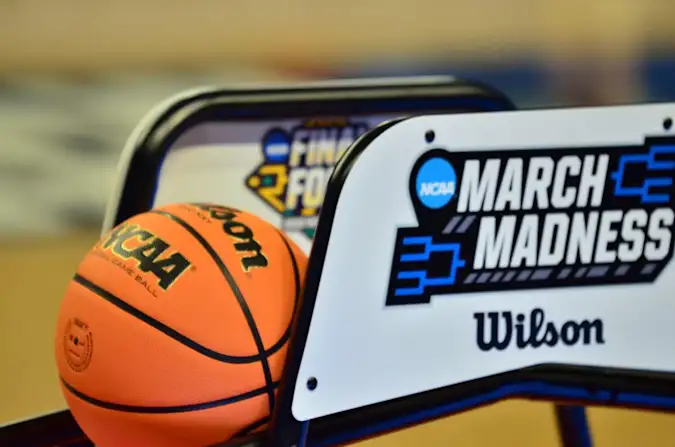
March Madness is upon us! Selection Sunday is now in the books, and people across the globe have begun filling out their brackets in hopes of accurately picking the next NCAA Tournament champion!
Starting on March 19th, 64 teams will compete in a single-elimination tournament for a chance to participate in the Final Four at Lucas Oil Stadium in Indianapolis, Indiana. It all culminates in the 2026 NCAA Championship Game on April 6th.
The Duke Blue Devils earned the number-one overall seed after winning the ACC Tournament and going 32-2. The Arizona Wildcats, Florida Gators, and Michigan Wolverines also received number-one seeds in their respective regions.
Everyone will use different strategies and methods to fill out their brackets. Some people will use calculated logic and historical analysis, while others might just flip a coin to pick their winners. The reality is that March Madness is a crapshoot. Thankfully, we have seven tips that can help you come as close as possible to filling out a perfect bracket.
1. Don't pick all number-one seeds to reach the Final Four.
Since the NCAA Tournament field expanded to 64 teams in 1985, only twice have all four number-one seeds reached the Final Four (2008 and 2025).
If history is an indicator of how the tournament might play out, be wary of Arizona. They have not reached a Final Four since 2001. Despite Arizona making the NCAA Tournament 22 times since the 1999-2000 season, the school has only six Elite Eight appearances during that stretch.
Michigan could be in for a tough contest if they end up meeting the St. Louis Billikens in the Round of 32. St. Louis ranks tenth in points per game (87.2), while the Wolverines are 57th in points per game allowed (69.2). Additionally, St. Louis could outpace the Wolverines, as they are the fourth-fastest team in the country.
2. The Big Ten Conference has been unlucky in March.
A Big Ten team has not won the NCAA Tournament Championship since 2000 (Michigan State Spartans). Since the COVID-19 Pandemic canceled the 2020 season, only once has a Big Ten team even reached the Final Four (Purdue in 2024).
Big Ten teams have tough paths to the Final Four in every region this year. Michigan State will likely need to beat UConn and Duke to make it out of the East. Nebraska and Illinois may not only face each other, but they'll probably also have to overcome Houston and Florida to win the South Region. We already discussed how St. Louis could be a problem for Michigan, but the Wolverines might also have to beat Iowa State, Alabama, or the battle-tested Texas Tech Red Raiders. Lastly, Purdue and Wisconsin will need to prove their worth against Arizona, BYU, and Arkansas. It's not impossible, but beware when picking a national champion from the Big Ten.
3. There will probably be a 12 vs. 5 upset.
In 34 of the last 40 NCAA Tournaments, a 12-seeded team has won at least one first-round game. Since the tournament expanded to 64 teams, 12 seeds have won 35.6% of their matchups against five-seeds.
This year, we will see:
#12 High Point vs. #5 Wisconsin out West.
#12 Akron vs. #5 Texas Tech in the Midwest.
#12 McNeese vs. #5 Vanderbilt down South.
#12 Northern Iowa vs. #5 St. John's in the East.
Texas Tech has managed to bounce back from the loss of its best player, JT Toppin, but it still ended the regular season on a three-game losing streak. Also, St. John's has been good all year long, but their scoring has dropped to 72.6 points per game over their last seven matchups. That doesn't bode well when facing a Northern Iowa team that has the best defense in the country (61.3 points per game allowed).
4. An unexpected team will likely reach the Sweet 16.
A double-digit seed (10 or higher) has advanced to the Sweet 16 in each of the last 17 tournaments. Over the last three years, exactly one double-digit seed has reached the Sweet 16 each season.
Since 2011, 11th-seeded teams have had the second-most Sweet 16 appearances amongst non-top-four seeds (15).
Santa Clara, VCU, Troy, Penn, Missouri, and Texas A&M seem like strong candidates to continue this double-digit seeding trend this year.
5. Avoid red teams winning it all, but lean Blue.
t sounds silly, but teams whose primary logo color is red have only won the National Championship twice over the last 30 years (Maryland in 2002 and Louisville in 2013), and one of those victories was vacated by the NCAA!
Conversely, schools whose main color is blue have dominated March Madness. Teams with a blue primary color have won the National Championship in 20 of the last 30 years.
This season will be tricky, considering all four number one seeds have blue as one of their main colors. Though Florida's primary color is technically Orange, if you find that information helpful at all.
6. The champion will probably be a one-seed, but maybe not the number-one overall team.
14 of the last 18 NCAA Tournament Champions have been number-one seeds. However, the number-one overall team in the tournament has only won the National Championship four times since 2004. Hell, eight number-one overall seeds have failed to advance to the Sweet 16 since the seeding committee started naming the number-one overall seed in 2004.
The Duke Blue Devils deserve to be the number-one seed in the tournament. But it's worth mentioning that they are banged up. Junior guard Caleb Foster, who is third on the team in minutes per game (25.4), is out indefinitely with a foot fracture. Simultaneously, center Patrick Ngongba II (fourth on the team in minutes per game, 22.4) does not have a timetable for his return to the court as he deals with a foot injury of his own. Those injuries could have a huge impact on the Blue Devils later in the tournament when the competition intensifies.
7. The national champion likely hit these three benchmarks before the tournament began...
They were ranked in the top 12 in Week Six of the AP Poll (20 of the last 20 national champs),
Ranked in the top 25 in KenPom adjusted offensive efficiency (19 of the last 20 national champs),
AND, ranked in the top 25 in KenPom adjusted defensive efficiency (15 of the last 20 national champs).
The KenPom website was created by Ken Pomeroy in 2002 and has long been used as an advanced statistics archive that measures several important categories. Advanced offensive efficiency equates to how many points a team scores every 100 possessions, while advanced defensive efficiency is how many points a team allows every 100 defensive possessions.
As of this writing, there are only seven teams in the country that meet these criteria:
Arizona
Offense: 5th
Defense: 3rd
Week Six ranking: 1st
Duke
Offense: 4th
Defense: 2nd
Week Six ranking: 3rd
Iowa State
Offense: 21st
Defense: 4th
Week Six ranking: 4th
Houston
Offense: 14th
Defense: 5th
Week Six ranking: 7th
Louisville
Offense: 19th
Defense: 25th
Week Six ranking: 11th
Michigan
Offense: 8th
Defense: 1st
Week Six ranking: 2nd
Michigan State
Offense: 24th
Defense: 13th
Week Six ranking: 9th
What To Do If You Have A Gambling Problem
If you or someone you know has a gambling problem and wants help, call or visit the Council on Compulsive Gambling:
Gamblers Anonymous at 855-2-Call GA or www.gamblersanonymous.org
CO, DC, IL, IN, LA, MD, MS, NJ, OH, PA, TN, VA, WV, or WY – Call 1-800-GAMBLER
AZ- Call 1-800-NEXT-STEP
IA – Call 1-800-BETS-OFF
KS, NV – Call 1-800-522-4700
KY – Call 1-800 GAMBLER, 18+
MI – Call 1-800-270-7117 for confidential help
MA – Call 1-800-327-5050
NC – Call – 1-800-662-4357
NY- Call 877-8-HOPENY or text HOPENY (467369)
DISCLAIMER: The information on this site is for entertainment purposes only. Gambling comes with its fair share of risks, and it is important to recognize that when using online gambling sites.
While we review different gambling sites, you should check with local laws in your area before gambling online. Also, all gambling sites and guides are rated 21+ only.
The following free gambling addiction resources can be of help:
21+ Please Gamble Responsibly. Gambling Problem? Call or text 1-800-GAMBLER